NHCX and What It Changes About Getting Paid
Published · Updated
The insurance desk of a mid-sized hospital runs on portals. One for each insurer, one for each TPA, each with its own login, its own document naming convention, its own idea of what a pre-authorisation form should contain, and its own habit of timing out at four in the afternoon. A senior executive spends her day switching between fourteen browser tabs, uploading the same discharge summary in three different formats, and telephoning to ask why a query was raised on a claim that was already answered.
The National Health Claims Exchange is an attempt to replace that with one road.
What it is
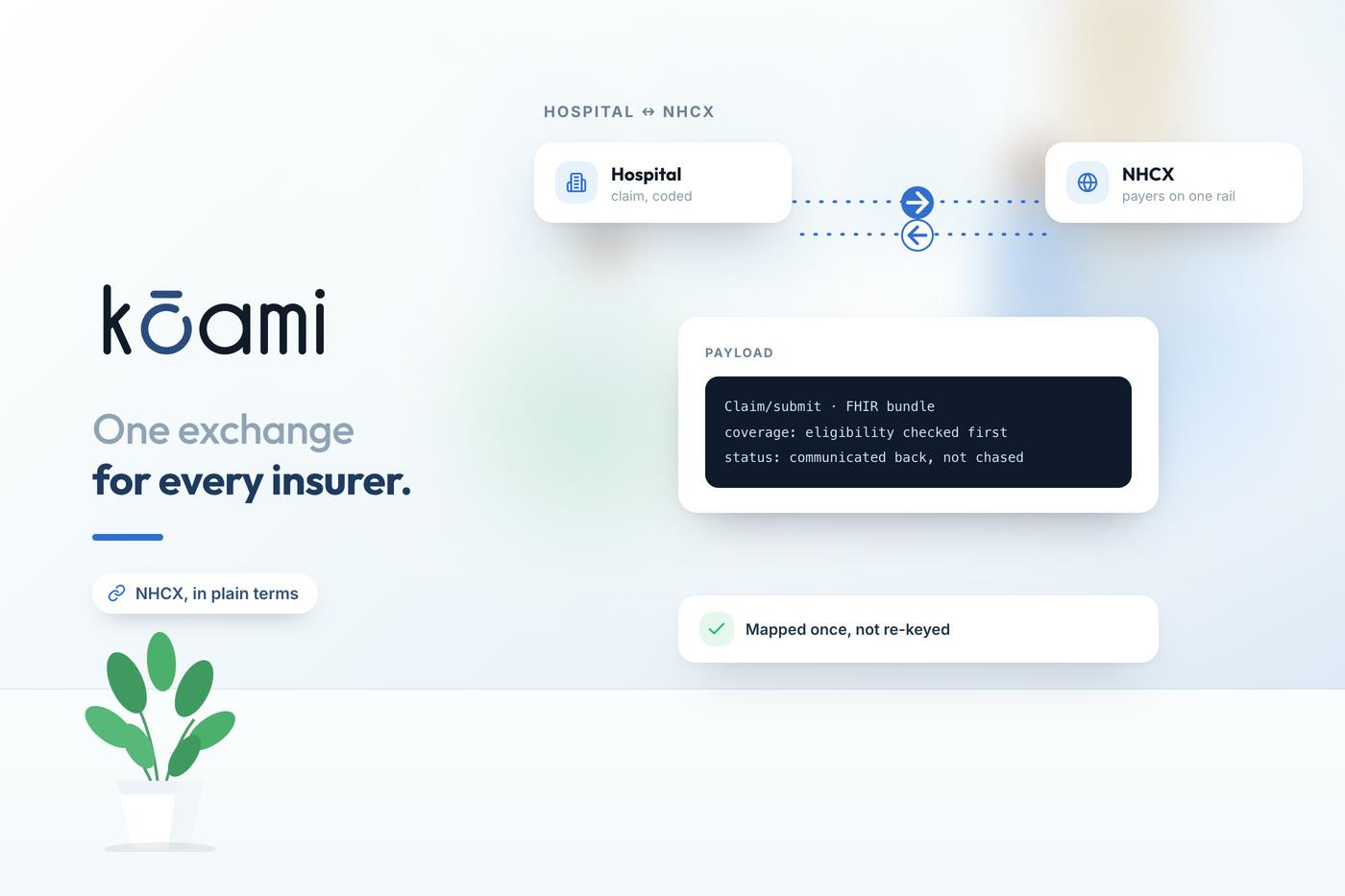
NHCX is a gateway, built under the National Health Authority alongside the insurance regulator, through which claims-related information moves between hospitals, insurers and TPAs in a standard, machine-readable form. It sits inside the wider ABDM framework and uses the same health data standards, which in practice means FHIR resources rather than PDFs and portal forms.
The important word is exchange. NHCX does not adjudicate claims or decide what is payable. Insurers still make those decisions using their own policies and rules. What changes is the transport and the format: instead of every hospital integrating separately with every payer, both sides connect to a common exchange and speak a common language.
- One integration for the hospital, rather than one per payer.
- Structured data instead of documents that have to be read by a human.
- Defined message types for pre-authorisation, claim submission, queries and responses.
- A traceable path, so both sides can see where a claim actually is.
Why the current process is expensive
The cost of the portal-per-payer world is easy to underestimate because it is spread across people rather than concentrated in a line item.
Re-keying is the obvious part. Data that already exists in the hospital system is typed again into a portal, and every re-keying is an opportunity for a mismatch between what the claim says and what the record says. Those mismatches are a leading cause of queries.
Then there is the waiting. A pre-authorisation that takes a day is a patient occupying a bed while the family waits for a decision. Discharge planning that depends on a portal response arriving is discharge planning that cannot be planned.
And there is the invisible cost: nobody can tell you, at any given moment, how much money is sitting in claims, at what stage, with which payer, and how long it has been there. The answer exists across fourteen portals and one spreadsheet that is updated when somebody has time.
The real cost of the portal era is not the effort. It is that a hospital cannot see its own receivables without assembling them by hand.
What has to be true inside the hospital first
This is the part that gets skipped. Connecting to an exchange does not fix a claims process; it exposes it. Structured claims demand structured source data, and most hospitals discover their gaps at exactly the wrong moment.
- Coding. Diagnoses and procedures must be coded consistently, not written as free text. A claim that says "fever, r/o dengue" cannot be structured, and the coder downstream is guessing.
- Charge capture. If consumables and procedures are added to the bill hours or days after they happen, the claim assembled at discharge is incomplete, and the shortfall becomes a query or a write-off.
- Package and tariff mastery. Package definitions, exclusions and payer-specific rates have to be current in the system. A tariff master that is six months stale produces claims that are wrong before they are sent.
- Documents. Discharge summaries, investigation reports and implant stickers need to be attached to the claim from the record rather than scanned and hunted for.
- Patient identity. Name, policy number and identifiers must match what the payer holds. A large share of rejections is nothing more than a mismatched name or an incorrect policy number.
A hospital with these in order gets most of NHCX's benefit almost immediately. A hospital without them gets a faster route to the same rejections.
What actually improves
Assuming the groundwork, the changes are concrete.
Pre-authorisation turnaround falls, because the request is structured and machine-readable and the payer's system can act on it without a person reading a PDF first. Not every case, and not instantly, but the routine ones stop waiting behind the difficult ones.
Queries become specific. A structured query points at a field, rather than arriving as a line of text asking for clarification, and can be answered from the record rather than by composing an email.
Status becomes visible. Because messages are exchanged rather than uploaded, the hospital's own system knows where each claim is. That single change is what makes a genuine receivables dashboard possible: how much is submitted, queried, approved, rejected and paid, by payer and by age, without anybody assembling it manually.
And first-pass rates improve, for the unglamorous reason that structured submissions carry fewer transcription errors than re-keyed ones.
What does not change
It is worth being blunt about the limits, because expectations that outrun reality produce disappointment and then disengagement.
Insurers still decide. Adjudication rules, exclusions, waiting periods and medical necessity assessments remain entirely with the payer, and a well-formed claim for something the policy excludes is still declined.
Coverage builds gradually. Not every insurer and TPA arrives at the same time, so hospitals run the exchange alongside existing portals during the transition, and the transition is longer than anyone plans for.
Bad data is still bad. The exchange transports what it is given. A claim built on stale tariffs and late charge capture arrives faster and is rejected on schedule.
And clinical documentation still has to justify the claim. Structuring the envelope does not improve the letter inside it.
Where NHCX has actually got to
The exchange moved from announcement to operation, and the useful question is no longer whether it will happen but whether your payers are on it yet.
Payer and provider onboarding has continued steadily, with published National Health Authority figures running to tens of thousands of registered provider facilities and claims processed in the tens of millions. Take the current numbers from the NHA's own dashboards rather than from any comparison article, including this one — adoption reporting in this area moves faster than the articles describing it.
The distinction that matters when you read those figures is between registration and transaction. A payer being onboarded to the exchange is not the same as that payer processing your claims through it at volume, and a hospital that plans on the first number will be disappointed by the second. Ask each of your major insurers and TPAs a narrow question: are you accepting pre-authorisation and claim submission for our facility over NHCX today, and if not, when. The answers will vary by payer and will decide how long you run the exchange and the portals in parallel.
There is also now money attached. Claims routed through the exchange fall under the National Health Authority's incentive arrangements, and the wider Digital Health Incentive Scheme pays health facilities for ABHA-linked records — the same records a well-formed NHCX claim depends on. Neither is large enough to justify a software purchase by itself. Both are large enough that a hospital doing the work anyway should be counting them, and most are not.
What FHIR has to do with any of this
Everything, and it is the part hospitals discover last. NHCX moves claims as FHIR resources, which means the exchange inherits whatever structure your clinical record does or does not have.
A hospital whose diagnoses are free text and whose reports are scanned PDFs can technically submit over NHCX. What it submits is a structured envelope wrapped around unstructured content, which passes transport validation and then generates exactly the queries the portal era generated. The exchange rewards the preparation described below; it does not perform it.
Preparing without waiting
The useful thing about NHCX readiness is that almost every step is worth doing on its own merits, whether or not the exchange arrives on your timeline.
- Measure first-pass claim rate and query rate by payer. If you cannot, that is the first finding.
- Age your receivables by payer and by stage, once, manually. It will be uncomfortable and it will tell you where the money is stuck.
- Fix charge capture at the point of care, so the bill is complete when the patient leaves.
- Get the tariff and package masters current, and put a review cycle on them.
- Move diagnoses and procedures to coded fields.
- Ask your HIS vendor a direct question: are you building NHCX and ABDM connectivity, on what timeline, and at what cost.
- Sort out ABHA linking and patient identity capture at registration, because identity errors are the cheapest rejections to eliminate.
The hospitals that will benefit most from a claims exchange are the ones whose data was already clean enough to send. The exchange rewards the preparation; it does not substitute for it.
Follow Kōami on LinkedIn
Get the next guide on hospital operations, software and compliance in your feed, as soon as it is published.