Why PM-JAY Claims Get Rejected, and How to Stop It
Every hospital empanelled under Ayushman Bharat has a folder — physical, or on a shared drive — that everyone calls "pending". Inside are claims that were rejected, claims queried and never answered, claims raised against the wrong package, and claims never submitted because the file was incomplete and whoever could have completed it has left. In a mid-sized hospital in a tier-2 city that folder can quietly hold several lakh, and nobody's monthly target includes it.
Scheme claims fail for a small number of reasons, they fail the same way almost everywhere, and nearly all the causes sit upstream of the person who submits the claim.
Scheme billing is not TPA billing with a different logo
This is the root error, and it is organisational rather than technical. Hospitals put scheme claims on the TPA desk, staffed by people trained in TPA logic, and expect it to work. The two are different instruments.
- TPA billing is itemised against your tariff master. Scheme billing is package-based at a rate the state health agency has already fixed. What you actually consumed is your problem.
- A TPA claim is negotiable; someone will discuss a deduction with you. A scheme claim is adjudicated against published rules by a medical officer you will never speak to.
- TPA queries arrive by email. Scheme queries sit in a portal, and they expire.
- Your empanelment defines which specialities and packages you may claim at all. Treat outside that scope and there is no claim, however good the care was.
The consequence is an inversion most claims desks miss: the pricing decision is made at admission by whoever selects the package, not at discharge by whoever raises the bill.
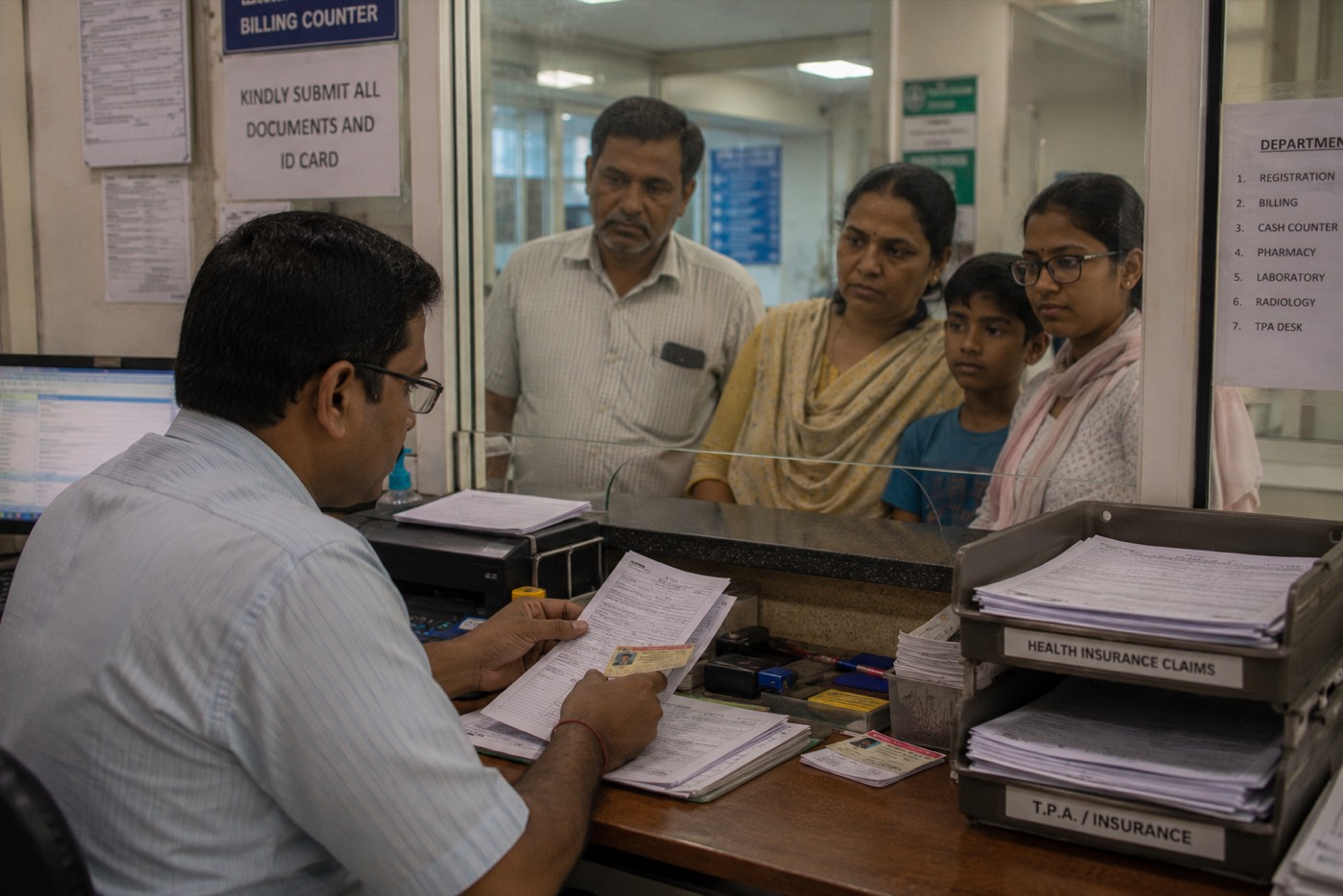
The claim is won or lost at the registration counter
Beneficiary verification is not paperwork. It is the moment the claim becomes possible.
The failure mode is familiar. A patient arrives in casualty at night, is admitted as a cash case because the family did not bring the card, and on the morning of discharge someone asks whether this could go under the scheme. It usually cannot. Verification, authentication and the entitlement check belong at or before admission, in the manner the state prescribes, and retrofitting them is a losing exercise.
A claim that begins at discharge is not a claim. It is a hope.
Three habits make the front desk work.
- Verify before admission wherever the clinical situation allows. Emergency routes exist and differ by state; know yours and use it deliberately rather than by accident.
- Tie the scheme identity to the MRN at registration. If the arogya mitra desk keeps a parallel register that never meets the hospital record, you spend the admission reconciling two versions of one patient.
- Confirm the entitlement covers the intended treatment, not merely that the beneficiary exists.
The wrong package sinks the claim
Package selection is where most avoidable rejections are created. Packages are defined by procedure and speciality, often stratified by approach, implant or complexity. Choose the wrong one and the claim contradicts its own evidence. The recurring patterns:
- A general medical management package claimed where a specific listed procedure was performed, or the reverse.
- Unbundling — claiming separately for items the package already includes.
- Claiming a package the facility is not empanelled to perform, or one implying a level of care the notes do not support.
Getting this right needs the treating consultant involved, at least briefly, because in practice a claims executive picks from a dropdown using a discharge summary written in a hurry. The fix is small: the procedure note and the selected package are read together before submission, by someone competent to read both. Ten minutes per case.
The other direction matters too. Claiming a higher-value package than the record supports is not clever revenue capture; claims are audited, patterns are visible across a hospital's history, and consequences run to de-empanelment.
Documentation and photographs are part of the treatment
Scheme adjudication is evidence-based in a very literal sense: the agency cannot see your patient, only what you uploaded. That means admission notes, investigation reports, the procedure note, implant details where applicable, and a discharge summary naming the same diagnosis and procedure as the pre-authorisation. Most state schemes also require photographic evidence at defined points — commonly at admission, during or after the procedure, and at discharge — in the format the state specifies.
Photographs are where busy wards lose money. Nobody takes the admission photograph because casualty is full, and there is no honest way to create it three days later. That is a checklist problem rather than a technology one, though a system helps: Kōami holds the required documents and evidence against the episode itself, so an incomplete file is visible while the patient is still in the bed rather than after they have gone home.
The second discipline is consistency. Auditors read the pre-authorisation, operative note, discharge summary and claimed package side by side; if the diagnosis drifts between them, the claim invites a query even where the care was appropriate.
Pre-authorisation, queries, and the queue nobody owns
A pre-authorisation request is a clinical argument, not a form. A medical officer reads it to decide whether the proposed package is justified by the presentation, and weak requests all look alike: a one-line diagnosis, no supporting investigation, no reason given for this procedure now. Emergency admissions follow a separate route with their own intimation requirement, and every one of these timelines is set by the scheme, varies between states and gets revised — work from your state health agency's current guidelines, not the note pinned above the desk.
Then there is the query, where money leaves silently. The agency raises one, the hospital has a stipulated window in which to respond, and it is short. Either nobody checks the portal daily and it is found after it has expired, or the response resubmits the same file instead of answering the actual question.
A rejected claim makes no noise. No patient calls, no TPA follows up, no ageing report anyone reads. It simply stops moving. What restarts it is ownership.
- One named owner for scheme claims, not a responsibility split across three departments.
- A daily worklist with ageing buckets: awaiting pre-authorisation, awaiting documents, query open, submitted, part-paid, rejected.
- Line-item reconciliation of settlements. Payments arrive in batches against many claims at once and are frequently short-paid; without matching each receipt to a claim, a hospital does not know what it is owed.
Kōami keeps that worklist, tracks the query clock and reconciles batch settlements back to individual claims. What it cannot supply is the owner. That has to be a person with a name.
Where the money actually is
Hospitals chasing scheme revenue look outward: more empanelment, more specialities, higher-value packages. The faster return is inward — the gap between what was treated and what was claimable, then between what was claimed and what was paid.
Categorise a quarter's rejections and four or five causes will account for most of the volume. A verification skipped at the counter. A package chosen without reading the operative note. A missing photograph. A query that expired. None are claims-desk failures. They are front-desk and ward failures the claims desk inherits, and they are only ever fixed where they happen.