Cutting Hospital Billing Time: Where the Forty Minutes Actually Go
Published
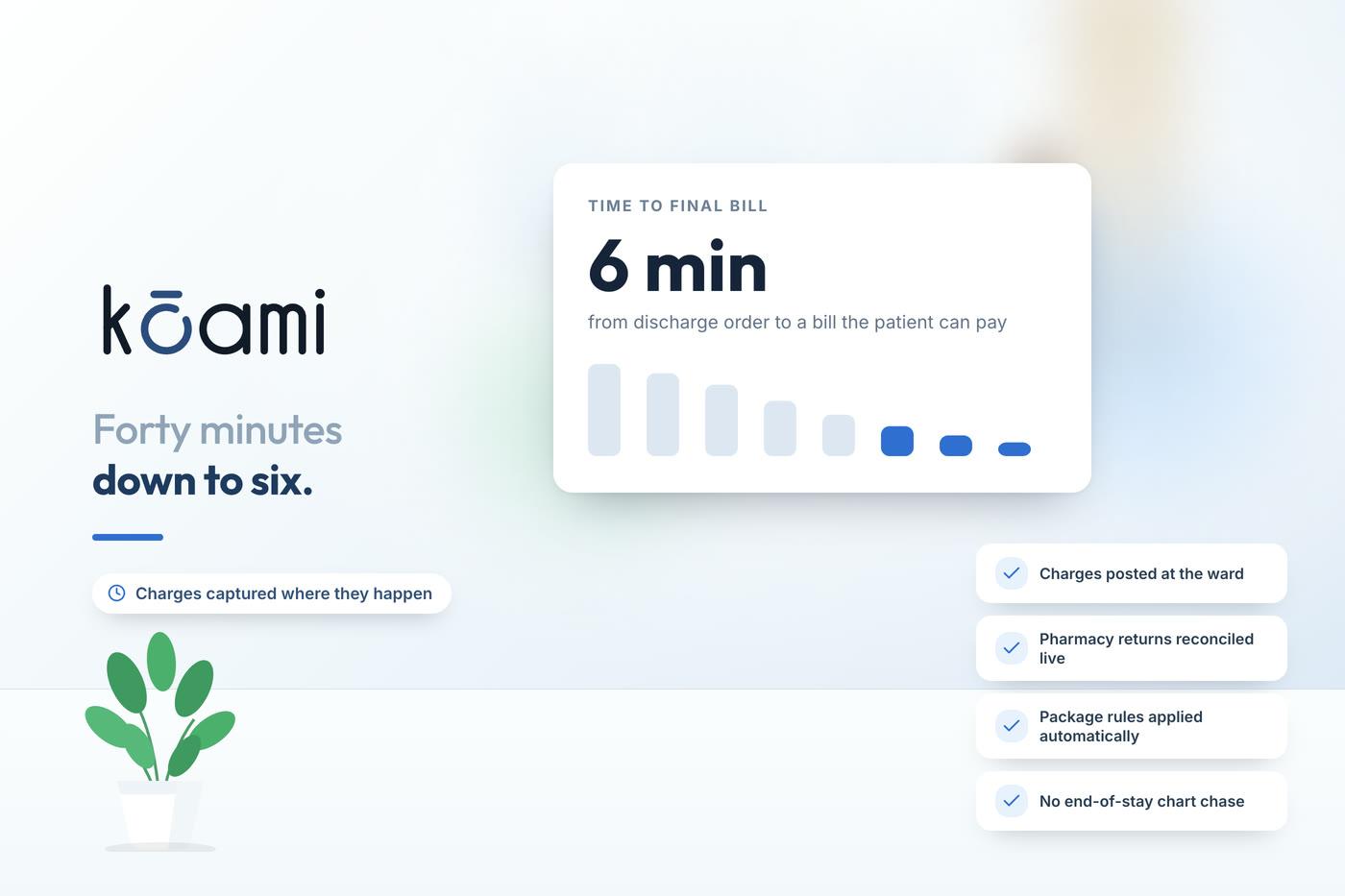
Stand at a discharge billing counter for one afternoon and you will stop believing that billing is slow because the software is slow. The clerk is not typing slowly. They are waiting. Waiting for the ward to confirm what was consumed, for pharmacy to post the last dispense, for a consultant to finalise a charge, for someone to find out whether the implant used yesterday was billed. The keystrokes take four minutes. The bill takes forty.
That distinction is the whole problem, and it is why hospitals that buy faster software and change nothing else get a faster version of the same wait.
Why does hospital billing take so long?
Because most charges are recorded after the care happened, so the bill has to be assembled at the end instead of simply being read.
A bill in a hospital is not a transaction, it is a reconciliation. Between admission and discharge, dozens of chargeable events occur in six or seven different places: the ward, the pharmacy, the lab, radiology, the operating theatre, the stores. If each of those places records what it did in its own register, on its own timetable, then at discharge somebody has to go and collect them.
The time is spent in three places, in roughly this proportion:
- Waiting for departments to post charges that already happened, which is most of it
- Resolving disputes about tariff, package inclusion, discount authority and payer split
- Actual data entry and printing, which is the smallest part by a wide margin
Any effort spent on the third while ignoring the first is wasted.
What is the single biggest cause of billing delay?
Charges captured after the fact rather than at the point of care.
This is the root of it. When a nurse administers a drug and writes it in a register for pharmacy to enter later, the charge exists in the hospital before it exists in the billing system, and the gap between those two moments is dead time that surfaces at discharge. Multiply by every consumable, every implant, every investigation and every procedure.
The fix is structural rather than procedural. The dispense should create the charge. The theatre consumable scanned as it is opened should create the charge. The lab order fulfilled should create the charge. When capture and care are the same event, the bill is never assembled, because it was always complete. We wrote about this at length in capturing charges as care happens.
A hospital that can produce a correct interim bill for any inpatient at any moment has already solved discharge billing. One that cannot has a reconciliation problem, not a printing problem.
How do you cut billing time at the OPD counter?
Separate registration from payment, price from a tariff engine rather than a memory, and let patients pay before they reach the counter.
Outpatient billing is a different problem from inpatient. The volume is high, the value per transaction is low, and the queue is visible to everyone in the waiting area. Four things move the needle:
- Pre-registration and online appointments, so the patient arrives already in the system with a record number rather than being created at the window
- A tariff and package engine that prices the consultation, the procedure and the corporate or scheme rate automatically, so the clerk selects rather than calculates
- Digital payment at the point of service, including a link sent to the patient's phone, so the counter is not also a cash desk
- Splitting the registration desk from the payment desk at peak hours, because they have different service times and queueing them together makes both slower
The measurement that matters is not average counter time. It is the ninetieth percentile, because the queue is created by the slow cases, not the typical ones.
Where do the hours go in inpatient discharge billing?
Between the clinical decision to discharge and the moment the last department posts its charges, and that gap is usually three to five hours.
The sequence in most hospitals runs: the consultant decides on the round at ten, the ward informs billing at some point, billing requests final postings, pharmacy returns unused medicines and reverses those charges, the ward confirms consumables, any pending investigation is chased, insurance approval for the final amount is sought if applicable, and only then is the bill raised.
Almost every step in that chain is a handoff between people, and every handoff waits for someone to be free.
What compresses it is starting the process at the decision rather than at the paperwork. An "initiate discharge" action taken by the consultant on the round should immediately notify pharmacy to reconcile returns, prompt the ward to confirm consumption, alert billing to prepare a provisional bill, and trigger the insurance desk to seek final approval — all in parallel rather than in sequence. That is the difference between a five-hour discharge and a ninety-minute one, and it is covered in more detail in why discharge takes so long.
What about insurance and TPA patients, where the delay is worst?
Start the payer conversation at admission, keep an approximate bill live throughout the stay, and never let the final approval request be the first the payer has heard of the actual amount.
The classic failure is a cashless patient whose pre-authorisation was taken for an estimated amount at admission, whose stay extended, and whose final bill exceeds the approval. The enhancement request goes at discharge, and the patient waits in a bed that the hospital needs.
The working pattern is to treat the approximate bill as a living document that updates as charges accrue, with a threshold that automatically flags when the accrued amount approaches the sanctioned limit, so the enhancement request goes at hour thirty rather than at discharge. The related mechanics are in pre-auth and TPA claims without the back-and-forth.
What should a hospital measure?
Five numbers, tracked weekly, broken down by ward and by payer.
- Time from discharge decision to final bill, at median and at the ninetieth percentile
- Time from final bill to patient departure
- Number of charge postings made after the discharge decision, which is the direct measure of late capture
- Value of charges written off at discharge because they could not be substantiated
- OPD counter service time at peak hour, ninetieth percentile
The third one is the leading indicator. Drive late postings toward zero and the other four improve without being addressed directly.
How Kōami shortens hospital billing time
Kōami Hospital is built so that the bill is a by-product of care rather than a task performed after it.
- Charges are captured where care happens. Pharmacy dispensing, ward indents and consumption, theatre consumables, lab and imaging orders all post to the patient's bill as the event occurs, so there is nothing to collect at discharge.
- A tariff and package engine prices automatically across package and open billing, sponsor, TPA and corporate rate cards, so counter staff select rather than compute, and discount authority is enforced by role rather than by convention.
- Admission to "Initiate Discharge" is a single flow. The decision on the round triggers pharmacy reconciliation, ward confirmation and billing preparation in parallel instead of one after another.
- Approximate and pre-authorisation bills stay live through the stay, so an enhancement request goes when the number moves, not when the patient wants to leave.
- Because pharmacy, inventory, lab and imaging sit on the same record rather than in separate systems, there is no interface waiting to post and no reconciliation between two versions of the same stay.
- Audit-ready GST invoices and payer-specific formats come out of the same engine, so the finance team is not reformatting anything afterwards.
If billing time is the number your board is asking about, the useful next step is to bring one week of your own discharge data to a demo and ask to see where those hours would have gone. That conversation is more informative than any feature list, including this one.
Follow Kōami on LinkedIn
Get the next guide on hospital operations, software and compliance in your feed, as soon as it is published.