Getting PM-JAY Empanelled, and Staying That Way
Published
Empanelment is treated as a finish line. The application goes in, the inspection happens, the hospital appears on the list, and everybody moves on to the next thing. Then the claims start, and within two quarters the hospital discovers that being empanelled and being paid are separate achievements, and that the second one depends on operational discipline nobody costed for during the application.
The hospitals that do well under the scheme are not the ones with the best application. They are the ones whose systems were ready for what came after it.
What does PM-JAY empanelment actually require?
Empanelment is a state-administered process against national criteria: you apply, you are assessed on infrastructure and staffing against the specialities you want to offer, and you are approved for a defined set of packages.
The application itself is mostly documentary, and the parts that delay hospitals are consistent.
- Registration and licences current, including the establishment registration, pharmacy licence, biomedical waste authorisation and fire clearance.
- Staffing evidence for the specialities applied for, with qualifications and registrations that can be verified.
- Infrastructure appropriate to those specialities, including ICU and theatre where the packages require it.
- Bank account and PAN details in the hospital's legal name, matched exactly.
- Increasingly, digital health prerequisites: registration on the Health Facility Registry, and the ability to create and link ABHA numbers.
Speciality selection is the decision that matters most and gets the least thought. Apply for what you genuinely staff and can document. A hospital approved for a speciality it cannot consistently deliver ends up with rejected claims and awkward questions rather than revenue.
What changes operationally on day one
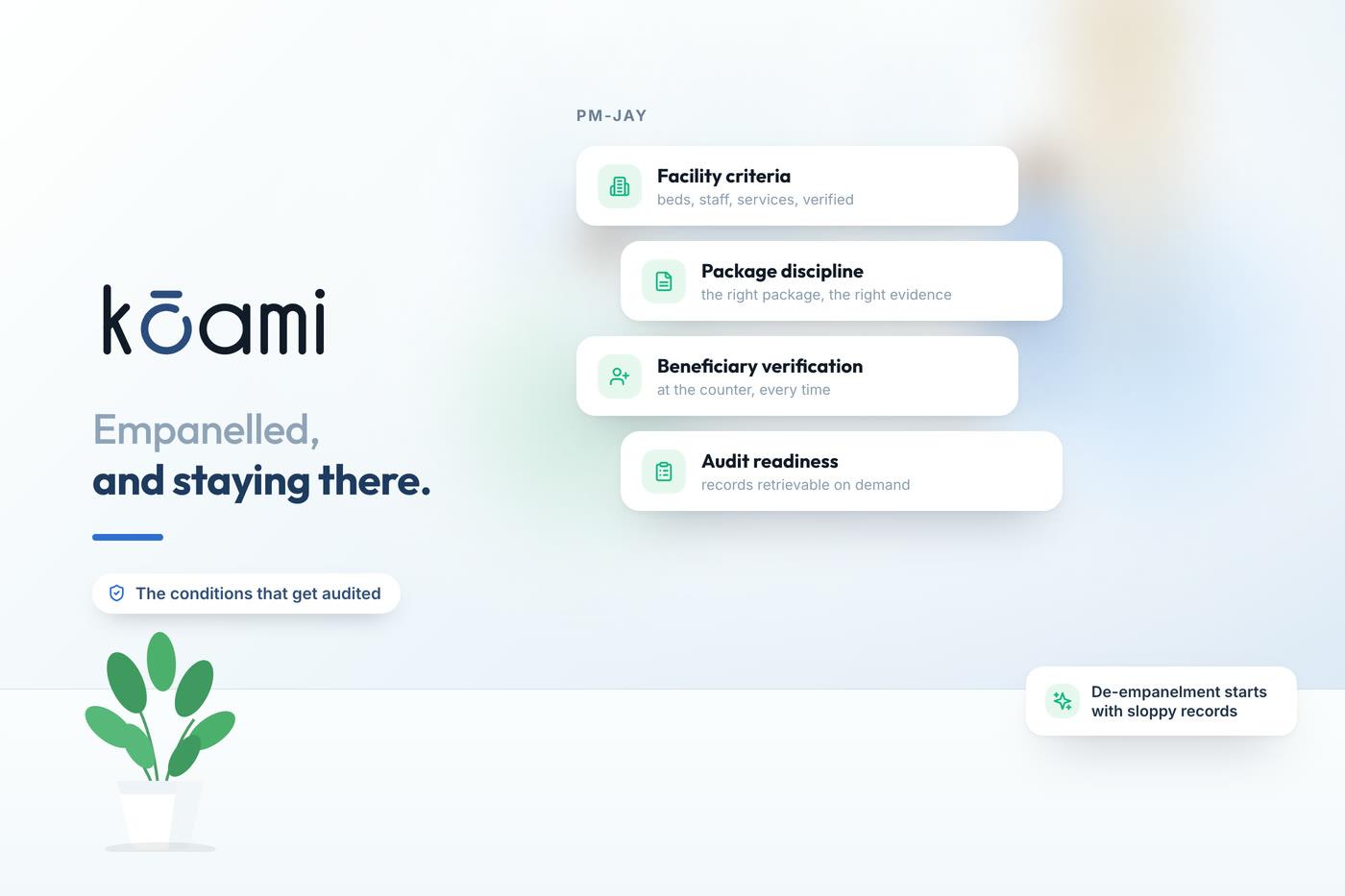
The moment you are empanelled, three things become daily work that were previously occasional.
Pre-authorisation. Most packages need approval before the procedure, with clinical justification and supporting documents. That is a queue, it has a turnaround time, and it sits directly in front of a patient waiting for a decision. Somebody has to own it by name.
Package discipline. Care is billed against defined packages with defined inclusions. A hospital used to itemised billing has to learn what falls inside the package and what genuinely does not, and the learning is expensive if it happens through rejections.
Documentation at a different standard. Scheme claims need evidence that the procedure happened as claimed: notes, investigation reports, implant details where applicable, and photographs where the package specifies them. Documentation that was adequate for an insurer may not be adequate here.
Why claims get rejected, and what actually fixes it
Most rejections are administrative, not clinical, which is good news because administrative causes are fixable with system configuration rather than with argument.
- Beneficiary identity mismatch. The name, the card and the record do not agree. This is the cheapest rejection to eliminate and one of the commonest.
- Missing pre-authorisation, or a procedure that drifted from what was authorised.
- Package selected incorrectly, or unbundled into components that the scheme expects as one package.
- Documents missing at submission: a report, an implant sticker, a required photograph.
- Late submission, past the window.
- Clinical documentation that does not support the package claimed.
The fix for almost all of these is the same and unglamorous: capture at the point of care, validation before submission, and a checklist enforced by the system rather than remembered by a person. A billing screen that will not let a scheme claim be submitted without its required attachments prevents more revenue loss than any amount of follow-up afterwards.
A rejection queue is a system telling you what your workflow forgot to capture. Read it as a defect list, not as a collections problem.
The part hospitals underestimate: the money takes time
Scheme rates are fixed and payment cycles are longer than private insurance, so empanelment changes your working capital, not just your patient mix.
Model it before you commit. Volume at scheme rates against your actual cost per case, with a realistic assumption about how long payment takes and what proportion is queried on the first pass. A hospital that plans on gross claim value and receives it two quarters later, minus deductions, has a cash flow problem that has nothing to do with clinical quality.
This is also why the receivables view matters more here than anywhere else. You need to know, at any moment, how much is submitted, queried, approved and paid, by age. If assembling that takes a day of somebody's time, you will not do it monthly, and you will find out about a problem a quarter late.
Staying empanelled
De-empanelment and penalties usually follow from patterns rather than from single mistakes, and the patterns are visible in your own data first.
Scheme administrators run analytics for exactly this: unusual package mixes, procedures at implausible volumes, admissions that look avoidable, readmissions inside a suspicious window, claims for specialities that are thinly staffed. A hospital acting in good faith can still show an odd pattern — a genuinely high-volume speciality, a seasonal surge, one surgeon whose case mix is unusual — and the time to understand it is before somebody asks.
The defensive posture is straightforward. Run the same analysis on yourself, quarterly. Keep clinical documentation that would justify each claim to a reviewer who was not there. Make sure the beneficiary verification step is real and recorded, since identity fraud committed by others still lands on your hospital's record. And keep the empanelment paperwork current, because licences expire and a lapsed fire clearance is a needless way to lose a listing.
A checklist worth running before you apply
- Licences and clearances current, with expiry dates on a reminder rather than in a drawer.
- Specialities chosen against what you actually staff, documented.
- HFR registration done, ABHA creation working at your counters.
- Named owner for pre-authorisation, with a defined turnaround target.
- Package master loaded in your system with inclusions, so billing is not interpreting them case by case.
- Required-document rules enforced at submission, not checked afterwards.
- A receivables view by payer, stage and age that you can produce in a minute.
- A cash flow model that assumes queries and delay, not gross claim value.
Empanelment is worth having. It is a volume decision with a working capital consequence and an administrative overhead, and hospitals that treat it that way from the start do considerably better than the ones who treat it as an approval to be obtained.
Follow Kōami on LinkedIn
Get the next guide on hospital operations, software and compliance in your feed, as soon as it is published.