Package Billing vs Open Billing, Explained
Published
Two patients have the same operation on the same day by the same surgeon. One is billed a single fixed figure agreed in advance. The other is billed line by line - every investigation, every consumable, every day of the room. Both are legitimate. Which one you use changes what the patient expects, what the hospital collects, and how much argument happens at discharge. Package billing and open billing are two different contracts with the patient about how care becomes a bill, and confusing them is where revenue and goodwill both leak.
The two models, plainly
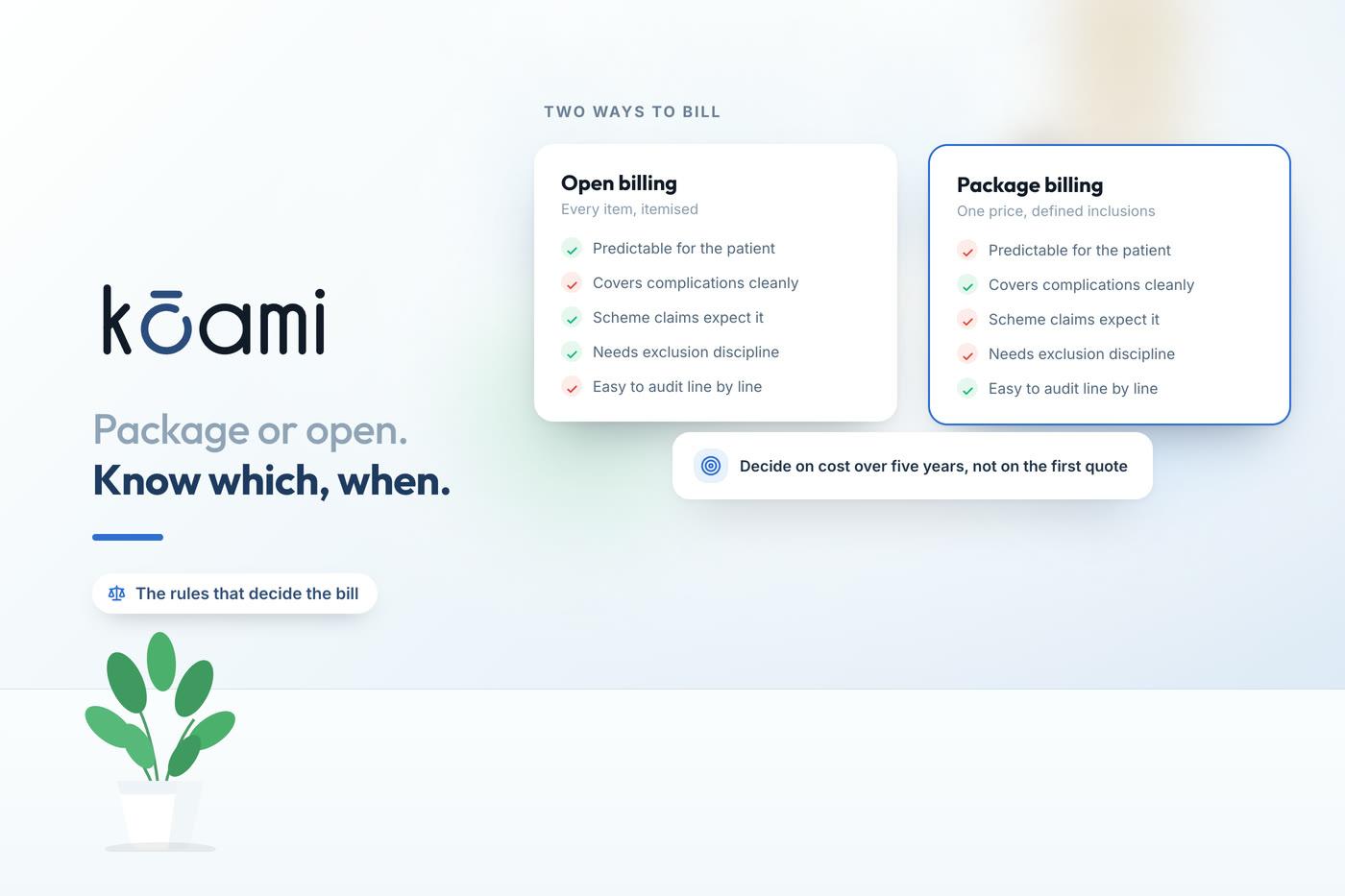
Open billing is the itemised approach. Every service the patient consumes is captured and charged at its tariff rate: consultations, investigations, procedures, drugs, consumables, room charges per day. The final bill is the sum of everything that actually happened. It is transparent and it is precise, and its total is not known until care is complete.
Package billing is the fixed-price approach. A defined set of services is bundled into a single agreed price for a defined episode - a normal delivery, a cataract, a knee replacement. The patient knows the figure up front. The bundle specifies what is included, for how long, and under what conditions, and the hospital absorbs the ordinary variation within those bounds.
- Open billing: pay for exactly what was used, totalled at the end
- Package billing: pay a fixed price for a defined episode, known at the start
- Open billing shifts variation onto the patient; package billing shifts it onto the hospital
Where package billing earns its keep
Packages exist because predictability has value to everyone. The patient gets a number they can plan around. The hospital gets a clean, fast-settling bill and a competitive offer for common, well-understood procedures. Insurers and TPAs like packages because they cap exposure and simplify approval. For high-volume, low-variance work, a package is usually the better instrument.
The discipline a package demands is a clear definition of what is inside it. A package that is vague about inclusions is a dispute waiting to happen. The bundle has to state, precisely, the room category it assumes, the length of stay it covers, the procedures and investigations included, and what happens when reality exceeds the bundle.
A package is only as good as its list of what happens when the patient does not fit the package.
That last part is where packages actually live or die. Real patients develop complications, need an extra day, or arrive with a comorbidity that changes the work. A workable package defines its boundaries: what is included, what triggers a move to itemised charging, and how the overage is handled. Kōami lets a package carry its inclusions, its room-category and stay assumptions, and its exclusion rules, so the point where a case leaves the package is defined rather than argued.
Where open billing is the honest answer
Open billing is right when the work is genuinely variable and cannot be predicted into a bundle. Complex medical admissions, long ICU stays, cases where the diagnosis itself is still moving - forcing these into a fixed package either overcharges the simple ones or bankrupts the hospital on the complex ones. Itemised billing charges for what actually happened, which is the fair answer when what happens is genuinely uncertain.
Choosing the right instrument per case
The two models are not rivals to pick between once and forever. A single hospital runs both, and often a single admission uses both: a package for the core procedure, open billing for what falls outside it. The important thing is that the choice is deliberate and visible, not an accident of which clerk raised the bill.
- Use packages for high-volume, predictable episodes where a firm price serves everyone
- Use open billing where clinical variation is real and a fixed price would misprice the case
- Expect to combine them: a package core with itemised extras for what exceeds it
- Make the tariff the common foundation, so both models price from the same rate card
The common thread is the tariff. Both models ultimately reference the hospital's rate card - open billing charges each item at tariff, and a package is essentially a pre-agreed roll-up of tariff items at a negotiated total. When both are built on the same tariff, switching a case from package to open billing at the boundary is a controlled transition rather than a re-pricing exercise from scratch.
Get the transition right and the rest follows
Most billing disputes at discharge are not about the model. They are about the moment a case crossed from one model to the other and nobody told the patient. A package patient who quietly accrued three days of open charges because of a complication, and only discovers it at discharge, is an unhappy patient and a slow payment - even when every charge is legitimate.
The fix is to make the boundary explicit and early. When a case exceeds its package - an extra day, an excluded procedure, a higher room category - that transition should be recognised when it happens, communicated to the patient, and reflected in the running estimate. The final bill then contains no surprises, because the patient watched it change in real time rather than meeting it at the counter.
Package versus open billing is not a question of which is better. It is a question of matching the instrument to the case: fixed price where the work is predictable, itemised where it is not, and a clean, visible boundary between them when a single patient needs both. Build both on one tariff, define the package edges honestly, and handle the crossover in the open. Do that and the model serves the patient and the hospital instead of becoming the thing they fight about at discharge.
Follow Kōami on LinkedIn
Get the next guide on hospital operations, software and compliance in your feed, as soon as it is published.