Capturing Charges as Care Happens
Published
Here is a number that should bother every hospital finance lead: the revenue you lose is rarely the bill you failed to collect. It is the charge you never captured in the first place. A consumable used in theatre and never scanned. An injection given on the ward and never posted. A procedure done at the bedside that nobody billed because the person who did it was busy doing the next one. Charge capture is the discipline of turning care that happened into charges that exist, and the gap between the two is pure, silent leakage.
The leak nobody sees
Uncollected bills are visible. They sit in a receivables report, they get chased, someone owns them. Uncaptured charges are invisible by definition - you cannot chase a charge that was never created. The service was delivered, the cost was incurred, and no revenue record was ever made against it. It does not appear as a loss because it never appeared at all.
The leak concentrates in predictable places, all of them characterised by care happening faster than paperwork.
- Consumables and implants used in theatre under time pressure
- Drugs and injections administered on the ward between other tasks
- Bedside procedures done by clinicians who are not thinking about billing
- Investigations ordered verbally and performed before any order exists in the system
None of these are fraud or laziness. They are the natural result of asking busy clinical staff to also be the billing department, using a workflow that treats charging as a separate task to be done later. Later is where charges go to be forgotten.
Capture at the point of care, not after it
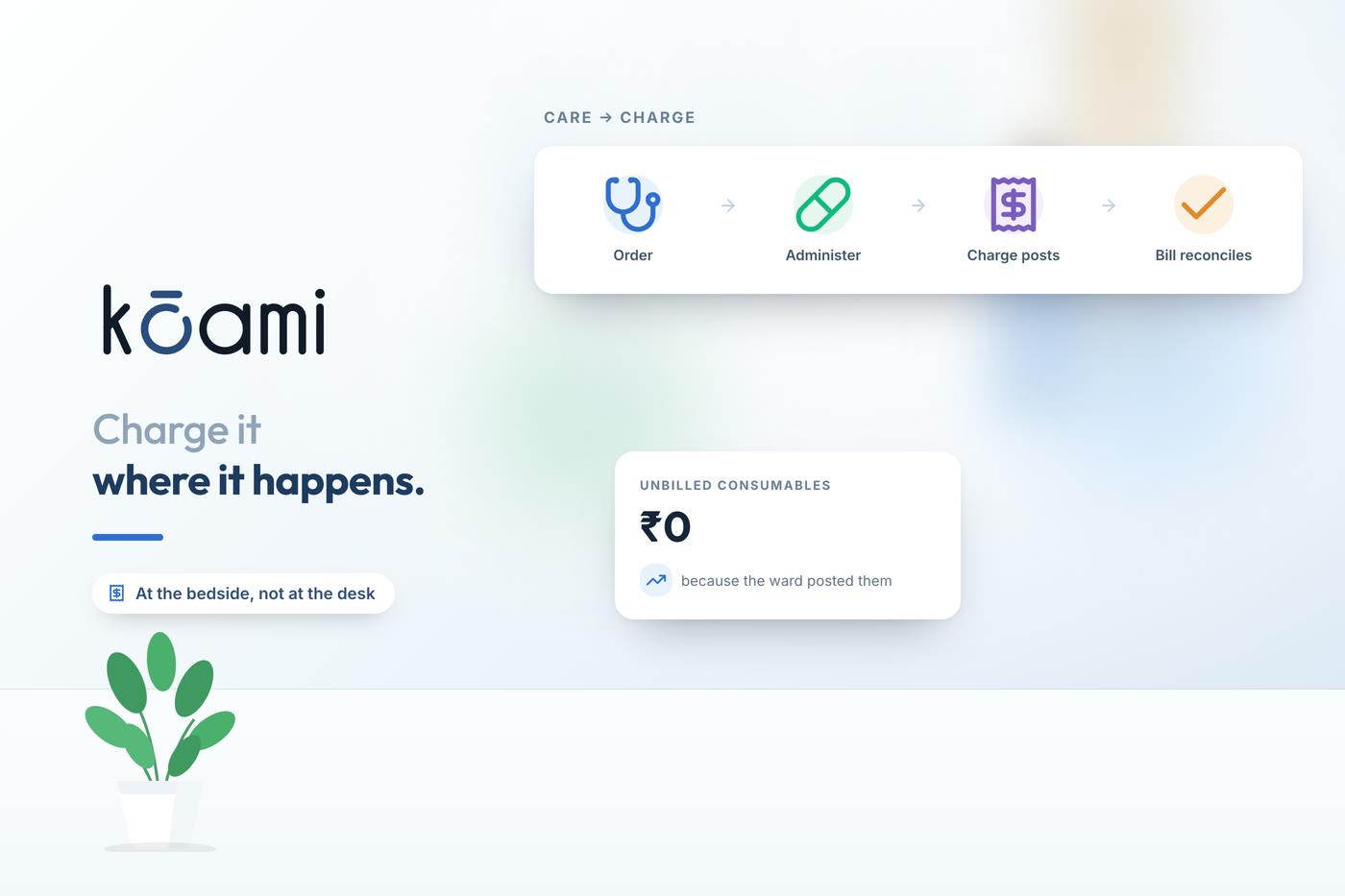
The core principle is simple to state and hard to retrofit: the charge should be created as a byproduct of the clinical action, at the moment and place it happens, not reconstructed afterwards from notes and memory. When a nurse records that an injection was administered, that record should be the charge. When a consumable is taken from theatre stock for a case, that issue should generate the charge. The clinical act and the billable event are the same event, captured once.
This is the opposite of the common pattern, where care is delivered all day and a clerk sits down at some point to bill it from the chart. Every hour between the act and the billing is an opportunity to lose it, and every reconstruction from notes is an opportunity to get it wrong.
A charge captured where the care happened is a charge that cannot be forgotten later, because it was never waiting to be remembered.
Kōami ties charge capture to the clinical and stock events themselves - the administration record, the consumable issue, the procedure note - so the billable item is created as care is delivered rather than assembled from it afterwards.
Let the tariff do the pricing
Capturing that something happened is half the job; pricing it correctly is the other half. If clinical staff have to know or look up the price of everything they use, capture will fail, because that is not their job and they will not do it. The clinical action should record what was done and how much; the tariff should turn that into a priced charge automatically.
When every service and item carries its tariff rate, the person at the point of care never has to think about money. They record the clinical fact - this drug, this dose, this procedure, this implant - and the correct charge follows from the rate card without a manual pricing step. This also keeps charges consistent, since the same tariff prices the same item every time regardless of who captured it.
- Record the clinical fact at the point of care, not a price
- Let the tariff convert the fact into a correctly priced charge automatically
- Price the same item the same way every time, independent of who captured it
- Keep the charge linked to the clinical event, so it can be justified if questioned
What you get when the charge and the care are one
When charge capture rides on the clinical workflow, several problems solve themselves at once. The bill at discharge is complete, because it was assembled continuously as care happened rather than reconstructed at the end. The running total is real throughout the stay, so a patient or a TPA can see an accurate figure at any point, not just a rough guess. And the leakage - the injections and consumables and bedside procedures that used to vanish - largely stops, because there is no longer a gap between doing the thing and charging for it.
There is a second benefit that is easy to miss. A charge captured at the point of care carries its context - who did it, when, to which patient, against which order or clinical note. That context is exactly what you need when a charge is later questioned by a patient or an insurer. Instead of defending a line item reconstructed from memory, you have a charge tied to the moment of care that produced it.
Charge capture is unglamorous, and that is precisely why it leaks. Nobody wakes up thinking about the injection that did not get billed, and no single missed charge is worth chasing. But the sum of them, across every ward and every theatre and every day, is a large number quietly missing from the hospital's revenue. Close the gap by making the charge and the care the same event - captured once, priced by the tariff, tied to the moment it happened. The care was already delivered. The only question is whether you charged for it, and that should never be left to memory.
Follow Kōami on LinkedIn
Get the next guide on hospital operations, software and compliance in your feed, as soon as it is published.