Pre-Auth and TPA Claims Without the Back-and-Forth
Published
The patient is admitted, the surgery is booked, and now begins the other procedure - the one between the hospital and the insurer. Pre-authorisation requests go out, queries come back, documents get re-sent, and somewhere in that exchange a discharge gets delayed or a bill gets stuck. Anyone who has worked a hospital's insurance desk knows the real enemy is not rejection. It is the back-and-forth: the endless round trips of missing information, mismatched figures, and requests for one more document. Cut the round trips and you have solved most of the problem.
What pre-auth is really asking for
A TPA - Third Party Administrator - sits between the hospital and the insurer, processing cashless claims on the insurer's behalf. Before a planned admission or procedure, the hospital submits a pre-authorisation request: who the patient is, what is wrong with them, what treatment is planned, and what it is expected to cost. The TPA reviews it and, if satisfied, approves a sum for the cashless treatment.
Every query in that process is really the TPA saying one of a few things.
- We cannot match this patient to a valid policy
- The clinical justification does not support the treatment claimed
- The estimated cost does not line up with the tariff we expect
- A document we need is missing or unreadable
Each of those is preventable at source. The back-and-forth is not an inherent feature of insurance; it is the accumulated cost of sending incomplete or inconsistent requests and then answering questions one at a time.
Get the request right the first time
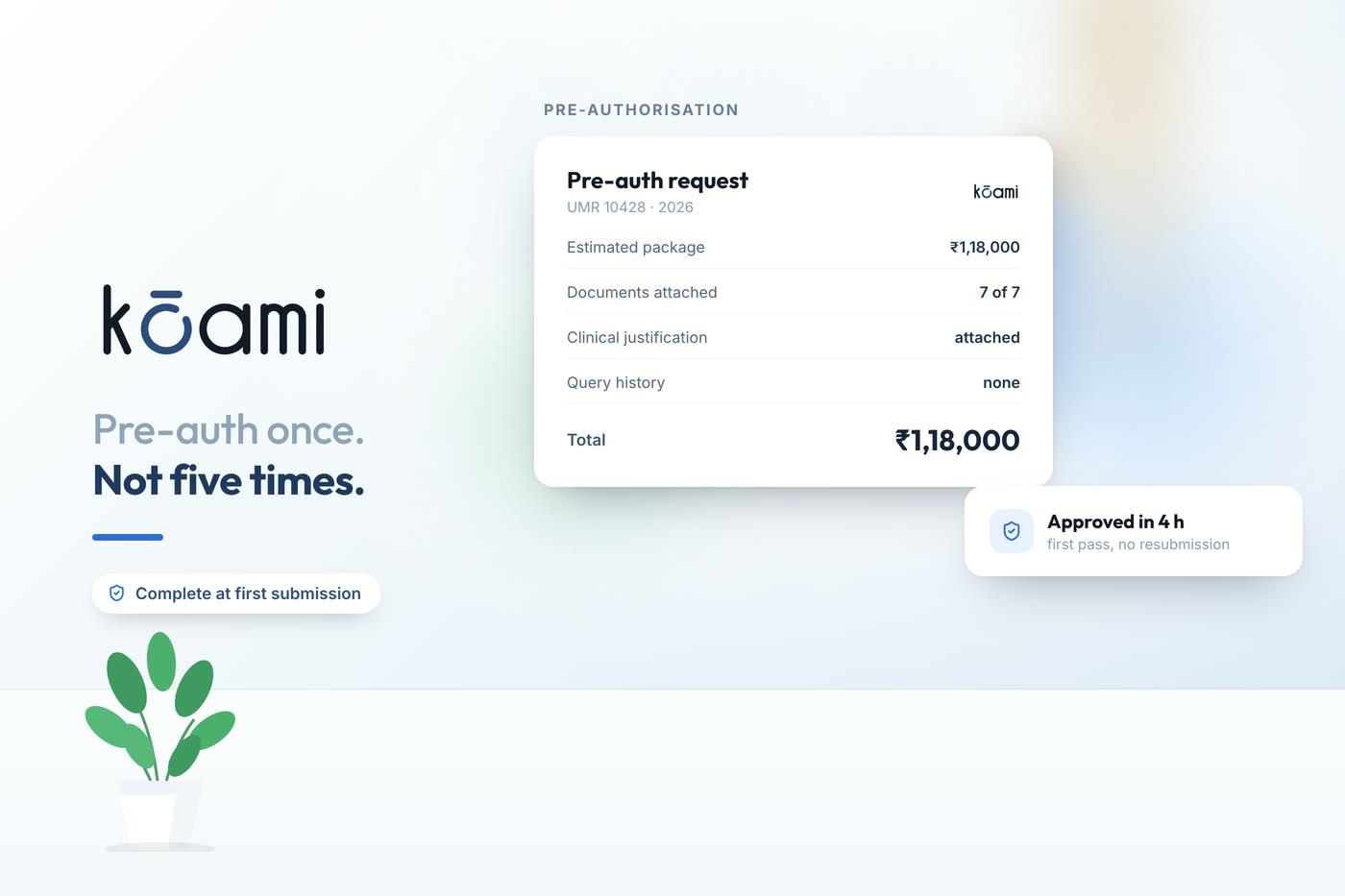
The single biggest lever is a first submission that is complete and internally consistent. A pre-auth that arrives with the correct policy details, a clear diagnosis, the planned procedure, and a cost estimate built from the actual tariff gives the TPA nothing to query. The round trips do not get faster; they stop happening.
That means assembling the request from data the hospital already holds rather than re-typing it onto a form. The patient's demographics, the treating consultant, the diagnosis and planned procedure, and the estimate all exist in the system already. Pulling them together, rather than re-keying them, removes the transcription errors that trigger half the queries.
Most pre-auth queries are not clinical disagreements. They are the TPA asking you to confirm something you could have stated clearly the first time.
Kōami assembles the pre-auth request from the patient's existing clinical and billing record and builds the cost estimate from the applicable tariff, so the figure the TPA sees is grounded in the hospital's own rate card rather than a guess that invites a query.
The approximate bill is a negotiation, not a formality
The cost estimate - the approximate bill - is where a lot of the friction concentrates. Submit a number that is too low and you will be topping up authorisation mid-stay, one enhancement request at a time. Submit one that is disconnected from your tariff and the TPA queries it. Build it properly and it holds.
An approximate bill worth submitting is itemised against the tariff that will actually be charged: room category, procedure, likely consumables, investigations. When it is derived from the same tariff that will generate the final bill, the estimate and the eventual claim are consistent by construction, which is exactly what keeps the final settlement clean.
- Build the estimate from the tariff that will produce the final bill, not a separate guess
- Itemise it so the TPA can see what each component covers
- Account for the room category and package terms up front, since these drive approval limits
- Raise enhancement requests early when the clinical picture changes, not at discharge
When the approximate bill is anchored to the real tariff, the gap between what was authorised and what is finally claimed shrinks, and the shrinking of that gap is where disputed deductions live.
Track the claim like the live thing it is
A pre-auth is not fire-and-forget. It has a state - submitted, queried, approved, enhanced, and eventually the claim itself - and that state changes while a patient occupies a bed. The hospital that loses money is usually the one that lost track of where each request stood: a query that sat unanswered for two days, an approval that came in but never got attached to the file, a discharge cleared before final authorisation landed.
Keeping every claim in view until it settles
Visibility is the fix. Every pre-auth and every claim should have a clear current status and a clear owner, so nothing sits in a silent queue. When a query comes back, the person who can answer it should know immediately, and the answer should go out with the supporting document attached rather than promised.
- Show the live status of every pre-auth and claim in one place, not scattered across inboxes
- Flag queries the moment they arrive so response time is measured in hours, not days
- Keep the clinical documents linked to the request, ready to send without a hunt
- Reconcile the approved amount against the final bill before discharge, not after
Kōami keeps each pre-auth and claim as a tracked item with a visible status against the patient's stay, so the insurance desk works from a live picture rather than reconstructing where things stand from a pile of emails.
The insurance process will never be frictionless; there is a genuine reviewer on the other side doing a real job. But most of the pain is self-inflicted, manufactured by incomplete first submissions and lost track of afterwards. Send a complete, tariff-grounded request, anchor the approximate bill to the real rate card, and keep every claim visible until it settles. Do that and the back-and-forth mostly disappears, which means the discharge happens on time and the money arrives without a fight.
Follow Kōami on LinkedIn
Get the next guide on hospital operations, software and compliance in your feed, as soon as it is published.