Walking Into an NABH Audit Without the Week-Before Panic
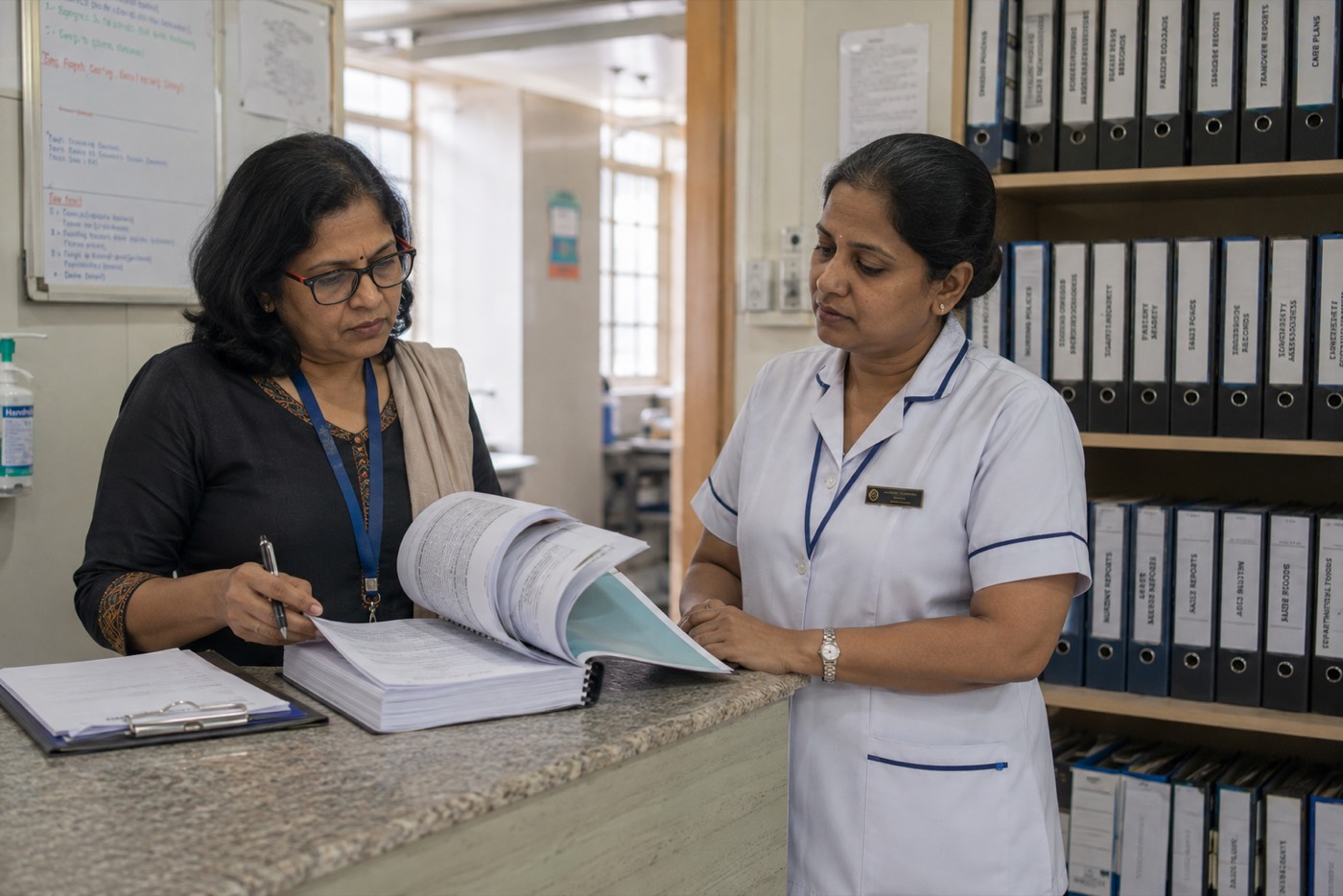
Three weeks before the assessment, the hospital changes shape. A store room is cleared out and becomes a documentation cell. Two staff nurses come off the roster to work through last quarter's case files. Somebody discovers that the calibration certificates for four ICU monitors expired in March. The photocopier runs all day. In medical records, a junior is filling gaps in nursing charts from six months ago, and there is a general understanding that nobody will look too closely at that.
Any hospital that has been through an accreditation cycle recognises this fortnight. It is expensive, exhausting, and it produces a version of the hospital that exists in no other month of the year.
The scramble is itself the finding
An assessor is not really reading your files. She is reading your habits, and files are simply where habits leave marks.
Pull ten case sheets from the assessment quarter and ten from the quarter before it. If the first set is complete and the second has blank consent columns, unsigned nursing notes and discharge summaries dated a week after the patient went home, the conclusion writes itself. Documentation here is an event, not a practice. That single observation shapes the rest of the visit, because now everything gets checked twice.
The hospitals that walk through an assessment calmly are not the ones with better files. They are the ones where the files were never a separate activity.
What an assessor actually asks for
Strip away the anxiety and the questions are fairly predictable, because they follow the patient rather than the department. The assessor picks an MRN, usually not one you offered, and walks it end to end.
- Consent. Taken before the procedure, by someone qualified to explain it, in a language the patient understands, with risks and alternatives actually recorded rather than implied by a pre-printed line.
- The medication chart. Prescribed by whom, administered by whom, at what time, and where a dose was missed or delayed, whether anyone wrote why.
- Assessment and reassessment. Within the timeframe your own policy commits to, with evidence that the patient was looked at again as their condition changed.
- The discharge summary. Complete, signed, handed over, and inside the timeline the hospital has committed to in its own manual.
- Incidents. Not zero, because nobody believes zero. A register with entries, investigations, and evidence that something changed as a result.
- People. Credential and privileging files for consultants, with qualifications verified, registration current, and a clear record of what each clinician is permitted to do here.
- Equipment. Calibration and preventive maintenance records for the devices that matter, traceable and current, not a folder of certificates with a gap in the middle.
None of this is exotic. What makes it hard is that the evidence lives across seven departments, six formats and two languages, and nobody owns the whole trail until three weeks before the visit.
Retrospective documentation announces itself
Hospitals badly underestimate how visible back-filling is. An experienced assessor has read thousands of case sheets and reads them the way a radiologist reads a plate: patterns first.
Ink that stays uniform across a two-week admission. Handwriting that does not change across three different nursing shifts. Vitals recorded at implausibly tidy intervals — 06:00, 10:00, 14:00, exactly — on a weekend when the ward was short-staffed. Nursing notes describing a deterioration with no corresponding entry in the doctor's notes for another eleven hours. A consent signed at 09:15 for a procedure the theatre register shows started at 09:05.
Nothing looks more suspicious than a perfect file.
Electronic records do not fix this on their own, and can make it worse if the system is treated as a typing pool. If every entry for a five-day admission carries a timestamp from the afternoon before the assessor arrived, the audit trail is the confession. The value of a system is not that it produces tidy documents. It is that it records when things actually happened.
Evidence should be a by-product of the work
The shift in thinking is small and it changes everything: stop treating documentation as a task that follows care, and let it be the thing that happens while care is given.
A nurse administers a drug and marks it at the bedside. That one action is the clinical record, the stock movement, the billing entry and the audit evidence at the same time. Nobody transcribes it later. A consultant closes the discharge summary before the patient leaves, and the hospital sees its compliance against its own stated timeline as a running number rather than discovering it in a file review. A monitor carries its calibration due date, so the ward knows the device in bed 6 has lapsed before an assessor does. Systems like Kōami are useful here for an unglamorous reason: they capture the user, the timestamp and the sequence as the work happens, which means the evidence trail assembles itself.
This is also where ABDM work pays off in a way people do not anticipate. Clean, uniquely identified, properly linked patient records are normally pitched as an interoperability project. In practice the first thing they buy you is a complete longitudinal record for one MRN in half a minute, in front of an assessor, without anybody running to the record room.
The files nobody owns until the week before
Clinical documentation gets attention because it is visible. The findings that catch hospitals out tend to sit elsewhere, in the registers with no obvious owner.
Credential files drift. A consultant's registration renewal came through eighteen months ago and the copy never reached HR. A visiting anaesthetist has been operating for two years against a file that was never completed. Calibration lapses because the biomedical engineer tracked it in a personal spreadsheet and then resigned. The incident register goes quiet for four months, not because nothing happened but because the ward sister who maintained it was transferred and nobody picked it up. Mandatory training records for fire safety, BLS and infection control exist as attendance sheets in a cupboard rather than against each employee's name.
Every one of these is trivial to maintain continuously and painful to reconstruct. An HRMS that holds registration expiry against the employee record and flags it ninety days out costs the hospital almost nothing in effort and removes a whole category of finding. A 180-bed hospital in a tier-2 city might carry 240 staff files and thirty-odd consultants on visiting arrangements. That is a spreadsheet problem for exactly as long as it takes the person maintaining the spreadsheet to leave.
The goal is a boring assessment
The tell for a genuinely prepared hospital is not confidence. It is indifference. Somebody asks for the medication chart of an MRN from last April, and a staff nurse pulls it up without any change of expression, because it is the same three clicks she uses every shift.
Accreditation was never designed as an examination to be revised for. It describes a hospital that already runs the way it says it runs. The week-before panic is the distance between those two things, measured in overtime. Close that distance and the assessment stops being an event, which was rather the intention.