The Cryobank Question: Where Exactly Is Straw 1188?
Published
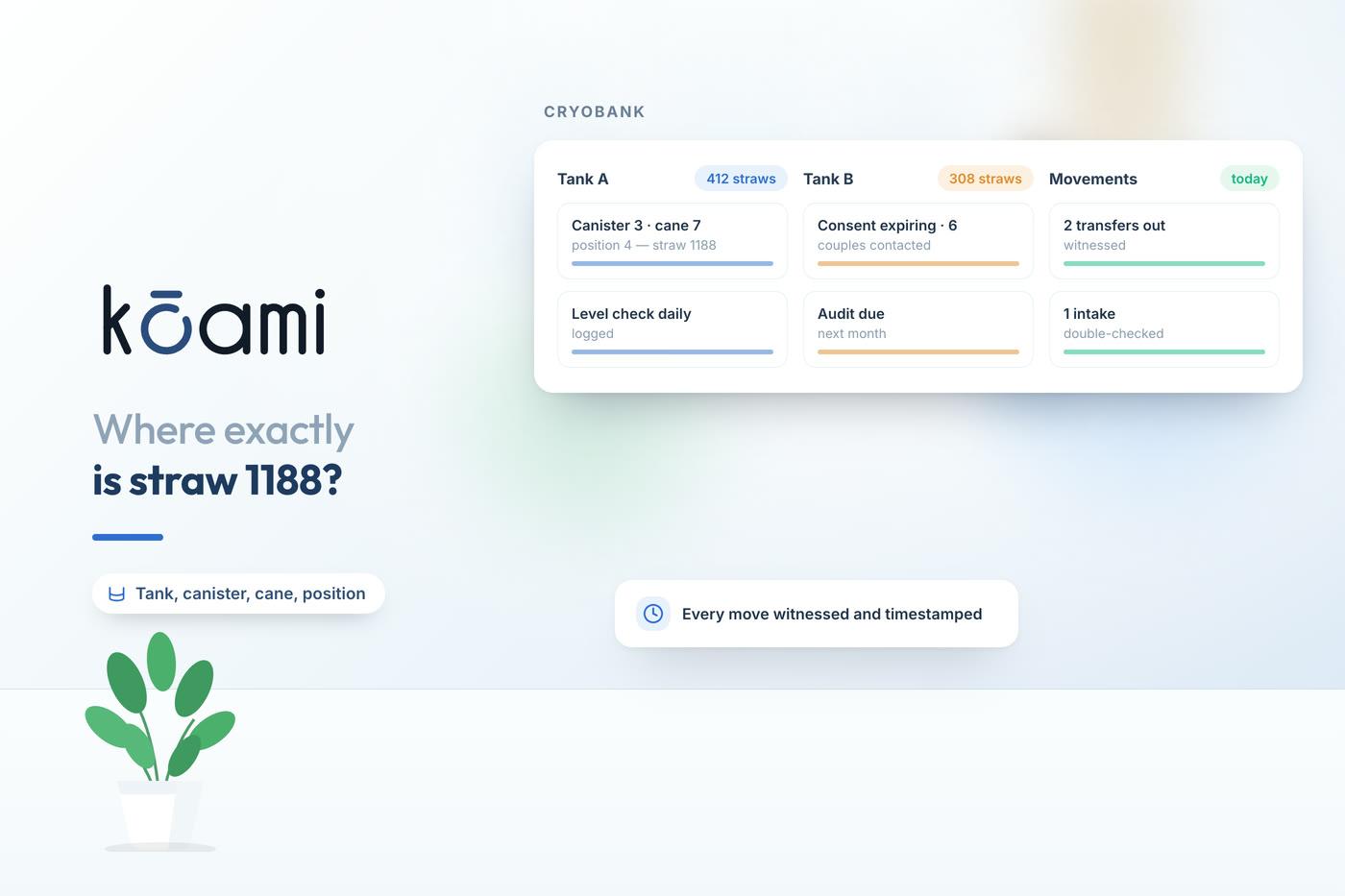
A patient who froze embryos four years ago has moved cities and wants them transferred to a clinic near her new home. The request arrives by email on a Tuesday. The embryologist goes to the register, finds her name, and reads the entry: straw 12, blue, second position. Two of the three tanks have been reorganised since then. The person who did the reorganising left last year. It takes most of an afternoon, two people and a nitrogen top-up to establish, with reasonable confidence, that the material is where they now think it is.
Everybody involved is competent. The record was simply never designed to answer the question being asked.
Free text is the root of it
Cryo location, in most systems, is two or three free-text fields. Straw number. Colour. Position. There is no pattern, no picklist, nothing mandatory, and the fields carry whatever convention the person on duty was using at the time. Over a few years a single tank accumulates several vocabularies, and they are all valid to the software.
A storage address is a hierarchy, and it should be recorded as one.
- Tank, which is a physical vessel with an identity of its own.
- Canister within the tank.
- Cane within the canister.
- Goblet within the cane, where the clinic uses them.
- Straw or vial, which carries its own permanent identifier.
The point is not tidiness. It is that a structured address can be validated, searched, counted and reconciled against what is physically in the tank. A free-text address can only be read and interpreted, which is a job for a person who was there.
The update that erases the past
The more serious problem is what happens when material moves, and it moves more than people expect: a tank is decommissioned, a canister is consolidated, material is transferred to another clinic, straws are moved to make room.
In most systems the move is an update. The record is edited to show the new position, and the previous one is gone. All that survives is a modified-by and a modified-on, which tells you somebody changed something at some point and nothing at all about what it was before.
That single design decision destroys the chain of custody. Chain of custody is not knowing where something is. It is being able to show every place it has been and who moved it, without gaps. An update-in-place record can never demonstrate that, because the evidence is overwritten by the act of recording.
If relocating a straw erases where it used to be, you do not have a cryobank record. You have a current guess with a timestamp.
The fix is structural and cheap: movements are inserts, never updates. Every event — frozen in, relocated, thawed, transported out, discarded — is a new row carrying the specimen, the source address, the destination address, the reason, the person, the witness and the time. Current location is derived from the latest event rather than stored as a mutable field. Nothing is ever overwritten, so nothing can be lost.
Clinics often discover this at the worst moment: when they want to introduce it, and the tanks are already full. The best time to put a structured, insert-only model in place is before there is anything in the table to migrate, and the second best time is now, because the volume only grows.
What a cryobank record has to carry beyond location
Location is the obvious part. The rest is what turns a location log into something a clinic can actually run on.
- Ownership and consent. Whose material this is, what they consented to, and what happens at the end of the agreed storage period. This is the field that generates every difficult conversation, and it is frequently absent.
- Storage term and renewal. When the current term expires, who was notified, when, and how they responded. Renewal reminders that live in somebody's calendar are not a system.
- Disposition. What is to be done at expiry or on withdrawal of consent, recorded in advance rather than decided under pressure.
- Witness. Cryo steps often have no witness field at all, not even the weak typed-name kind. Freezing and thawing are identity-critical steps and need the same treatment as any other.
- Transport. When material leaves the building, who released it, to whom, under what conditions, with what acknowledgement of receipt.
- Discard. The most consequential action in the whole module, and the one that most deserves a two-person authorisation and an immutable record.
The tank has its own record
Software people think about the data. The people who run the lab think about the vessel, and the vessel needs a record too.
Nitrogen levels and top-up history. Temperature monitoring and alarm events, including who acknowledged each alarm and how quickly. Service history. Age of the tank, because vacuum-jacketed vessels do fail, and they usually give warning in the form of rising consumption that nobody was tracking.
A cryobank inventory that knows exactly where every straw is, in a tank whose nitrogen history nobody has looked at in eight months, is only half a system. The most consequential cryostorage incidents are equipment failures, not clerical ones, and the warning signs are usually visible in consumption data that was collected and never reviewed.
Reconciliation is the test
Everything above can be true in the software and false in the tank. The only way to know is to reconcile: take a canister, list what the system says is in it, and check physically.
Do it on a schedule, do it on a sample rather than everything at once, and record the result including the discrepancies. Every clinic finds discrepancies the first time. The number matters less than the trend, and than whether the reconciliation itself is recorded, because an unrecorded reconciliation has the same evidentiary weight as one that never happened.
A first pass usually surfaces the same handful of causes: material moved in an emergency and recorded later, if at all; straws consolidated during a reorganisation with the register updated in bulk; entries where the straw number was recorded but not the position, because the field was optional; and material belonging to couples who stopped responding years ago, whose disposition nobody has been willing to decide.
That last group is the real backlog in most Indian clinics, and it does not shrink on its own. It needs a policy, a documented attempt to make contact, and a decision recorded against each specimen — which is only possible if each specimen has an identity in the first place.
Where to start
If your cryo record is three text fields, you do not need to fix everything at once.
- Give every straw a permanent identifier, and stop describing material by colour and position.
- Make the address structured, with tank, canister, cane and goblet as separate validated fields.
- Make movement insert-only. This is the single highest-value change, and it is a schema decision, not a workflow one.
- Add a witness to freeze, thaw, transport and discard.
- Run one reconciliation on one canister, and record the result honestly.
The clinics that handle this well are not the ones with the newest tanks. They are the ones that can answer, in under a minute and without walking to the lab, where straw 1188 is and every place it has been.
Follow Kōami on LinkedIn
Get the next guide on hospital operations, software and compliance in your feed, as soon as it is published.