Contract Labour Compliance for Hospitals: Labour Codes
Published
Walk through any 150-bed hospital at 7 am and count who is on contract. Housekeeping, security, the kitchen, laundry, the ambulance drivers, often the general duty assistants and ward boys, sometimes the billing data-entry team. In many Indian hospitals, a large share of the people on the floor are not on the hospital's payroll. They are, however, very much on the hospital's compliance books. This article is for the HR head and administrator who sign off the contractor's monthly invoice, and for the CFO who releases the payment: what the Labour Codes say the hospital still owns, and a monthly checklist to prove it.
This is general information, not legal advice. State rules differ and change; have a labour-law practitioner review your contracts and checklist.
Where the law stands now
The four Labour Codes, the Code on Wages 2019, the Industrial Relations Code 2020, the Code on Social Security 2020 and the Occupational Safety, Health and Working Conditions (OSH) Code 2020, came into effect on 21 November 2025. The Central Government notified the OSH (Central) Rules on 8 May 2026.
For a private hospital, the detail matters less at the centre than in your state. The OSH Code defines the "appropriate Government", and for most establishments other than central ones, that is the State Government. So the forms, registers, wage-payment periods and licence procedure that bind you come from your state's rules. Check their status with your consultant before you redesign anything.
Principal employer vs contractor: what you still own
The OSH Code defines "contract labour" as a worker hired in or in connection with the work of an establishment by or through a contractor, with or without the knowledge of the principal employer. The hospital is the principal employer. The contractor employs the workers, but several duties land on, or come back to, the hospital.
- Applicability (section 45): The contract labour part applies to every establishment in which fifty or more contract labour are employed, or were employed on any day of the preceding twelve months, and to every manpower supply contractor who has employed fifty or more. Count across all your contractors, not one at a time.
- Licensed contractors only (sections 47 and 54): A contractor covered by this part needs a licence, which specifies the number of contract labour it can supply. A licence under section 47(1) is valid for five years (section 48). If you engage a contractor who needed a licence and does not have one, the employment is deemed to be in contravention of the Code.
- Work order intimation (section 50): When a contractor receives your work order, it must intimate the licensing authority within the prescribed time. Ask for proof.
- Welfare facilities (section 53): The welfare facilities under sections 23 and 24, such as drinking water, separate latrines, washing facilities and locker rooms, must be provided by the principal employer to contract labour working in the establishment.
- Wages (section 55): The contractor is responsible for paying wages within the prescribed period, by bank transfer or electronic mode, and must inform the principal employer electronically of the amount paid. If the contractor fails to pay or short-pays, the principal employer is liable to pay the unpaid amount and can recover it from the contractor, by deduction from any amount payable or as a debt.
- Code on Wages (section 43): Where an employer, which the Code defines to include a contractor, fails to pay amounts due under the Code, the proprietor of the establishment where the employee works is responsible for the payment.
- ESI (Code on Social Security, section 31): The employer must pay both the employer's and employee's contribution for every employee, whether directly employed or employed through a contractor, and can recover them from the contractor. The contractor must maintain a register of employees and submit it to the employer before the settlement of any amount payable.
- PF (Code on Social Security, section 17): Contributions paid by an employer for an employee employed through a contractor may be recovered from the contractor. No contractor may deduct the employer's contribution from the worker's wages.
The pattern is the same across all three codes: the contractor pays first, and if it does not, the hospital pays and recovers. Your monthly proof file is what tells you which situation you are in.
The core activity question
Section 57 of the OSH Code prohibits contract labour in the core activities of an establishment. Core activity means any activity for which the establishment is set up, including activities essential or necessary to it. Section 57 still allows contract labour in a core activity if it is ordinarily done through contractors, if it does not need full-time workers for most of the working day, or for a sudden increase in volume that must be completed in a specified time.
The definition lists activities that are not treated as essential or necessary, if the establishment is not set up for them. For a hospital, the relevant ones include:
- Sanitation work, including sweeping, cleaning, dusting and the collection and disposal of all kinds of waste
- Watch and ward, including security services
- Canteen and catering services
- Housekeeping and laundry services, where they are in the nature of support services
- Transport services, including ambulance services
- Civil and construction works, including maintenance, and gardening
Note what is not on that list. Nursing care is close to the reason a hospital exists, and the listed exception for "running of hospitals" is worded for hospitals that are a support service of some other establishment, which is a different situation from a hospital itself. Roles such as patient-care attendants and GDAs sit in a grey area. If any of your contracted roles are close to direct patient care, get a written opinion and keep it in the audit file. Section 57(2) provides for the appropriate Government to decide disputed questions on whether an activity is core.
The monthly contractor compliance checklist
Run this for every contractor, every month, before the invoice is approved. Make the payment release conditional on it in the contract.
Licence and deployment
- Valid contractor licence on file, with the licensed headcount at or above the number deployed in your hospital
- Proof of work order intimation under section 50 for any new or amended order
- Deployment list with each worker's name, role, joining date, UAN, ESIC insurance number and masked ID
- Appointment letter issued to each new worker (OSH Code section 6 requires a letter of appointment for every employee)
Attendance
- Attendance taken on the hospital's own system, not only the contractor's register
- Shift-wise man-days per worker, matched to the roster your department heads approved
- Overtime hours with the worker's consent recorded, since OSH Code section 27 requires overtime at twice the wage rate and with consent
- Weekly offs given, since section 26 limits work to six days a week unless exempted
Wages
- Wage register for the month, showing rate, days, gross, each deduction and net pay
- Bank transfer statement or payment file showing credit to each worker's own account
- Payment date within the wage period your state prescribes; under section 17 of the Code on Wages, monthly wages are due before the seventh day of the following month unless the Government provides another time limit
- Rate at or above the minimum wage notified for that category in your state (Code on Wages section 5)
- Same rate for the same or similar work regardless of gender (section 3)
- Total deductions within 50% of wages (section 18)
PF and ESI
- PF electronic challan cum return (ECR) and payment receipt for the month
- ESI contribution challan and list of insured persons for the month
- UAN and ESIC numbers in the challans matching the deployment list, worker by worker
Welfare, safety and grievances
- Welfare facilities available to contract staff, such as drinking water, separate toilets, washing and locker space
- Training records relevant to the role, for example waste segregation and spill handling for housekeeping, and fire drills for security
- Accidents, needle-stick injuries and grievances logged, with actions taken
Annual and event-based
- Licence renewal or amendment before expiry or before a headcount increase
- Bonus and leave records where applicable
- Experience certificates issued on demand (section 56)
- Full and final settlement proof when a worker leaves
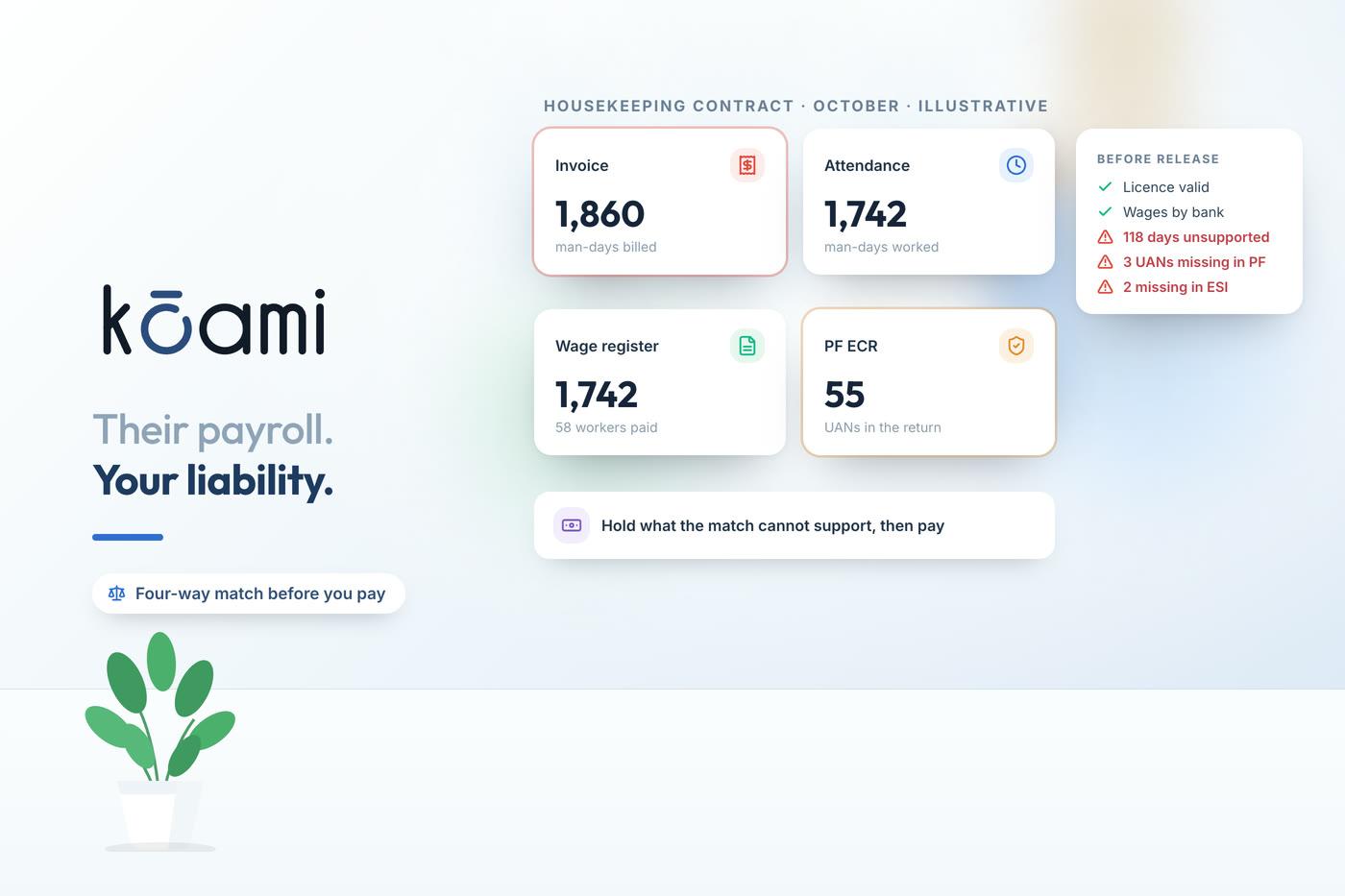
The four-way match (illustrative)
Most problems show up as a mismatch between four numbers. Here is an illustrative month for a housekeeping contract with 60 workers deployed:
- Invoice: 1,860 man-days billed (60 workers x 31 days)
- Hospital attendance: 1,742 man-days actually worked, after weekly offs, leave and absences
- Wage register: 1,742 man-days paid, 58 workers paid
- ECR and ESI challan: 55 UANs and 56 insurance numbers
Three findings in one minute. The invoice billed for weekly offs and absences that were not worked. Two of the 60 deployed workers were not paid through the register, so either they left mid-month or they were paid in cash. And three paid workers are missing from the PF return, and two from the ESI challan. Each is a question for the contractor before the payment goes out, not after an inspection. The numbers are illustrative; your contract terms decide whether paid weekly offs are billable.
For the CFO, the rule is simple: hold the portion of the invoice that the four-way match cannot support, and write that right into the contract.
Attendance is the foundation
Every check above depends on knowing who actually worked which shift. If attendance lives only in the contractor's paper register, you are verifying the contractor's numbers against the contractor's numbers. Capture contract staff attendance on the same system as your own staff, ideally with location-bound check-in at the hospital gate or ward. Our article on geofenced attendance explains the method and its limits.
Once attendance is yours, the man-day count that feeds the invoice, the wage register and the PF base comes from one source. That is the same principle as running your own statutory payroll: clean attendance first, then deductions.
The audit file, folder by folder
When a labour inspector, an auditor or an NABH assessor asks about a contract worker, you should be able to answer from one place. A simple structure:
- 00 Master: contract and scope of work, rate card, contractor licence, your establishment registration, the core-activity opinion for each contracted role, insurance certificates
- 01 Monthly, one subfolder per month and contractor: invoice, four-way match sheet, wage register, bank payment proof, ECR and PF receipt, ESI challan, attendance extract, overtime consents, sign-off by HR and the department head
- 02 Workers: deployment list with joining and exit dates, appointment letters, training records, experience certificates, full and final settlements
- 03 Welfare and safety: facility checks, incident and injury logs, grievance register
- 04 Recoveries: any wages or contributions the hospital paid on the contractor's behalf, the recovery entry and the correspondence
Keep the monthly folder closed and signed by the 15th of the following month. A file that is complete in real time costs an hour a month; one rebuilt after a notice can cost weeks. Treat contractors like any other vendor with performance terms, as described in our piece on vendor management.
Where software helps
The work above is mostly matching: attendance against invoices, invoices against wage registers, registers against challans. In Kōami, contract staff can be held as worker records alongside employees, with their UAN and ESIC numbers, so the same attendance data drives both the internal roster and the contractor reconciliation. The Kōami HRMS page covers how attendance, rosters and payroll connect.
Whatever you use, start with the checklist this month. Pick your largest contractor, run the four-way match on last month's invoice, and see how many lines it can support. If you would like to see contractor attendance and reconciliation on synthetic data, we can walk you through it. Book a demo: koami.in/book-demo
Frequently asked questions
- Is a hospital liable if its housekeeping contractor does not pay wages?
- Yes. Under section 55 of the OSH Code, if the contractor fails to pay wages within the prescribed period or short-pays, the principal employer must pay the unpaid amount and may recover it from the contractor by deduction from amounts payable or as a debt.
- When does the contract labour part of the OSH Code apply to a hospital?
- Section 45 applies it to every establishment in which fifty or more contract labour are employed, or were employed on any day of the preceding twelve months, and to every manpower supply contractor who has employed fifty or more. Work of only an intermittent or casual nature is excluded.
- Can a hospital outsource nursing staff through a contractor?
- Section 57 prohibits contract labour in core activities, with limited exceptions such as work ordinarily done through contractors, work not needing full-time workers, or sudden increases in volume. Nursing care is usually central to why a hospital is set up, so take a specific legal opinion before contracting it out.
- Who pays ESI for contract workers deployed in a hospital?
- Section 31 of the Code on Social Security makes the employer liable to pay both contributions for employees employed through a contractor, and lets it recover them from the contractor. The contractor must keep a register of those employees and submit it before settlement.
- Do central rules apply to a private hospital?
- For most private hospitals the appropriate Government under the OSH Code is the State Government, so the state's rules set the forms, registers and timelines. The central rules notified on 8 May 2026 apply where the Central Government is the appropriate Government.
Sources
- The Occupational Safety, Health and Working Conditions Code, 2020 (Gazette of India), sections 2, 3, 6, 45 to 57
- The Code on Social Security, 2020 (Gazette of India), sections 17 and 31
- The Code on Wages, 2019 (Gazette of India), sections 3, 5, 17, 18 and 43
- All India Radio News: Government implements four new Labour Codes (21 Nov 2025)
- SCC Online: Occupational Safety, Health and Working Conditions (Central) Rules, 2026, key highlights
Follow Kōami on LinkedIn
Get the next guide on hospital operations, software and compliance in your feed, as soon as it is published.