Getting PF, ESI, PT and TDS Right, Every Month
Published
Payroll in an Indian hospital is not one calculation. It is a stack of them, each with its own rules, thresholds and filing calendar, sitting on top of attendance data that is often messy to begin with. Provident Fund, Employee State Insurance, Professional Tax and Tax Deducted at Source each answer to a different authority, and each one is unforgiving about deadlines. Get them right and nobody notices, which is the whole point. Get them wrong and you are looking at interest, penalties, and a queue of staff outside the HR office asking why their take-home dropped. Getting statutory payroll right every month is less about cleverness and more about discipline built into the system.
Four deductions, four different rulebooks
The reason payroll feels harder than it should is that these four components do not share a logic. Treating them as one lump is exactly how mistakes creep in.
- PF applies on a defined wage base with employer and employee contributions, and the base itself is a source of endless confusion when allowances enter the picture.
- ESI applies to employees below a wage threshold, which means a mid-year increment can push someone out of coverage - but only from the correct contribution period, not the day the raise lands.
- PT is a state subject, so a hospital with units in more than one state is running different slabs and different due dates in parallel.
- TDS on salary depends on the employee's declared regime, investment proofs and projected annual income, and it has to be smoothed across the year rather than lumped into March.
The danger is not the arithmetic. It is the assumption that last month's rules still apply this month. They often do not.
Each of these has moving parts that change with a promotion, a threshold revision, a new state of operation, or a mid-year statutory update.
Where hospitals actually get caught
Across the units we have seen, the errors are rarely exotic. They are the same handful, repeated:
- Applying an ESI threshold change from the wrong date, so an employee is deducted after they should have exited or vice versa.
- Running PT on the head-office state slab for staff who actually work in another state.
- Treating LOP inconsistently, so the PF and ESI bases do not match the days actually worked.
- Under-deducting TDS early in the year and then shocking staff with a large March cut when the shortfall is recovered.
Notice how many of these trace back to attendance. If the LOP is wrong, every downstream deduction inherits the error. Statutory payroll is only as clean as the attendance and roster data feeding it.
Start upstream, at attendance
This is why payroll cannot be an island. In the Kōami ecosystem the payroll engine reads from the same roster and attendance records that the HRMS already maintains, so the days-worked figure that drives PF, ESI and LOP is the one the geofenced check-ins and approved leave actually produced. A swap that was properly recorded, a night differential that was earned, a leave that was sanctioned - these arrive as facts, not as month-end reconstructions. When the input is trustworthy, the statutory calculation stops being a guess.
The corollary is blunt: if a hospital is fixing attendance by hand every month, no payroll software will save it. The leverage is in getting the presence data right the first time, so payroll has something honest to compute on.
Make the month-end run boring
A good statutory payroll process is deliberately unexciting. The system should carry the current rules, apply them to clean data, and produce outputs that map directly to what each authority expects:
- Contribution registers for PF and ESI aligned to the correct wage bases and periods.
- PT computed against the right state slab for each employee's place of work.
- TDS projected across the financial year, adjusted as declarations and proofs come in, and reconciled so March holds no nasty surprises.
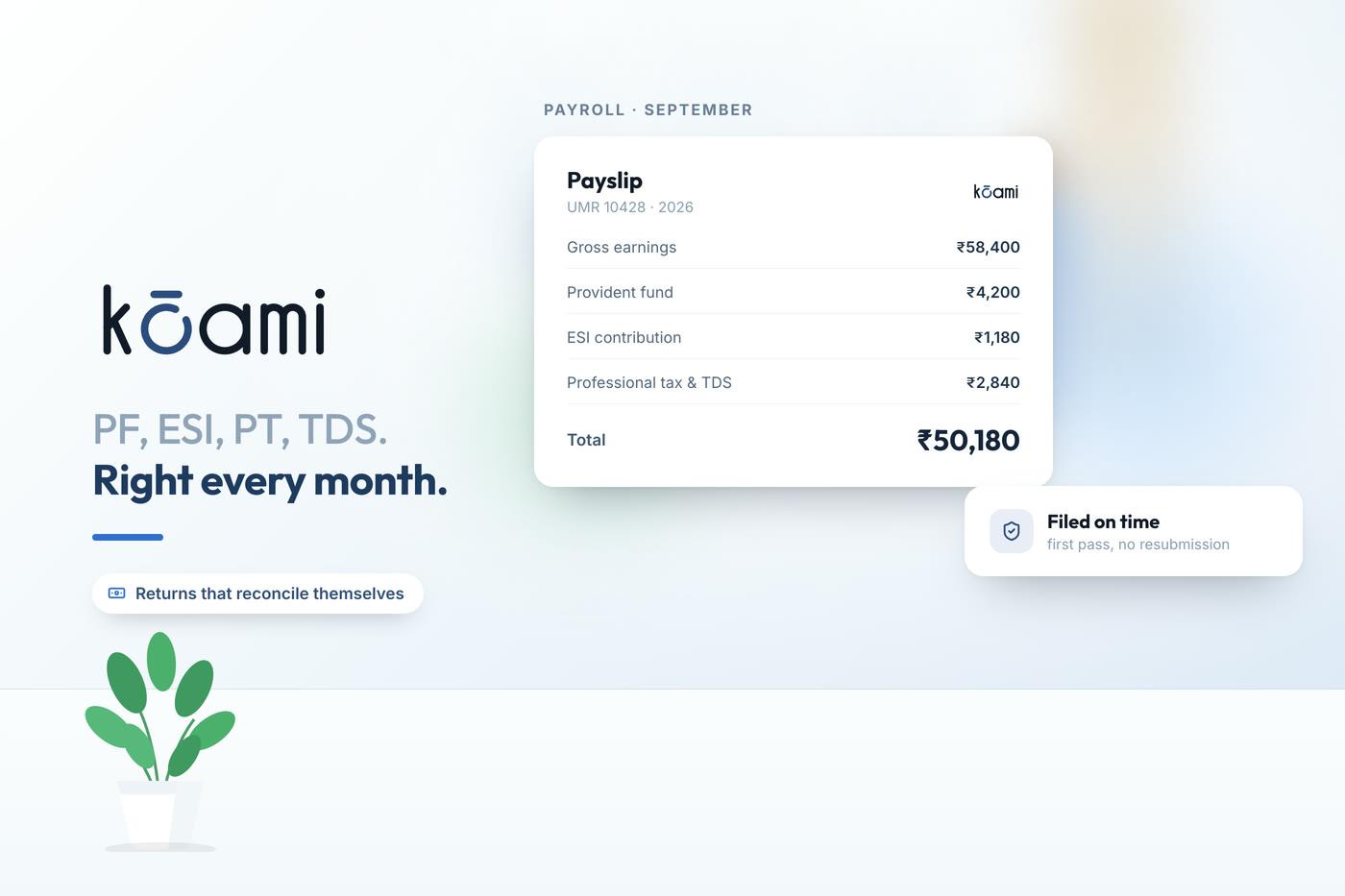
- Payslips that show each deduction as a distinct, explainable line rather than an opaque net figure.
That last point earns disproportionate goodwill. When an employee can see exactly why PF, ESI, PT and TDS were deducted, the HR queue at the counter shrinks. Transparency is not a compliance requirement, but it is a trust requirement, and it costs nothing once the line items are already there.
Keep the audit trail, because someone will ask
Compliance is not only about computing correctly this month. It is about being able to show, later, that you did. A payroll run should leave behind a defensible record: which rule version was applied, what the wage base was, how LOP was derived, when the deduction was remitted. When an inspector or an auditor asks about a specific employee in a specific month, the answer should be a lookup, not an investigation. Kōami's approach is to keep these calculations and their inputs traceable so that the story holds together after the fact, without anyone reconstructing it from spreadsheets.
None of this is glamorous, and that is precisely the ambition. Statutory payroll done well is invisible: staff are paid correctly, deductions land where they should, filings go out on time, and the phrase "payroll dispute" slowly disappears from the HR vocabulary. It gets there not through a single clever feature but through the unglamorous discipline of clean attendance, current rules, transparent payslips and a trail you can stand behind. Every month, the same way, without drama.
Follow Kōami on LinkedIn
Get the next guide on hospital operations, software and compliance in your feed, as soon as it is published.