Geofenced Check-In Without the Friction
Published
Attendance sounds like the most solved problem in a hospital. People arrive, people leave, a machine records it. Then you look closely and find the exceptions eating everyone alive: the biometric reader that rejects wet or gloved hands, the queue at shift change when three hundred people badge in within ten minutes, the home-visit nurse who was never near a fixed device, and the ward sister covering for a colleague across the building. Geofenced check-in is meant to remove that friction. Done badly, it adds a new kind. Done well, it becomes invisible, which is exactly what good attendance should be.
Why fixed devices quietly fail
The classic hospital attendance setup is a biometric terminal at a staff entrance. It works until it does not, and the failure modes are boringly predictable:
- Clinical staff scrub, glove and sanitise constantly, so fingerprint reads degrade through the shift.
- Shift-change crowding turns a five-second punch into a five-minute queue.
- Community and field roles - home care, sample collection, camp duty - are nowhere near the device.
- One broken reader at one door creates a day of manual corrections in the HRMS.
Every one of those exceptions becomes a manual regularisation, and manual regularisations are where payroll disputes are born. The person keying the correction is guessing, and the nurse who lost forty minutes to a dead reader is the one who pays for the guess.
How a geofence changes the model
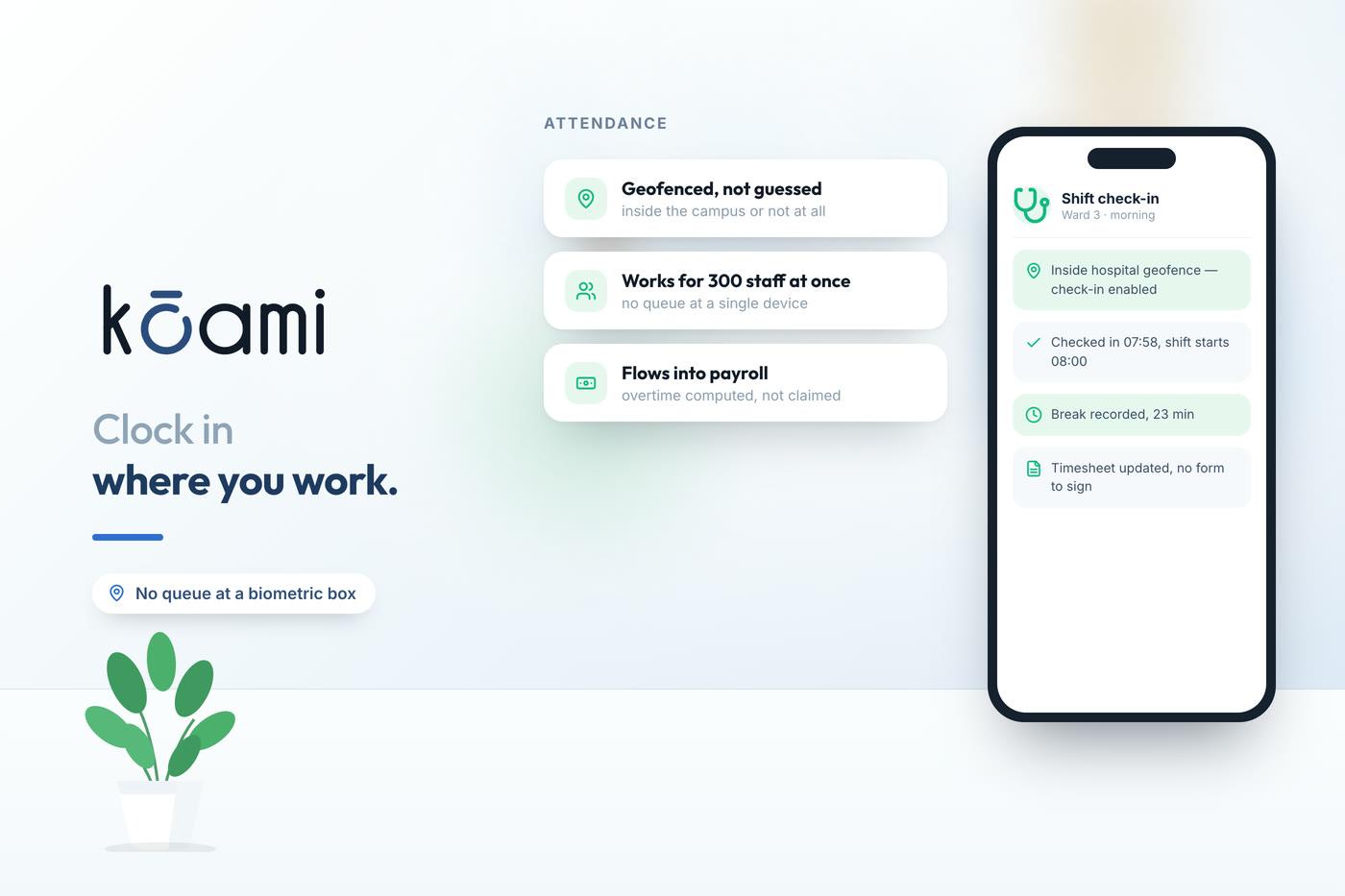
A geofence is simply a defined boundary around a place - a hospital campus, a specific block, a patient's home for a scheduled visit - expressed as coordinates and a radius. Check-in then becomes a question the phone can answer: is this person inside the boundary they are meant to be in, at the time they are meant to be there? The staff member opens the Kōami app, confirms, and the location plus timestamp is captured. No queue, no shared surface, no hunt for a working terminal.
The point of a geofence is not to watch people. It is to let the honest, present majority prove they were where they said, without waiting in a line to do it.
For a home-visit nurse this is transformational. The check-in happens at the patient's doorstep, tied to the scheduled visit, and the record reflects the actual care delivered rather than a punch at a building she visited hours earlier.
Getting the friction out without inviting fraud
The reasonable worry is that a phone-based check-in is easy to game. A serious implementation closes the obvious holes rather than pretending they do not exist:
- Location integrity checks that look for mock-location and spoofing signals, not just a raw coordinate.
- Device binding, so an account checks in from its registered phone rather than any handset.
- Optional selfie or supervisor confirmation for high-trust roles or first check-in of a shift.
- Sensible radius tuning, so a large campus is covered without a boundary so loose it becomes meaningless.
The goal is proportionate assurance. A ward nurse checking in inside a bound device, inside the campus geofence, at her rostered time is low risk and should sail through. The exceptions are where you spend your scrutiny.
Where geofence meets roster and payroll
Attendance that lives in its own silo is just data. The value appears when the check-in event flows straight into the roster and the payroll run. In the Kōami HRMS, a geofenced check-in is matched against the shift the person was rostered for, and the arithmetic follows automatically:
- On-time arrival closes the shift expectation with no human touch.
- A late or missed check-in surfaces as an exception for a supervisor, not a silent LOP.
- Overtime and shift differential accrue from the same event that recorded presence.
- Month-end LOP is computed from real attendance rather than reconstructed from memory.
This is the difference between attendance as a tracking exercise and attendance as the spine of accurate pay. When the same event that proves presence also drives the differential and the loss-of-pay calculation, the arguments at month end mostly disappear, because everyone is looking at the same record.
Respecting the humans holding the phone
Location capture is sensitive, and pretending otherwise erodes the trust you need. A geofence used for attendance should capture location at the moment of check-in and check-out, not track people continuously through their shift. Staff should know exactly what is recorded and when. The boundary is a gate you pass through, not a leash. Hospitals that communicate this plainly get adoption; those that stay vague get quiet resistance and a workforce that assumes the worst.
There is also a fairness argument. A well-tuned geofence protects staff as much as it protects the employer. The nurse who was present has proof. The field worker who completed her visits has a record nobody can dispute. Friction removed on the honest side of the ledger is worth more than the small fraction of gaming it prevents.
Attendance should be the least dramatic part of anyone's day. When check-in is a two-second confirmation from the place you already are, when the record flows cleanly into roster and pay, and when staff understand and trust what is captured, the whole apparatus fades into the background. That invisibility is the goal. The best attendance system is the one nobody has to think about, and nobody has to argue with at the end of the month.
Follow Kōami on LinkedIn
Get the next guide on hospital operations, software and compliance in your feed, as soon as it is published.