Medical Equipment Service Management for Distributors
Published
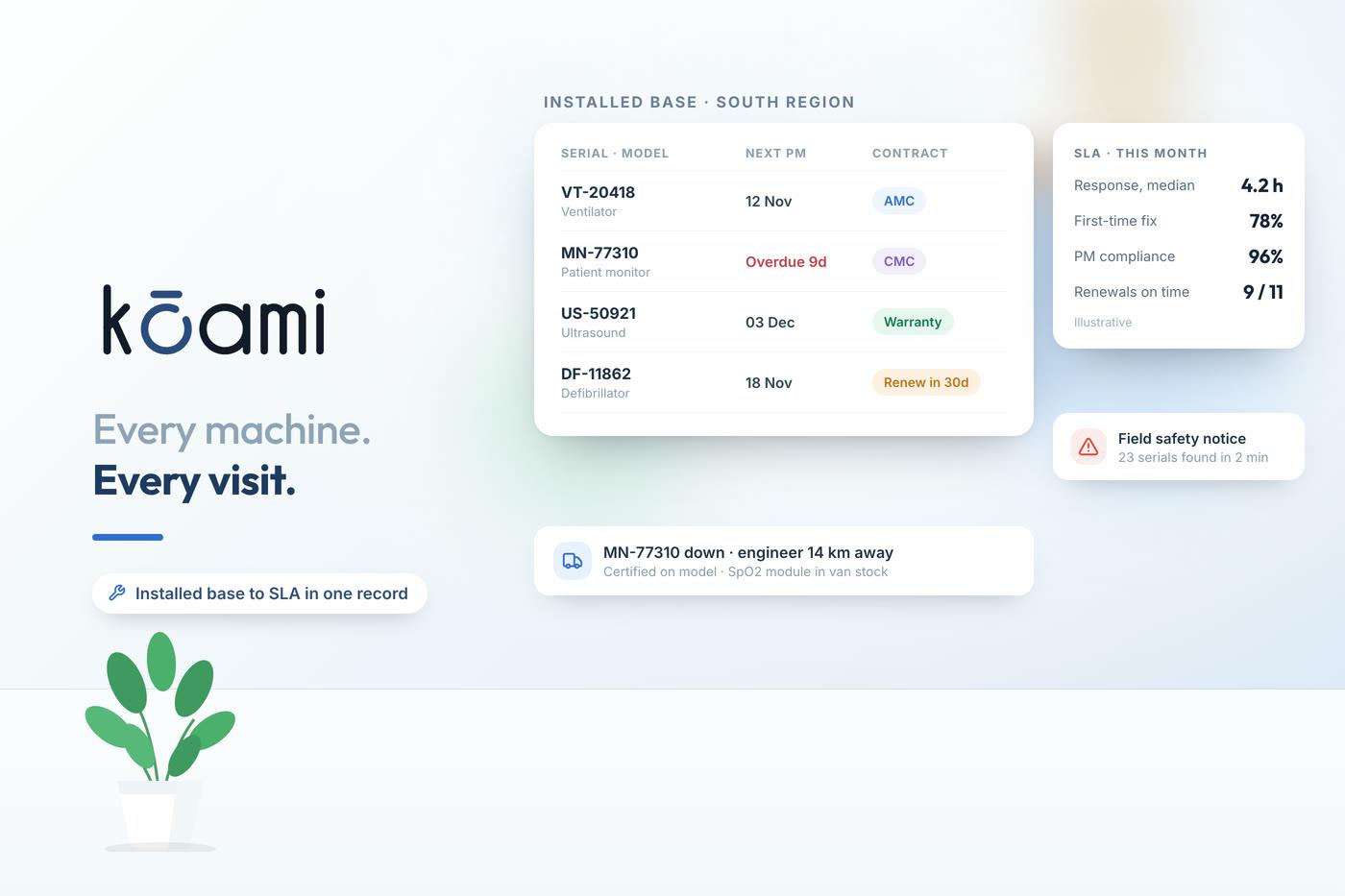
A distributor with 500 machines in the field rarely has a capacity problem. It has a visibility problem. The service head knows the team is busy. What nobody can say quickly is which preventive maintenance (PM) visits are overdue, which annual maintenance contracts (AMCs) expire next month, which engineer is closest to the ventilator that just failed in a district hospital, and whether the spare part is in Hyderabad or Vijayawada.
This article is for the national or regional service head at an Indian medical device distributor or OEM service partner. It covers the installed-base record, PM scheduling and AMC renewals, dispatch and spare parts, and the SLA metrics worth reporting to customers. It ends with an SLA metric sheet you can copy. All numbers in examples are illustrative.
Why WhatsApp and Excel break at around 500 machines
Run the arithmetic on a mid-sized installed base. Say 500 machines across three states, each needing two PM visits a year, plus about 0.6 breakdown calls per machine per year. That is 1,000 PM visits and 300 breakdown calls, roughly 1,300 jobs a year. Spread across eight engineers and about 220 working days, it is less than one job per engineer per day.
On paper that looks comfortable. In practice the day goes on travel between districts, waiting for the biomedical engineer to release the machine, and a second trip because the part was not in the bag. The workload is manageable. The coordination is not.
The spreadsheet-and-WhatsApp setup fails in predictable ways:
- PM due dates live in one file, contract end dates in another, and service history in engineers' phones.
- A call logged on a WhatsApp group has no timestamp anyone reports on, so response time cannot be measured.
- When an engineer leaves, the knowledge of which hospital has which probe, which software version and which quirky UPS leaves with them.
- Renewal quotes go out late because nobody saw the expiry coming.
- When the OEM issues a field safety notice, finding every affected serial number takes days.
None of this is solved by working harder. It is solved by keeping one record per machine and generating the work from it.
The installed-base record
Every PM plan, renewal quote and dispatch decision should come from a single installed-base record. If a field is missing here, it will be missing everywhere downstream. At minimum, each machine needs:
- Serial number, model and the OEM's device identifier. Rule 46 of the Medical Devices Rules, 2017 provides for a unique device identification made of a device identifier and a production identifier such as serial or lot number, so capture both where the label carries them.
- Customer, site, department and room, because "second floor, ICU 2, bed 6" is how engineers actually find a machine.
- Install date, warranty end date and contract type: warranty, AMC, comprehensive maintenance contract (CMC) or no contract.
- Software or firmware version, and the accessories that travel with it (probes, sensors, batteries).
- PM frequency from the OEM service manual, last PM date, and next PM due.
- Customer contacts: the biomedical engineer, the department head and the purchase contact for renewals.
- The full job history: every PM, breakdown, part replaced and calibration certificate, with dates.
Why traceability matters more than it used to
The Medical Devices Rules, 2017 put reporting duties on licence holders. A manufacturing licence holder must inform the licensing authority of any suspected unexpected serious adverse event and action taken, including any recall, within fifteen days (Rule 26). An import licence holder must report, within fifteen days, administrative action such as a market withdrawal taken in any country where the device is sold (Rule 38). If you are the importer or the authorised agent, those clocks are yours. If you are a distributor for someone else, your principal will expect you to find every affected unit quickly.
Hospitals are also asking more. NABH's 6th edition standards for hospitals expect a documented preventive and breakdown maintenance plan, periodic inspection and calibration, monitoring of recalls and hazard notices, and downtime tracking for critical equipment (FMS.5). The hospital's biomedical team needs your service reports to show that evidence. The Materiovigilance Programme of India, run by the Indian Pharmacopoeia Commission, publishes guidance for hospitals on reporting medical device adverse events, so expect customers to ask what you know about a failure, not just when it will be fixed.
A field safety notice turns your installed base from an asset list into a recall list. How long it takes you to produce that list is a fair test of your service operation.
PM scheduling and AMC renewals
PM scheduling looks simple until you add geography, engineer certification and hospital availability. A workable method:
- Generate due dates from the last completed PM and the OEM interval, not from the install date. A PM done three weeks late moves the next one.
- Group due visits by district and by the engineer certified on the model. A CT engineer and a patient monitor engineer are not interchangeable.
- Plan a month ahead and confirm a week ahead with the hospital's biomedical engineer, because the machine has to be released from clinical use.
- Close the visit only with the checklist, readings and the customer's acknowledgement attached. A PM without a signed report did not happen, as far as the hospital's assessor is concerned.
A worked renewal example (illustrative)
Take 180 machines under AMC with an average annual contract value of ₹60,000. That is ₹1.08 crore of renewals a year, about ₹9 lakh a month. If quotes go out on the expiry date instead of 60 days before, and one in five customers lets the contract lapse while procurement catches up, you lose around ₹1.8 lakh of service revenue a month. Each lapsed hospital is also running on time-and-material calls, which annoys both sides.
A renewal pipeline fixes most of this:
- 90 days before expiry: send a usage summary (visits done, uptime, parts replaced).
- 60 days: send the quote, with AMC and CMC options priced separately.
- 30 days: escalate to the regional manager and the hospital's purchase head.
- On expiry: mark the machine "out of contract" so dispatch knows the call is chargeable.
Dispatch, spare parts and first-time fix
The first decision is made when the call is logged, not when the engineer arrives. A good call-logging screen captures:
- Machine identified by serial number, so contract status and history load automatically.
- Severity: machine down, degraded, or a scheduled request.
- Symptoms and error codes, ideally with a photo of the screen.
- Whether a backup unit is available at the site, which changes how urgent the call really is.
Dispatch then matches three things: the engineer certified on the model, the engineer's current location and load, and the parts likely to be needed. If you track location, tell engineers what is tracked and why, and keep it to working hours. Engineers' location data and hospital contacts are personal data under the Digital Personal Data Protection Act, 2023, so collect what the job needs and not more.
First-time fix is a parts problem
Most second visits are caused by a missing part, not a missing skill. Three habits move first-time fix:
- Keep a van stock per engineer based on the models in their territory and the parts that actually fail, reviewed monthly from job history.
- Make the engineer record the failed part and the part used on every job, so failure patterns by model become visible.
- For CMC machines, where parts are included, track parts cost against contract value. A CMC that consumes more in parts than it earns should be repriced at renewal.
Customer portals and SLAs
Hospitals do not want to call you to ask where the engineer is. A simple customer view answers most of their questions:
- Open calls with status and the assigned engineer.
- PM due dates for the next 90 days and completed PM reports to download.
- Contract status and expiry for every machine.
- Calibration certificates and service reports, filed by serial number.
This view also helps the hospital's biomedical engineer prepare for an NABH assessment, which makes you easier to renew.
The SLA metric sheet
Report these monthly, by customer and in total. Define each one once and do not change the formula without telling customers. Targets below are illustrative and should be set per contract.
- Response time: call logged to engineer on site. Formula: median and 90th percentile, in hours. Report separately for machine-down calls.
- Restore time: call logged to machine back in clinical use. Formula: median and 90th percentile, in hours.
- First-time fix rate: breakdown calls closed on the first visit divided by all breakdown calls closed. Example target: 75%.
- PM compliance: PM visits completed by the due date divided by PM visits due in the month. Example target: 95%.
- PM overdue backlog: count of PM visits past due, aged 0 to 15, 16 to 30 and over 30 days.
- Uptime: hours available divided by contracted hours, for critical equipment, with downtime measured from report to restore.
- Repeat call rate: machines with a second breakdown within 30 days of a fix, divided by machines fixed.
- Renewal rate: contracts renewed before expiry divided by contracts expiring in the month.
- Report turnaround: PM or service report shared with the customer within 48 hours, as a percentage of visits.
- Parts fill rate: jobs where the needed part was in the van or reached site within 24 hours, divided by jobs needing parts.
Two rules make the sheet credible. Every number must be traceable to job records with timestamps, not typed in at month-end. And the customer should be able to see the same figures you see.
A 30-day starting plan
- Week 1: export every machine from every spreadsheet into one installed-base list. Expect duplicates and missing serials; fix them now.
- Week 2: load PM intervals from service manuals and generate the next 90 days of PM due dates.
- Week 3: move call logging off WhatsApp into one queue with timestamps, even if dispatch stays manual for now.
- Week 4: publish the first SLA sheet internally, with response time, PM compliance and renewals due.
Where software fits
The method above works in any system that keeps one record per machine and generates work from it. Kōami Field Service covers the core of it: work orders, technician dispatch and route planning, preventive maintenance schedules, warranty and AMC tracking, SLA escalations and a mobile app for engineers in the field. You can see how it is organised on the field service product page. If you also serve hospitals that run their own biomedical teams, our guide to biomedical equipment management software covers the hospital side of the same records.
This article is general information about operations and regulation, not legal advice. Check reporting duties under the Medical Devices Rules with your regulatory adviser and your principal's quality team.
If you would like to see an installed base, a PM calendar and an SLA sheet built on synthetic data that looks like your territory, we can walk you through it. Book a demo: koami.in/book-demo
Frequently asked questions
- What is installed base management for medical equipment?
- It is a single record of every machine you have sold or service, by serial number, with its site, department, install date, warranty or contract status, software version, PM frequency and full service history. Every PM plan, renewal quote and dispatch decision is built from it.
- How should a distributor schedule preventive maintenance visits?
- Take the PM frequency from the OEM service manual for each model, generate due dates from the last completed PM, then group visits by district and by the engineer certified on that model. Plan a month ahead and lock the schedule a week ahead so hospitals can release the machine.
- What is a good first-time fix rate for medical equipment service?
- There is no published Indian benchmark. Measure your own: breakdown calls closed on the first visit, divided by all breakdown calls closed in the month. Track it by model and by engineer, and look at missing parts as the most common reason for a second visit.
- Why do hospitals ask distributors for PM and calibration reports?
- NABH-accredited hospitals have to show a documented preventive and breakdown maintenance plan, periodic inspection and calibration, monitoring of recalls and hazard notices, and downtime tracking for critical equipment (FMS.5 in the 6th edition). Much of that evidence comes from the distributor's service reports.
- When should AMC renewal reminders go out?
- Start at 90 days before expiry with a usage summary, send the quote at 60 days, and escalate at 30 days. A machine that lapses out of contract is a lost renewal and, often, a hospital running without cover.
Sources
- CDSCO: Medical Devices and Diagnostics (Medical Devices Rules, 2017)
- Indian Pharmacopoeia Commission: Materiovigilance Programme of India (MvPI)
- NABH: Accreditation Standards for Hospitals, 6th Edition (effective 1 January 2025), FMS.5 medical equipment management
- MeitY: Digital Personal Data Protection Act, 2023 (official text)
Follow Kōami on LinkedIn
Get the next guide on hospital operations, software and compliance in your feed, as soon as it is published.