Hospital Linen Management: Par Levels, Loss and Turnaround
Published
Every housekeeping manager knows the 7am version of this problem. A discharge is signed, the patient has left, the next admission is waiting in casualty, and the ward boy is walking the corridor looking for a clean draw sheet because the sub-store shelf is empty. The bed is free. It is not ready. Linen is rarely the reason anyone gives for a slow bed turnaround, but it is often the reason in practice, and it is one of the few causes that a hospital can fix almost entirely with arithmetic and discipline.
This guide is for the housekeeping manager or facility manager who owns linen, and for the medical superintendent who wants to know why beds take longer to turn than they should. It covers how much linen you actually need, how linen moves from the bed to the laundry and back, how to measure loss honestly, and how to decide between an in-house laundry and an outsourced one.
Why linen deserves a number, not a feeling
Most hospitals set linen stock by habit: someone once decided each ward gets a certain number of sheets, and it has been topped up ever since. The trouble is that the right number depends on things that change. Occupancy rises. The laundry vendor changes and the turnaround goes from one day to two. A new ICU opens with more frequent changes. The old number quietly becomes wrong, and the shortage shows up as delayed beds and staff borrowing from other wards.
MoHFW's Kayakalp guidelines for public facilities give a useful reference point. They ask for at least four sets of linen per bed and describe six as preferable: one on the bed, one ready in the ward sub-store, one in transit, one in the washing cycle and two in the central store. For a 100-bed hospital, that is 600 bed sheets. It is a sensible starting point, but your own number should come from your own cycle.
The par-level calculator
A par level is the total quantity of an item that must be in circulation so that the ward never runs out between laundry deliveries. Calculate it separately for each item: bed sheets, draw sheets, pillow covers, patient gowns, towels, blankets and OT linen all behave differently.
The formula has four parts:
- Daily usage: occupied beds multiplied by changes per bed-day, plus one full change for every discharge
- Cycle days: days on the bed, plus days in transit and laundry, plus days on the clean shelf before use
- Base par: daily usage multiplied by cycle days
- Allowances: rewash (items returned stained), loss until the next purchase, and a surge buffer for occupancy peaks
Then: par level = base par + rewash allowance + loss allowance + surge buffer.
Worked example: bed sheets in a 100-bed hospital (illustrative)
All figures below are illustrative. Replace them with your own data from the bed board and laundry register.
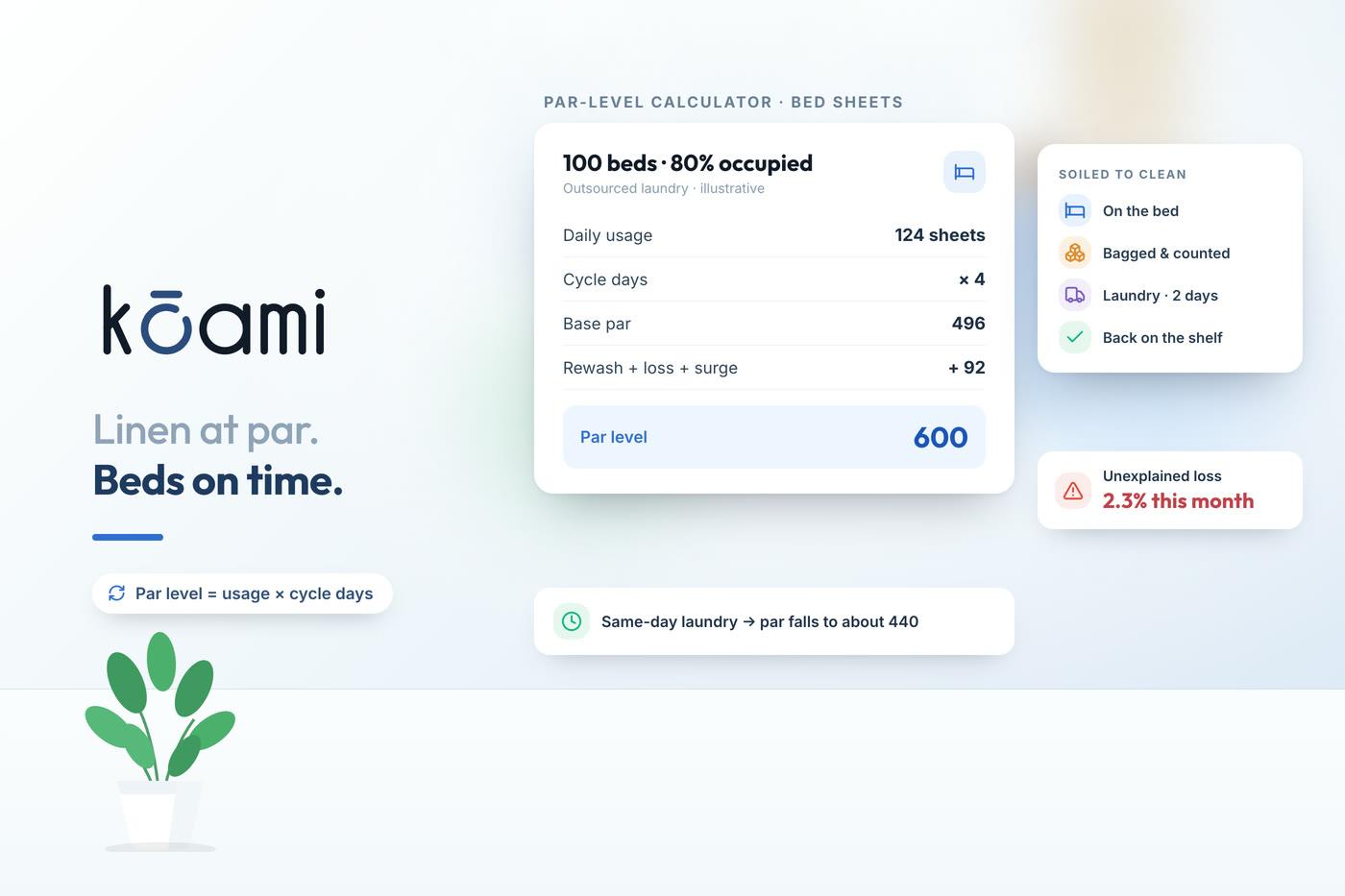
- Step 1, occupied beds: 100 beds at 80% occupancy gives 80 occupied beds
- Step 2, routine changes: 80 beds at 1.3 changes per bed-day (one daily change plus extra changes for soiling) gives 104 sheets
- Step 3, discharge changes: about 20 discharges a day at an average length of stay of 4 days gives 20 more sheets
- Step 4, daily usage: 104 + 20 = 124 sheets a day
- Step 5, cycle days with an outsourced laundry: 1 day in use + 2 days with the laundry + 1 day on the shelf = 4 days
- Step 6, base par: 124 x 4 = 496 sheets
- Step 7, rewash allowance: 5% of daily usage held for the 2 laundry days, 124 x 0.05 x 2 = about 12 sheets
- Step 8, loss allowance: 2% monthly loss on circulating stock, held for a quarterly purchase cycle, 496 x 0.02 x 3 = about 30 sheets
- Step 9, surge buffer: 10% of base par for occupancy peaks, about 50 sheets
- Step 10, par level: 496 + 12 + 30 + 50 = 588, rounded to 600 sheets
The result lands close to the Kayakalp figure of six sets per bed, which is reassuring. Now change one input. If an in-house laundry returns linen the same day, cycle days fall from 4 to 3. Base par becomes 372, the allowances shrink with it, and the par level comes to about 440 sheets. At an illustrative ₹350 per sheet, that is roughly ₹56,000 less linen in circulation for bed sheets alone. That does not mean in-house laundry is cheaper overall. It means turnaround time has a rupee value, and it belongs in any comparison of laundry options.
Splitting the par across locations
Once you have the total, decide where it sits. A practical split is one day of usage on each ward's sub-store shelf, one day in the central linen store, and the rest in the cycle. Each ward's shelf level should be printed and pasted on the shelf, so the night supervisor can see at a glance whether the ward is short before the morning discharges start.
The soiled-to-clean cycle, step by step
Par levels only hold if linen actually moves through the cycle on time and does not leak out of it. The Kayakalp guidelines and the CDC's laundry guidance agree on the basics of safe handling, and those basics also happen to be what keeps counts accurate.
- Step 1, strip and bag at the bedside: place used linen in bags at the point of use, remove any sharps or equipment first, and do not shake, rinse or sort linen in the patient area
- Step 2, segregate: Kayakalp describes green trolleys for dirty linen and yellow trolleys for soiled or infected linen, with soiled linen in impermeable, securely tied bags
- Step 3, count and record at the ward: the attendant or sister in charge records the number of each item collected in the ward's daily transaction register
- Step 4, transport: covered, dedicated trolleys, dirty and soiled linen kept separate, never the trolleys used for waste
- Step 5, receive at the laundry: record item type, quantity, source department, date and time in the receiving register
- Step 6, disinfect and sluice infected linen: Kayakalp describes soaking infected linen in 0.5% bleaching solution for 30 minutes and rinsing before washing, and says that when laundry is outsourced, this must be done inside the facility before handover
- Step 7, wash: Kayakalp recommends hot water above 71°C, with a minimum 25-minute cycle for infected linen; the CDC notes that at least 71°C for 25 minutes is commonly recommended for hot-water washing
- Step 8, dry, inspect and iron: check every piece for stains and tears, send repairable items for mending, and condemn the rest under the hospital's condemnation policy
- Step 9, return: clean, covered trolleys to the central store, issued to wards against indents, with clean and dirty linen never stored in the same area
When a piece of linen is discarded rather than washed, it leaves the linen system and enters the waste system. Under Schedule I of the Bio-Medical Waste Management Rules, 2016, discarded linen, mattresses and bedding contaminated with blood or body fluid are yellow-category waste, to be collected in non-chlorinated yellow bags or suitable packing and treated by the routes the Schedule prescribes, such as non-chlorinated chemical disinfection followed by incineration, plasma pyrolysis or energy recovery. Each condemnation should be recorded with the item, reason and date, both for the waste record and because unrecorded condemnations look exactly like theft in a stock count.
Measuring linen loss honestly
Linen disappears in three ways: it wears out, it is lost in transit or at the vendor, and it walks out of the building. Only the first is a normal cost. The other two are controllable, but only if you measure them separately.
Run a physical count of every item at least once a month, on the same day, across wards, the central store and whatever is at the laundry. Then calculate:
- Unexplained loss rate (%): (opening stock + purchases - condemned items - closing physical count) / (opening stock + purchases) x 100
- Condemnation rate (%): condemned items / average stock in circulation x 100
- Rewash rate (%): items returned for rewash / items sent for washing x 100
- Laundry count variance: pieces sent to the laundry minus pieces returned, by item, by day
Illustrative monthly count for bed sheets
- Opening stock: 600
- Purchases: 0
- Condemned with records: 8
- Closing physical count: 578
- Unexplained loss: 600 - 8 - 578 = 14 sheets, or about 2.3% of the 600 available
Track this figure by ward and by laundry vendor, month on month. A single bad month is noise. A ward that loses twice as much as its neighbours every month is a process problem, often linen used as rags, patients' attendants taking blankets home, or counts skipped on the night shift. There is no regulatory benchmark for loss, so your own trend is the only fair comparison.
The laundry count variance is where outsourced linen usually leaks. If the vendor returns linen by weight but you send it by piece count, you will never find the gap. Count pieces both ways and get the challan signed at both ends.
Outsourced or in-house laundry
There is no universally right answer, but there is a right way to compare the two. Make the comparison per clean piece delivered to the ward, not per kilogram washed.
What an in-house laundry costs
- Washer-extractors, dryers and a flatwork ironer or calender, with maintenance
- Water, steam or electricity, and detergent and chemicals
- Laundry staff across shifts, including leave cover
- Space with a physically separate soiled receiving area and clean processing area
- Wastewater handling for the laundry discharge
What an outsourced laundry costs
- The per-kilogram or per-piece rate, plus transport if charged separately
- The larger par stock needed to cover the longer cycle, as in the worked example above
- Loss at the vendor, unless the contract makes the vendor liable
- Supervision time on your side for counting and quality checks
Clauses worth putting in a laundry contract
- Piece counts at pickup and delivery, by item, on a challan signed by both parties
- Turnaround time in hours, with a penalty when the ward runs short because of delay
- Liability for lost or damaged pieces at an agreed replacement value
- Free rewash for any item returned stained or damp
- Documented wash parameters, including temperatures and chemicals, and your right to inspect the plant
- Clear handling for infected linen, including what you disinfect in-house before handover
Ask the vendor for their temperature logs once a month. A vendor confident in their process will not mind.
Connecting linen to bed turnaround
Bed turnaround is a chain: discharge order, billing clearance, patient leaves, cleaning, linen, bed marked ready. Linen is usually one of the shortest links, which is exactly why a shortage is so frustrating. If you already track discharge-to-bed-ready time, add one field to the housekeeping log: was the bed delayed waiting for linen, yes or no. A month of that data tells you whether your par is wrong, your laundry is late, or the problem lies somewhere else in the chain. Our pieces on bed management and discharge time cover the rest of that chain.
This is where connected systems help. In Kōami, linen can be held as stock items in the inventory module, issued to wards against indents and reconciled against laundry challans, while housekeeping tasks sit on the same bed board that shows discharges. When a bed shows dirty for longer than expected, the housekeeping supervisor can see whether the ward's linen shelf is below par at the same moment, instead of finding out from a ward boy at 7am.
A one-page linen routine
- Daily: ward transaction registers updated at every collection; laundry challan counts checked against what was sent
- Daily: sub-store shelf levels checked against printed par before the morning discharge rush
- Weekly: rewash rate and laundry turnaround reviewed with the vendor or laundry in-charge
- Monthly: full physical count, unexplained loss and condemnation rates by ward and vendor
- Quarterly: par levels recalculated with current occupancy, length of stay and turnaround
- Every change: recalculate par whenever you change laundry vendor, open beds or change changing frequency in a unit
None of this needs new equipment. It needs a formula, a count and someone who owns the numbers. If you want to see how linen stock, laundry challans and the bed board can sit in one system, we are happy to walk you through it on synthetic data. Book a demo: koami.in/book-demo
Frequently asked questions
- How many sets of linen does a hospital need per bed?
- MoHFW's Kayakalp guidelines ask public facilities for at least four sets per bed and describe six as preferable, which works out to 600 bed sheets for a 100-bed hospital. A better answer for your own hospital comes from your daily usage and your actual laundry turnaround, using the par-level method in this article.
- How do you calculate a linen par level?
- Multiply average daily usage by the number of days a piece spends in the full cycle (on the bed, in transit and washing, on the shelf), then add allowances for rewash, loss until the next purchase, and occupancy surges. Recalculate whenever your laundry turnaround or occupancy changes.
- What is a normal linen loss rate for a hospital?
- There is no regulatory benchmark. Measure your own unexplained loss each month from a physical count against opening stock, purchases and documented condemnations, and track the trend by ward and by laundry vendor rather than comparing with other hospitals.
- Is soiled hospital linen biomedical waste?
- Linen that is washed and reused is not treated as waste. Under Schedule I of the Bio-Medical Waste Management Rules, 2016, discarded linen, mattresses and bedding contaminated with blood or body fluid fall in the yellow category and must go to the authorised treatment route.
- Should a hospital outsource its laundry?
- It depends on volume, space for separate clean and soiled areas, water and steam availability, and how much control you need over turnaround. Outsourcing usually needs a larger par stock because of the longer cycle, so include that linen cost when comparing quotes.
Sources
- Guidelines for Implementation of Kayakalp Initiative (Laundry Services and Linen Management), MoHFW, hosted by NHSRC
- Bio-Medical Waste Management Rules, 2016, Schedule I (G.S.R. 343(E)), CPCB
- Bio-Medical Waste Management Rules and amendments, Central Pollution Control Board
- Laundry and Bedding, Guidelines for Environmental Infection Control in Health-Care Facilities, CDC
Follow Kōami on LinkedIn
Get the next guide on hospital operations, software and compliance in your feed, as soon as it is published.