Health Checkup Package Management for Corporate Wellness
Published
A corporate health check-up looks simple on the brochure: ten tests, one morning, one report. On the day, it is one of the most coordination-heavy things a hospital does. Forty fasting employees arrive at 8am. Phlebotomy, ECG, X-ray, the nurse doing vitals and the physician all need them in a particular order, the post-prandial sample runs on a clock, the company wants one consolidated invoice, and the employee wants one report, not five PDFs on WhatsApp. Most hospitals run this on a spreadsheet from the company's HR team, a printed list at the front desk, and a lot of goodwill.
This guide is for the business development head or operations head who sells and runs corporate wellness. It covers how to design a package that can actually be delivered, a day-flow map for a 10-test package, the capacity maths that decides how many people you can book, report compilation, invoicing, and the follow-up that makes the programme worth renewing.
Why corporate wellness is worth doing properly
Employers have a growing reason to care. The Occupational Safety, Health and Working Conditions Code, 2020 places a duty on employers to provide free annual health examinations, which PRS summarises as applying in notified establishments, and the government's own explainer on the Code lists free annual health check-ups among its worker benefits. Exactly which employees and establishments are covered depends on the central and state rules that apply to the employer, so let the client's HR or legal team tell you what they need, rather than selling a compliance claim.
What matters for the hospital is that a corporate client brings volume on predictable mornings, a single payer, and a relationship that renews yearly if the experience is good. That relationship is won or lost on the operational details below.
Designing a package you can deliver
A package is a promise about what will be done, in what time, at what price. Design it from the delivery side first.
- Map every component to your tariff: each test, scan and consultation in the package should point to an existing tariff item, so the lab, radiology and billing all see the same thing
- Separate the fixed core from add-ons: a core list everyone gets, and optional add-ons decided by your clinical team, priced and billed separately
- Mark the dependencies: which tests need fasting, which run on a clock after a meal, which need a doctor present, and which need a questionnaire first
- Set the report promise: same-day, next-day or 48 hours, depending on which components need a radiologist or consultant to sign
- Fix validity and rescheduling rules: how long a booked package stays valid and whether a no-show is billed
Pricing the package (illustrative)
Every figure here is illustrative. Use your own tariff and costs.
- Sum of individual tariff prices for the 10 components: ₹6,800
- Retail package price: ₹2,999
- Corporate rate after a 20% volume discount: ₹2,399
- Direct cost per person (reagents and consumables, ECG and imaging consumables, staff time, breakfast, report printing): ₹1,150
- Contribution per person at the corporate rate: ₹2,399 - ₹1,150 = ₹1,249
- For a camp of 200 employees: about ₹2.5 lakh in contribution
If the direct cost is not known per component, the discount conversation with the client turns into guesswork. Build the cost sheet before you build the brochure. Our piece on package vs open billing covers how package rates sit against itemised charges in the billing system.
The day-flow map for a 10-test package
The example package (illustrative) has ten components: complete blood count, fasting blood sugar, post-prandial blood sugar, HbA1c, lipid profile, liver function tests, kidney function tests, urine routine, ECG and chest X-ray, followed by a physician review. Fasting instructions and the post-prandial interval should follow your own laboratory's protocol. The times below assume a two-hour post-prandial interval purely for illustration.
One employee's morning (illustrative)
- Day before, 6pm: reminder on SMS or WhatsApp with the reporting time, fasting instructions as per your lab, what ID to bring, and a request to bring previous reports
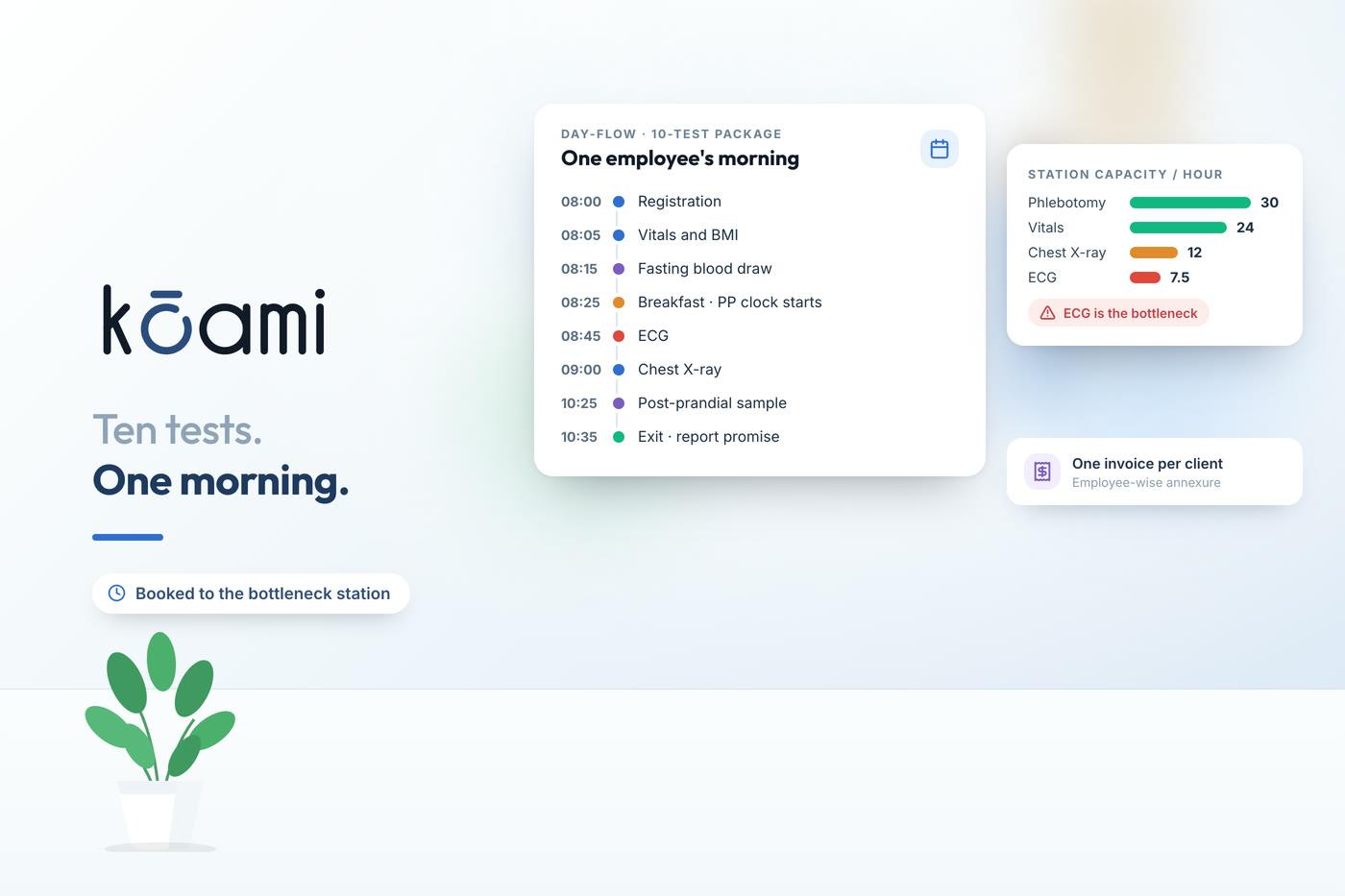
- 08:00, registration (target 5 minutes): employee ID checked against the list the company uploaded, package applied automatically, no payment at the counter for credit clients
- 08:05, vitals and measurements: height, weight, BMI and blood pressure by the nurse, recorded straight into the record
- 08:15, fasting blood draw: one venepuncture for CBC, fasting sugar, HbA1c, lipid profile, liver and kidney tests; urine container handed over with instructions
- 08:25, breakfast: a standard meal, with the meal start time recorded in the system, which sets the due time for the post-prandial sample
- 08:45, ECG: in a room close to the waiting area, so nobody walks across floors
- 09:00, chest X-ray: with the radiology department's usual safety screening questions before the exposure
- 09:15 to 10:20, the waiting window: the gap most packages waste; use it for the health questionnaire, any add-on consultations the client has bought, or simply a comfortable lounge with a visible queue screen
- 10:25, post-prandial sample: drawn at the due time the system calculated, with an alert to phlebotomy five minutes before
- 10:35, exit: confirmation of when and how the report will arrive, and the follow-up consultation slot if the package includes one
- Same day or next day: physician review of the compiled results, then report release
The whole visit hangs on the meal time. If registration is slow and breakfast starts at 08:50 instead of 08:25, every later step moves, and the employee who planned to be at work by 11 is not. That is why registration and the fasting draw are the two steps worth over-staffing.
Station capacity maths (illustrative)
Before you accept a booking of 40 people in one morning, check each station:
- Station capacity per hour = (60 / minutes per person) x number of rooms or chairs
- Phlebotomy: 4 minutes per person, 2 chairs, so 30 people an hour
- Vitals: 5 minutes per person, 2 nurses, so 24 people an hour
- ECG: 8 minutes per person, 1 machine, so 7.5 people an hour
- Chest X-ray: 5 minutes per person, 1 room, so 12 people an hour
The ECG room is the bottleneck. Forty people at 7.5 an hour need more than five hours, while fasting draws and breakfasts all need to happen in roughly the first two hours. Either add a second ECG machine and technician for camp days, split the group across two mornings, or stagger arrivals at 8-minute intervals for the ECG-limited group. The formula is simple, and running it before confirming dates prevents the worst camp days.
Patient flow problems in a check-up wing look a lot like OPD queue problems, and the same fixes apply. See our piece on OPD queues for how to make waiting visible.
Booking and scheduling without spreadsheets
The spreadsheet problem is not the spreadsheet itself. It is that the company's list, the front desk's list, the lab's worklist and billing's list are four copies that drift apart by 9am. One source of truth fixes most of it.
- Step 1: the company uploads its employee list (name, employee ID, mobile number, gender, date of birth, location) once, in a fixed format
- Step 2: each employee is registered against the corporate account and the package, so the same identity follows them through every station
- Step 3: slots are allocated by the capacity of the bottleneck station, not by the size of the reception hall
- Step 4: confirmations and reminders go from the system, and no-shows are marked at the end of the morning, not reconstructed at billing time
- Step 5: each station sees its own worklist, with what is pending for which employee
Employee lists and health results are personal data. Agree in writing with the client what the employer will receive. A common approach is that individual reports go only to the employee, while the employer receives attendance and aggregated, de-identified findings unless the employee has clearly agreed otherwise. Review that arrangement with your privacy counsel. Our article on the DPDP Act for hospitals explains the wider obligations.
Compiling one report, not five
Employees remember a check-up by its report. A compiled report should arrive once, complete, and readable.
- Pull lab results, the ECG tracing, the radiologist's X-ray report, vitals and the physician's summary into one document
- Hold release until every component is verified and signed, and show the operations team which components are pending for which employee
- Highlight values outside the reference range for the physician, and follow your laboratory's existing critical-value protocol for anything urgent
- Deliver through a secure link or patient portal, with the same report available to the hospital's doctors at the next visit
In Kōami, the check-up package is designed to run as a single order across the laboratory information system, radiology and the EMR, so the compiled report is assembled from results that are already linked to the same patient and the same visit, and the pending list is visible to operations before anyone calls the employee.
Corporate invoicing that the client's finance team accepts
Corporate receivables slow down for avoidable reasons: invoices without PO numbers, names that do not match the client's list, no-shows billed by mistake, and add-ons charged to the company that the employee was meant to pay.
- One consolidated invoice per client per billing period, with an employee-wise annexure (employee ID, name, date, package, add-ons)
- PO or work order number and rate contract reference on every invoice
- No-shows excluded unless the contract says otherwise
- Add-ons chosen by the employee billed to the employee at the counter, not to the company
- Invoice raised within a fixed number of days of the camp, and tracked in the receivables ageing until paid
On GST, entry 74 of Notification 12/2017-Central Tax (Rate) exempts health care services by a clinical establishment, and clause 2(zg) defines health care services around diagnosis, treatment or care for illness, injury, deformity, abnormality or pregnancy. If a wellness package bundles non-clinical items such as fitness sessions or merchandise, confirm their tax treatment with your CA. This is general information, not tax advice.
Follow-up: continuity of care, done ethically
A check-up that finds a raised HbA1c and ends there has done half its job. The follow-up should be about care, offered clearly and never pushed.
- Flagged results are reviewed by the physician, who decides whether a follow-up consultation is advised
- The employee is told what was found and offered an appointment, with consent recorded for any reminder calls or messages
- The hospital tracks how many flagged employees actually saw a doctor within 30 days
- Next year's camp pulls last year's results, so trends are visible to the employee and their doctor
KPIs for the wellness desk
- Show-up rate: employees attended / employees booked
- Time in facility: median minutes from registration to exit
- Post-prandial on time: second samples drawn within 10 minutes of the due time / all second samples
- Report turnaround: median hours from visit to complete report release
- Report completeness: reports released with all components / reports released
- Camp-to-invoice days: days from camp date to invoice issued
- Corporate receivable days: average days from invoice to payment, by client
- Follow-up uptake: flagged employees who saw a doctor within 30 days / flagged employees
Review these with each client at renewal time. A client who sees a median time in facility of two and a half hours and reports in 24 hours has a concrete reason to sign again.
If you want to see how a check-up package can run as one order across registration, lab, radiology, reports and corporate billing, we can walk you through it on synthetic data. Book a demo: koami.in/book-demo
Frequently asked questions
- What is the main bottleneck in a health check-up day?
- Usually it is the slowest single station, often ECG or imaging, multiplied by the number of people booked in the fasting window. Calculate each station's hourly capacity and set the number of daily slots from the lowest one.
- Why do post-prandial samples cause so many delays?
- The post-prandial draw is tied to a clock that starts when the person eats, so every minute of delay before the meal pushes the whole visit later. Record the meal time in the system and let it calculate the due time for the second sample.
- Are corporate health check-ups exempt from GST?
- Entry 74 of Notification 12/2017-Central Tax (Rate) exempts health care services by a clinical establishment, and the definition covers diagnosis, treatment or care. Non-clinical add-ons bundled into a wellness package may be treated differently, so confirm the treatment of each item with your CA.
- Should the employer receive each employee's report?
- Agree this in writing with the client before the first camp. A common approach is that individual reports go only to the employee, and the employer receives attendance and aggregated, de-identified findings unless the employee has clearly agreed otherwise; check the arrangement with your privacy counsel.
- Which KPIs matter for a corporate wellness programme?
- Show-up rate, average time in the facility, post-prandial samples drawn on time, report turnaround and completeness, days from camp to invoice, corporate receivable days, and the share of flagged employees who saw a doctor for follow-up.
Sources
- Occupational Safety, Health and Working Conditions (OSH) Code, 2020: explainer, PIB, 22 November 2025
- Bill Summary: Occupational Safety, Health and Working Conditions Code, 2020, PRS Legislative Research
- Advance Ruling (Karnataka) in Sayre Therapeutics, reproducing entry 74 and clause 2(zg) of Notification 12/2017-Central Tax (Rate), GST Council
Follow Kōami on LinkedIn
Get the next guide on hospital operations, software and compliance in your feed, as soon as it is published.