Cutting the OPD Wait with Token and Queue
Published
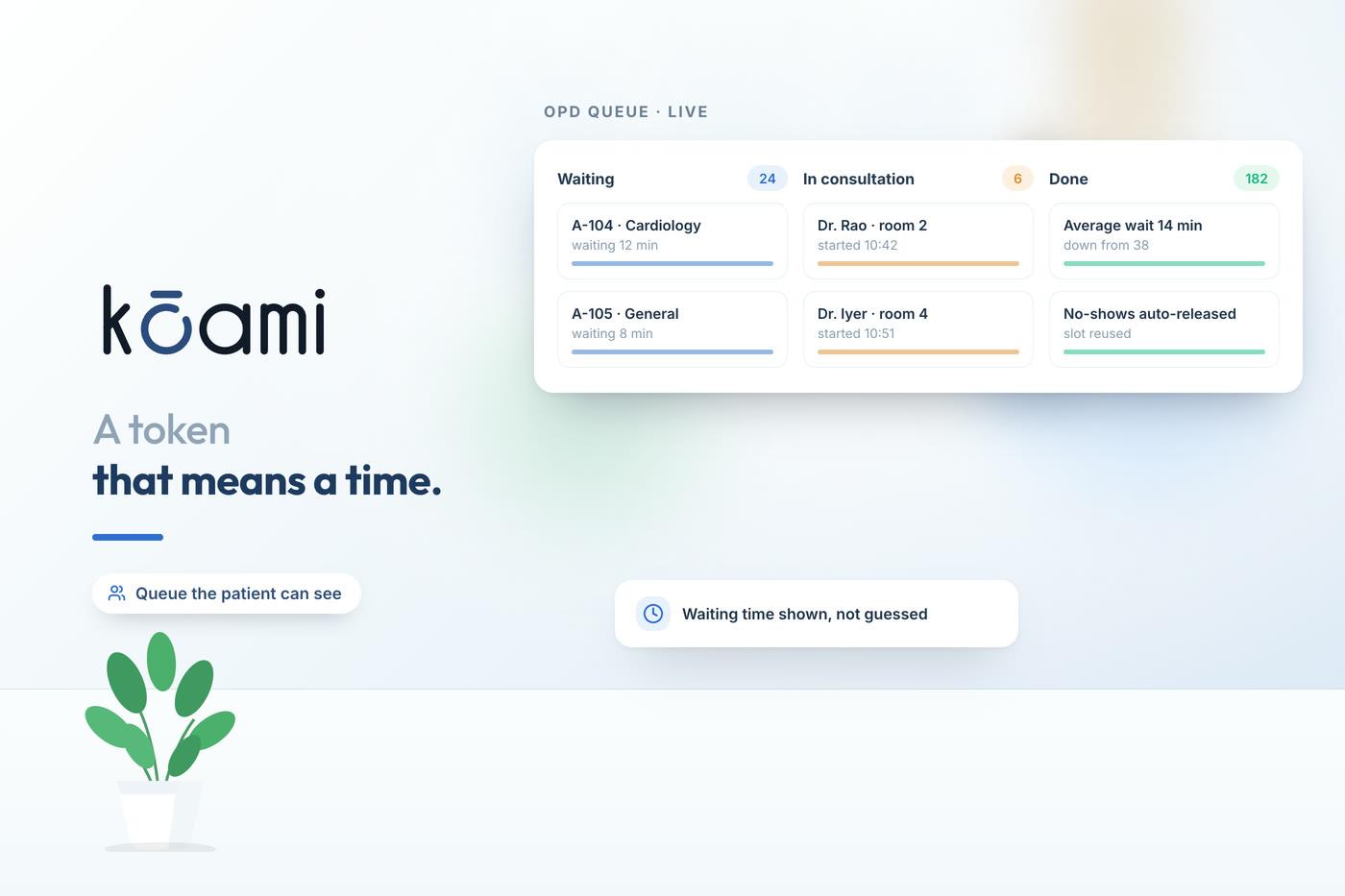
Ask any hospital administrator where the day starts to go wrong, and most will point at the same place: the OPD. The consultation itself might take eight minutes, but the patient has already spent ninety in a corridor, unsure whether they have been forgotten, whether they missed their name being called, whether the person who arrived after them is somehow ahead. The waiting is not just uncomfortable. It shapes how the patient rates the entire visit, and it quietly burns through front-desk goodwill all morning. A token and queue system does not make doctors faster. What it does is make the wait legible, fair, and predictable - and that turns out to matter almost as much as speed.
What actually creates the queue
Most OPD congestion is not a doctor problem. It is a flow problem, and it usually comes from a handful of concrete causes that stack on top of each other:
- Registration and consultation share the same physical line, so new patients and follow-ups fight for the same counter.
- Appointments are booked but walk-ins are also accepted, and the two streams are never reconciled at the point of care.
- A doctor runs late by twenty minutes at 9 a.m., and because nothing rebalances the load, that twenty minutes is still there at 1 p.m.
- Patients have no signal about their position, so they crowd the door of every room to avoid missing a call.
When you name the causes plainly, the fix stops being "hire more staff" and becomes "design the flow." A token is just the first step of that design: a stable identity in the queue that the patient can trust.
Tokens that carry context, not just numbers
A paper token with a printed number solves one problem - order - and nothing else. A digital OPD token in Kōami carries context. It knows whether the patient is a new registration or a scheduled follow-up, which doctor and which department they are waiting for, and roughly where they sit in that specific queue. That context is what lets you do the interesting things.
You can run parallel queues per doctor instead of one giant line, so a busy cardiologist's backlog does not stall the dermatology patients. You can weight the queue so that a booked appointment holds priority over a walk-in who arrived at the same minute, which is the only fair way to honour appointments at all. And you can hold a token in a "called but not arrived" state for a short grace period, then cycle to the next patient without losing the first one entirely.
A good queue is not the shortest one. It is the one where every patient can see that the rules are the same for everybody.
The display board and the patient's phone show the same token state, so the corridor empties out. People stop hovering at the door because they can watch their number advance from a bench, or from the pharmacy, or from the café downstairs.
Giving the front desk a live picture
The counter staff need a different view from the patient. They need to see the whole floor: which doctors are running behind, which rooms have gone quiet, how many walk-ins are still unassigned, and where a bottleneck is forming before it becomes a crowd. Kōami puts that on one screen.
When a consultant is thirty minutes behind, the supervisor can see it at a glance and act - open a second room, redirect a few follow-ups to a colleague, or simply reset expectations with the people waiting. That last option is underrated. A patient told honestly that the wait is now forty minutes, and given the freedom to step away, is far calmer than one left guessing. The system supports that by pushing a status update to the patient's phone when their token moves into the next band.
Reassignment matters too. If a doctor is called into an emergency, the affected tokens should not evaporate. They should shift, as a group, to another available consultant or to a clearly communicated hold, with the patients notified rather than surprised.
Measuring the wait so you can shrink it
You cannot improve a wait you do not measure. Every token generates timestamps almost for free: when it was issued, when the patient was called, when the consultation started, when it closed. From those, real numbers fall out - average time to first call, the gap between appointment time and actual start, turnaround per department, and the shape of the morning peak.
Those numbers change decisions. If registration is the choke point, you add a counter at 9 a.m. rather than at 11. If one clinic consistently overbooks, you cap its slots. If the peak is always 10 to 11:30, you stagger appointment blocks to flatten it. Kōami keeps this history so the OPD manager is tuning against evidence instead of yesterday's argument.
- Time-to-first-call tells you if registration and triage are keeping up.
- Appointment-to-start delay tells you whether your booking model is honest.
- Per-doctor turnaround tells you where to rebalance load.
- No-show and grace-period cycling rates tell you how much slack to build in.
Over a few weeks these metrics stop being a report and start being a habit. The floor supervisor reads them the way a shift nurse reads vitals.
Closing the loop with the rest of the visit
The queue does not end when the patient sees the doctor. A consultation usually spawns a lab order, a pharmacy pickup, a follow-up booking, or a billing step, and each of those is its own small queue. When the token flows through to those stations, the patient is not starting from zero each time. Their lab request is already waiting when they reach the collection counter; pharmacy can see the prescription before they arrive. Because Kōami connects OPD, orders, and billing in one ecosystem, the token becomes a thread that runs through the whole visit rather than a slip that gets thrown away at the consulting-room door.
Cutting the OPD wait is rarely one dramatic change. It is a token that carries context, a fair queue the patient can watch, a live floor view for staff, and a steady diet of timing data that tells you where to push. Do those four things well and the corridor stops being the worst part of the visit - and the eight-minute consultation finally gets to be the point of the morning.
Follow Kōami on LinkedIn
Get the next guide on hospital operations, software and compliance in your feed, as soon as it is published.