Teleconsultation in India: What the Guidelines Ask of Your Software
Published
A consultant takes a follow-up call on a Sunday evening. The patient describes a rash, sends two photographs on WhatsApp, and asks whether the medicine should continue. The consultant says yes, adds a second drug, and types the dose into the chat. It takes four minutes and it is good medicine. It is also, as a record, almost nothing: no identity check that anyone could later verify, no consent, no note in the chart, and a prescription that exists only in a message thread on two phones.
Nobody set out to practise badly. The consultation simply happened somewhere the hospital's systems were not.
Is teleconsultation legal in India, and under what rules?
Yes. Telemedicine has been formally permitted since the Telemedicine Practice Guidelines were issued in 2020, and they remain the operative framework.
The essentials, in the form they matter to a hospital:
- Only practitioners registered with the National Medical Commission or a State Medical Council may consult.
- The same professional standards apply as in person. A teleconsultation is a consultation, not a lesser thing.
- The practitioner must identify the patient and be identifiable themselves.
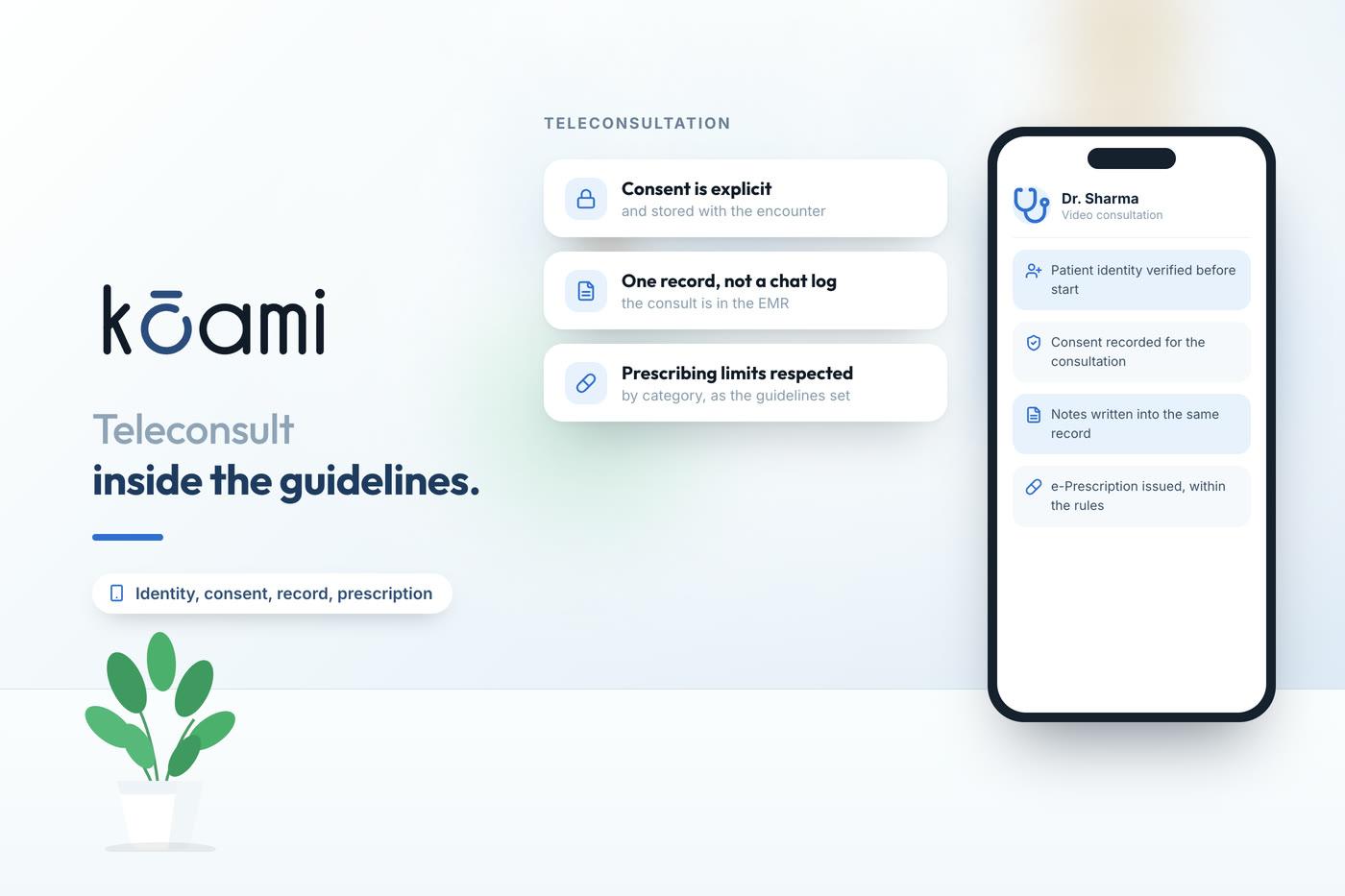
- Patient consent is required, and in many situations it is implied by the patient initiating the consultation — but it must be recorded.
- The practitioner exercises professional judgement on whether the case can be handled remotely at all, and must decline when a physical examination is essential.
- Records must be maintained as for any other consultation.
Read the guidelines themselves rather than a summary, including any subsequent clarifications, since they interact with medical council conduct rules and with state-level requirements.
What can and cannot be prescribed remotely?
Most medicines can be prescribed after a teleconsultation, with defined exclusions that the software should enforce rather than leave to memory.
The exclusions are the part worth building into the system: drugs listed in Schedule X of the Drugs and Cosmetics Rules, and substances under the Narcotic Drugs and Psychotropic Substances Act, are outside the scope of a teleconsultation prescription. The guidelines also distinguish between what may be prescribed on a first remote consultation and what is appropriate on follow-up.
A prescribing screen that knows which drugs are restricted, and refuses rather than warns, converts a rule somebody has to remember into a rule the system keeps. That matters most on a Sunday evening, which is exactly when nobody is checking.
What the record has to contain
A teleconsultation record should be indistinguishable in completeness from an in-person one, and it needs three things the in-person visit gets for free.
- Identity. Who the patient was, and how you established it. In person this is the person standing there; remotely it is a deliberate step that has to be recorded.
- Mode and consent. Whether it was video, audio or text, and that the patient consented, captured at the time rather than reconstructed.
- The clinical content itself. History, assessment, advice, prescription, and the decision about whether remote management was appropriate.
Anything shared during the consultation — photographs, reports, previous prescriptions — belongs in the record, attached to the encounter. This is the single largest gap in practice. Images sent over a messaging app are clinical data sitting on two personal phones, outside the record, outside your access controls and outside any retention policy. Under data protection law they are also personal data your hospital is responsible for and cannot account for.
If the consultation happened on a platform your hospital does not control, then clinically it happened and administratively it did not.
Why the messaging-app habit is hard to break
It persists because it is faster than anything the hospital has offered instead, and that is a design problem rather than a discipline problem.
Any replacement has to beat a chat window on effort. In practice that means the consultation opens from the patient's existing record rather than as a separate application, the previous encounter is visible without searching, images attach in one action, the prescription generates from the same screen and reaches the patient without being retyped, and the whole thing works on a phone on a weak connection.
If the compliant route takes ninety seconds longer than the non-compliant one, clinicians will use the fast one, and no policy will change that. The hospitals that have moved teleconsultation into their systems did it by making the system faster, not by circulating a memo.
Where the money and the identity go
A teleconsultation that is not billed and not registered is a patient interaction your hospital has no record of.
The workflow needs the same skeleton as an OPD visit: the patient is identified against their existing UMR so the encounter joins their history, payment is handled before or at the consultation, the encounter is recorded as an encounter, and a follow-up can be booked from it. Hospitals that bolt a video tool onto the side end up with a parallel stream of clinical activity that never reaches the patient record or the revenue cycle, and they usually discover it when someone asks how many teleconsultations were done last month.
Where teleconsultation is offered under a scheme or an insurer's programme, the documentation standard is the payer's, not the platform's — another reason for the encounter to live in the hospital's system rather than in a vendor's dashboard.
Data protection applies with full force
A remote consultation generates the same category of personal data as an in-person one, plus a recording risk that does not exist in a consulting room.
Decide in advance whether consultations are recorded at all, and if they are, on what basis, for how long, who can access them, and how the patient is told. A recording made for clinical reasons and kept indefinitely on a cloud service in a jurisdiction nobody has checked is a liability accumulating quietly.
The rest is the ordinary discipline: encrypted in transit and at rest, access limited to the care relationship, read access logged as well as writes, and a contract with the platform vendor that says what they may do with what passes through them.
A short readiness check
- Can a clinician start a teleconsultation from the patient's existing record, in one action?
- Does the system record identity verification, mode and consent, without extra typing?
- Do restricted drug categories get blocked at prescribing, not flagged in a policy document?
- Do images and reports shared during the consultation land in the record automatically?
- Does the prescription reach the patient from the system, rather than being retyped into a chat?
- Is the encounter billed and counted like any other?
- Do you know where recordings, if any, are stored and for how long?
Teleconsultation is not a separate product a hospital buys. It is a consultation that happens over a wire, and everything that makes an in-person consultation a proper clinical event applies to it unchanged.
Follow Kōami on LinkedIn
Get the next guide on hospital operations, software and compliance in your feed, as soon as it is published.