Nurse-Patient Ratio Planning: From Census to Roster
Published
Every nursing superintendent has had this conversation with the CFO. You ask for twelve more staff nurses. The CFO asks why, since the hospital already has 110 nurses for 120 beds, which sounds like almost one each. The honest answer is that 110 nurses on the payroll might mean 28 on the floor at 3 am, once you account for three shifts, weekly offs, leave and the nurse who is in a training session. This article gives you a calculator that turns census into a defensible headcount, and the headcount into a roster.
Reference norms, and where they actually come from
Before any arithmetic, be clear about which numbers are rules and which are references. Indian nursing ratios are quoted loosely, often without a source, and that weakens your case in a budget meeting.
- IPHS 2022 (Ministry of Health and Family Welfare): For district and sub-district hospitals, section 7.2.3 states that, as per Indian Nursing Council regulations, there should be one nurse for every six beds on general wards, 1:1 for ICU and 1:2 for HDU, with 1:3 for SNCU and 1:2 for NICU, PICU and paediatric HDU. It applies these considering an 8-hour shift, so nurses are needed across three shifts to cover 24 hours.
- IPHS 2022 on leave: It states that IPHS has not calculated leave reserves, that states may set their own, and it recommends leave and training reserves of 15% or as per state rule.
- IPHS 2022 on OT and emergency: Two nurses per OT shift, six for a theatre running 24x7, plus fixed nurses for triage, paediatric and isolation areas and at least two each for the red, yellow and green zones in emergency, across three shifts.
- NABH 6th edition (effective 1 January 2025): HRM.1 requires that the organisation maintains an adequate number and mix of staff to meet patient needs, and has contingency plans for long and short-term shortages. The indicator annexure lists the nurse-patient ratio for ICUs and wards as a measured indicator: calculated separately for ICUs and wards, for each shift, without counting the in-charge, and preferably split into ventilated and non-ventilated patients in the ICU.
- Indian Nursing Council: INC's current guidelines for B.Sc. nursing colleges say nursing staffing in the parent and affiliated hospitals should be as per Staff Inspection Unit (SIU) norms. They do not set out a separate ratio table of their own.
You will also see figures such as "1:3 in teaching hospitals" described as INC norms in training material. We could not trace a current INC publication that prescribes them, so do not put them in a board note without the original document in hand.
These are reference norms for planning and benchmarking. They are not a single binding standard for private hospitals, and your state, scheme empanelment and accreditation requirements may differ.
The calculator, step by step
The method below is a workload method, the same family of thinking as WHO's Workload Indicators of Staffing Need (WISN). It works in nurse-hours rather than ratios, so it handles different shift patterns and ward types in one sheet.
- Step 1, census by ward type: For each unit, take average occupied beds (beds x occupancy), or beds kept open, for ICU-type units where you staff to capacity.
- Step 2, nurse-hours per patient-day (NHPPD): Set a figure per ward type. A 1:6 ratio on 8-hour shifts equals 24 / 6 = 4.0 NHPPD. HDU at 1:2 equals 12.0. ICU at 1:1 equals 24.0.
- Step 3, required nurse-hours per day: Census x NHPPD, per unit.
- Step 4, shift posts per day: Required nurse-hours / shift length. Add fixed posts that do not move with census, such as emergency zones and OT teams.
- Step 5, annual hours required: Daily shift posts x shift length x days the post runs in a year (365 for 24x7 units).
- Step 6, productive hours per nurse: (365 - weekly offs - earned leave - casual and sick leave - public holidays - training days) x shift length.
- Step 7, FTE: Annual hours required / productive hours per nurse. Round up per unit, not at the end.
- Step 8, relief factor (a check): 365 / productive days. Multiply shift posts by this to sanity-check Step 7.
The supervisory layer (ward in-charges, nursing supervisors) sits outside this calculation, because NABH's indicator excludes the in-charge from the ratio. Add those posts separately.
A worked example: 120 beds (illustrative)
The numbers below are illustrative. Replace every input with your own census, ratios and HR policy.
Inputs
- General wards: 90 beds at 80% occupancy = 72 patients, planned at 1:6 per shift (4.0 NHPPD)
- HDU: 10 beds at 80% occupancy = 8 patients, at 1:2 (12.0 NHPPD)
- ICU: 10 beds at 90% occupancy = 9 patients, at 1:1 (24.0 NHPPD)
- Emergency: 3 fixed posts per shift, 24x7
- OT: 3 theatres, one day shift, 2 nurses each, 6 days a week
- In-charges: 6 units (three general wards, HDU, ICU, emergency), one in-charge each on the day shift, 6 days a week
- Shift length: 8 hours, three shifts
- Unavailable days per nurse per year: 52 weekly offs, 15 earned leave, 12 casual and sick, 10 public holidays, 5 training days
Calculation
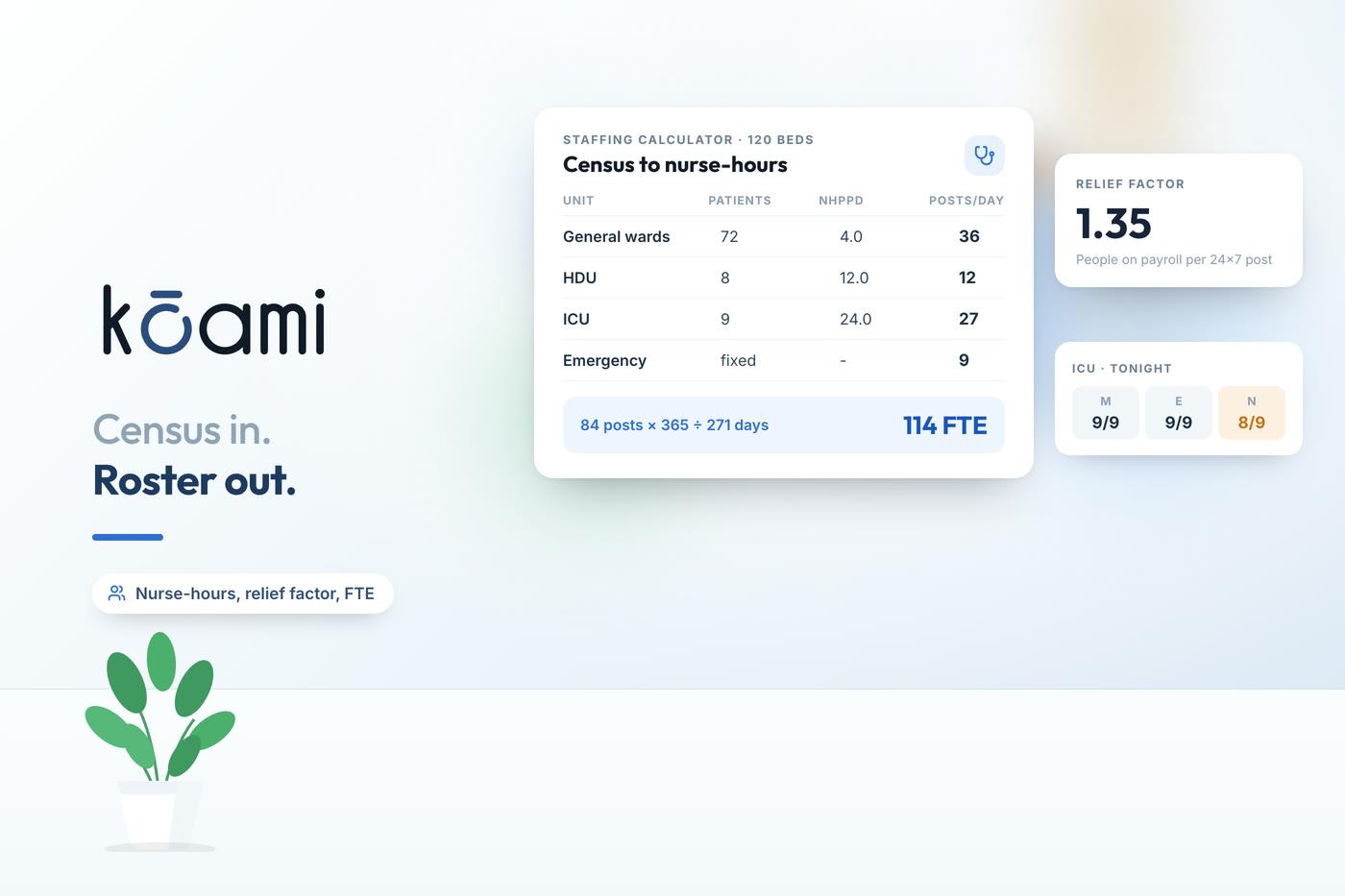
- General wards: 72 x 4.0 = 288 nurse-hours a day, / 8 = 36 shift posts (12 per shift)
- HDU: 8 x 12.0 = 96 nurse-hours, = 12 shift posts (4 per shift)
- ICU: 9 x 24.0 = 216 nurse-hours, = 27 shift posts (9 per shift)
- Emergency: 3 x 3 = 9 shift posts
- Total 24x7 posts: 36 + 12 + 27 + 9 = 84 shift posts a day, or 28 nurses on duty in each shift
- Annual shifts required: 84 x 365 = 30,660
- Productive days per nurse: 365 - 52 - 15 - 12 - 10 - 5 = 271
- 24x7 FTE: 30,660 / 271 = 113.1, round up to 114
- OT FTE: 6 posts x 6 days x 52 weeks = 1,872 shifts / 271 = 6.9, round up to 7
- In-charge FTE: 6 posts x 6 days x 52 weeks = 1,872 / 271 = 6.9, round up to 7
- Total: 114 + 7 + 7 = 128 nurses, before the nursing superintendent, supervisors and any float pool
The relief factor here is 365 / 271 = 1.35. In plain words: every 24x7 post on your roster needs about 1.35 people on the payroll. That is why 110 nurses for 120 beds can still feel short.
Sensitivity worth showing the CFO
- Each extra day of leave or absence per nurse per year adds about 0.4 FTE to the 24x7 requirement in this example (30,660 / 270 = 113.6 against 113.1).
- Running the ICU to all 10 beds instead of 9 occupied adds 3 shift posts a day, which is about 4 FTE.
- Moving general wards from 1:6 to 1:5 at night only adds 72 / 5 - 72 / 6 = 2.4 posts on that shift, or 2.4 x 365 / 271 = about 3 FTE.
Why the reserve percentage confuses everyone
IPHS recommends a 15% leave and training reserve. The example above implies 35%. Both can be right, because they cover different things. If weekly offs are already built into how posts are counted, the reserve only has to cover leave and training. If posts are counted as "nurses on duty per shift", the reserve also has to cover the weekly off, which alone is 7 / 6 = 1.17 for a six-day week.
So never compare two reserve percentages without asking what each one covers. Compute productive days from your own leave policy and let the relief factor fall out of it.
Hours, weekly offs and overtime
The arithmetic also has to fit labour law. Where the Occupational Safety, Health and Working Conditions Code, 2020 applies to your staff, section 25 caps work at eight hours a day, with intervals and spread-overs as notified by the appropriate Government, and section 26 limits work to six days a week. Section 27 requires overtime wages at twice the ordinary rate, with the worker's consent. Section 32 sets a statutory floor for annual leave with wages of one day for every 20 days worked, for workers who have worked 180 days or more in the year. Many hospitals give more; use your actual policy in Step 6.
If you run 12-hour shifts, check how your state's rules treat them before you build a roster around them. This is general information, not legal advice; confirm with your HR counsel or labour consultant.
Matching the roster to demand
The FTE number is a budget. The roster is where it either works or does not. A few practical rules:
- Use the census pattern, not the average. Pull census by day of week and by shift for the last 12 weeks. Mondays and post-holiday days often run higher; Sunday nights often run lower. Our piece on occupancy forecasting covers how to read that pattern.
- Weight the morning shift. Medication rounds, consultant rounds, investigations, admissions and discharges cluster between 8 am and 2 pm. Many hospitals put more nurses on the morning shift than the night shift on the same ward, then check the ratio per shift against the NABH indicator.
- Plan acuity, not just headcount. A general ward with three post-operative day-one patients needs more than its NHPPD says. Keep a simple acuity flag per patient and let the charge nurse move one nurse between wards with a documented reason.
- Build a float pool. Two to four cross-trained nurses per shift absorb sick leave and admissions surges more cheaply than overtime. Size it from your historical unplanned absence rate.
- Protect skill mix. An ICU shift with four nurses all in their first year meets the ratio and still fails the patient. Tag ICU-competent, ventilator-trained and paediatric-trained nurses, and make the roster check for at least one per shift. See how shift swaps can preserve that mix instead of quietly breaking it.
Monthly review routine
- Compare planned shift posts with actual nurses on duty, per unit and per shift, using attendance rather than the published roster.
- Report the NABH nurse-patient ratio indicator separately for ICUs and wards, per shift, excluding in-charges.
- Track overtime hours, agency or temporary staff shifts, unplanned absence days and vacancy count against the FTE plan.
- Revisit NHPPD for any unit whose acuity has changed, such as a ward that now takes step-down cardiac patients.
The broader nursing shortage means many hospitals will not reach their calculated number quickly. That makes the calculation more useful, not less: it shows which units are running below plan, by how much, and what each vacancy costs in overtime.
Where software helps
A spreadsheet can do the calculation once a year. The hard part is keeping it alive: census changes daily, leave is approved in one system, attendance is captured in another and the roster sits on a notice board. Kōami is designed so that the bed board, the roster and attendance share one record, and the planned versus actual ratio per shift comes from the same data the ward actually ran on. You can see how the scheduling side works on our nurse scheduling software page.
Whatever tool you use, take the calculator above, put your own inputs in, and walk into the next budget meeting with nurse-hours, relief factor and a per-shift ratio instead of a headcount request. If you would like to see the census-to-roster flow on synthetic data, we are happy to walk you through it. Book a demo: koami.in/book-demo
Frequently asked questions
- What is the nurse to bed ratio for ICU and general wards in India?
- IPHS 2022, citing Indian Nursing Council regulations, uses one nurse for every six general ward beds, 1:1 for ICU and 1:2 for HDU, applied per 8-hour shift. These are reference norms for public hospitals; private hospitals should check their state rules, insurer or scheme empanelment conditions and accreditation body requirements.
- Does NABH prescribe a fixed nurse-patient ratio?
- The NABH 6th edition standard HRM.1 requires an adequate number and mix of staff to meet patient needs, and its indicator list asks hospitals to measure the nurse-patient ratio for ICUs and wards separately, for each shift, excluding the in-charge. It leaves the target ratio to the hospital to justify.
- What is a nursing relief factor?
- It is the multiplier that converts shift posts into people, so that weekly offs, leave, holidays and training are covered. It equals the days a post must be filled in a year divided by the days one nurse is actually available, in this article's illustrative example it comes to 1.35 for a 24x7 post, and your own figure depends on your leave policy.
- Should we staff the ICU to occupied beds or to total beds?
- Many hospitals staff the ICU to the beds they keep open for admission, not to the average census, because a single unplanned admission at 2 am cannot wait for a nurse to be called in. The calculator lets you choose either input; be explicit about which one you used.
- How often should a nursing staffing plan be recalculated?
- Recalculate the full FTE number at least once a year at budget time and whenever beds, services or leave policy change. Re-check the shift-level roster monthly against actual census and acuity.
Sources
- Indian Public Health Standards 2022, Volume I: Sub District and District Hospital (MoHFW), section 7.2.3 Nurses
- NABH Accreditation Standards for Hospitals, 6th Edition (effective 1 Jan 2025): HRM.1 and KPI annexure
- Indian Nursing Council: Guidelines and Minimum Requirements to Establish B.Sc. (N) College of Nursing
- The Occupational Safety, Health and Working Conditions Code, 2020 (Gazette of India), sections 25 to 27 and 32
- WHO: Workload Indicators of Staffing Need (WISN) User's Manual
Follow Kōami on LinkedIn
Get the next guide on hospital operations, software and compliance in your feed, as soon as it is published.