Forecasting Bed Occupancy 48 Hours Out
Published
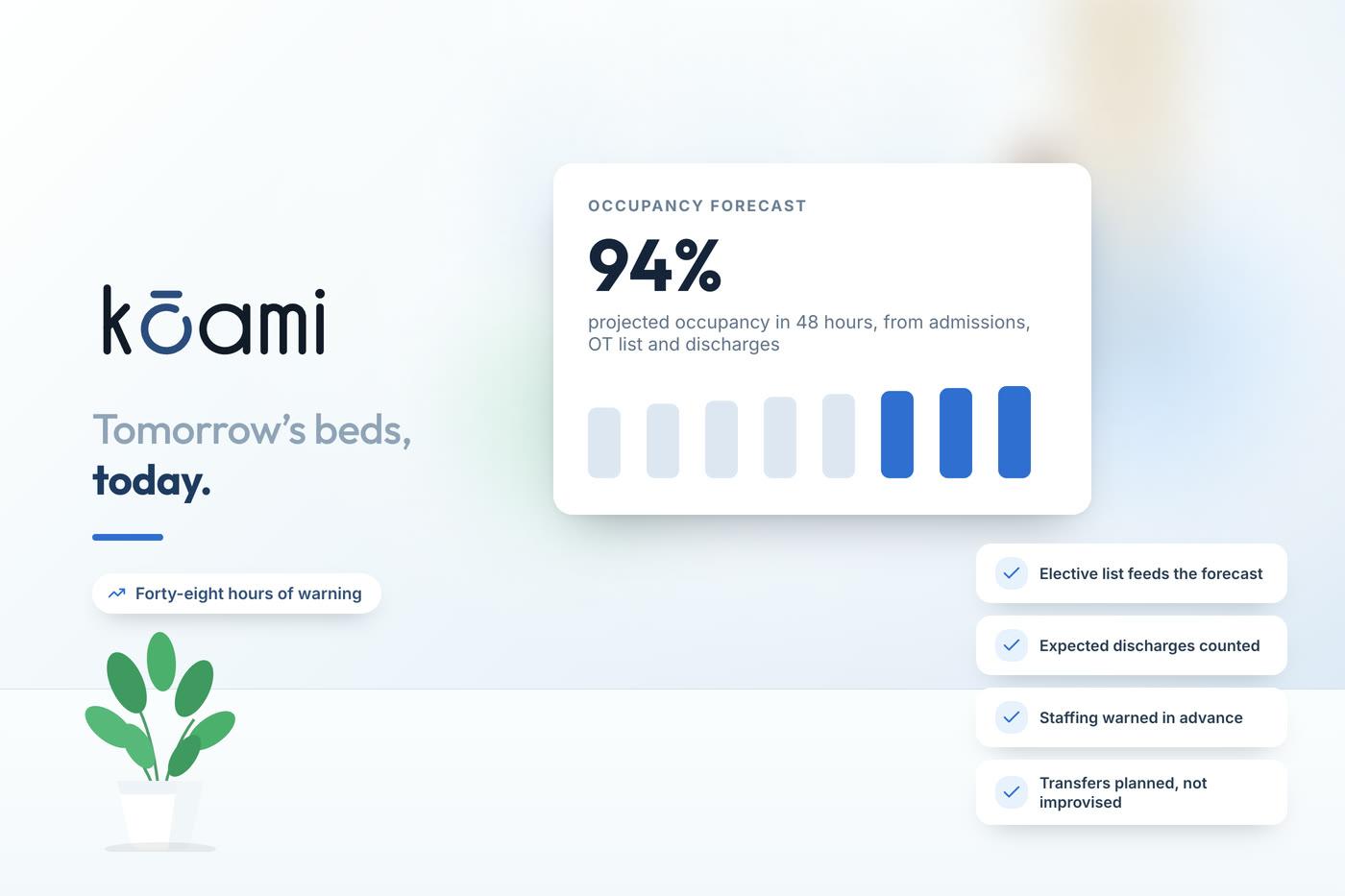
The bed manager's job is a forecasting job that nobody calls forecasting. Every afternoon someone in a hospital is trying to answer a question about tomorrow: will we have a bed for the elective admissions we promised, or are we about to spend the evening boarding patients in the emergency department corridor. They answer it with a whiteboard, a phone, and thirty years of instinct. Instinct is remarkable, and it is also unevenly distributed, unavailable at 3am, and impossible to hand over at a shift change. A 48-hour occupancy forecast is an attempt to write that instinct down.
Occupancy Is Two Flows, Not One Number
The mistake is to treat occupancy as a single figure - beds full, beds empty. It is really the balance of two independent flows, and forecasting each one separately is what makes the whole thing tractable. Admissions add to the ward. Discharges subtract from it. The occupancy in 48 hours is simply today's census plus the admissions you expect minus the discharges you expect, and the art is in estimating each side honestly.
- Predictable admissions - the elective surgical list, scheduled transfers, booked procedures - which you largely know in advance and can read straight off the schedule.
- Unpredictable admissions - emergency presentations that convert to inpatient - which are genuinely stochastic but follow strong day-of-week and seasonal patterns you can learn from history.
- Expected discharges - which is where length-of-stay modelling does the heavy lifting, because a patient admitted three days ago for a condition with a typical stay of four days is probably leaving tomorrow.
Kōami models these flows separately and recombines them, so a bed manager sees not just a predicted number but where that number comes from.
Length of Stay Is the Engine
If you can predict when patients will leave, you can predict occupancy, because the admissions side is comparatively easy. That makes length-of-stay estimation the engine of the whole forecast. A patient is not an average; a patient is a case with a diagnosis, an age, a set of comorbidities, and a procedure, and each of those shifts the expected discharge date.
The useful output is not a single predicted day but a distribution, because certainty here is false comfort. A post-operative patient recovering normally has a tight, predictable stay. An elderly patient admitted with a chest infection and three comorbidities has a wide, uncertain one. A forecast that pretends both are equally knowable will mislead you exactly when it matters. So the model should express its own confidence, and the bed manager should see it.
Predicting the average patient's discharge is easy and nearly useless. The forecast earns its keep on the patients whose stay is uncertain, by being honest about that uncertainty.
A Forecast You Cannot See Is a Forecast You Cannot Use
A number in a report that nobody opens changes no decisions. The occupancy forecast has to arrive where the bed manager already looks, at the time they are already deciding, and in a form they can act on. That is a design problem as much as a modelling one.
- Show occupancy by ward and by bed category, not just hospital-wide, because a full ICU and an empty general ward is not the same as a hospital that is half full.
- Highlight the crossing points - the projected hour at which a ward exceeds a safe threshold - so the warning arrives before the crisis, not during it.
- Make the levers visible. If the forecast says the surgical ward tips over tomorrow afternoon, the manager wants to know that pulling forward two discharges or delaying one elective case resolves it.
Kōami presents the 48-hour view as an operational board rather than a static report, so the forecast is a thing people act on during the morning huddle instead of a file they read after the fact.
The Forecast Has to Earn Trust, Then Keep It
Every predictive system in a hospital faces the same adoption problem. The first time the forecast is confidently wrong, the staff who were sceptical feel vindicated, and rebuilding that trust is slow. So you plan for the forecast to be wrong sometimes and you design for it.
- Compare predicted occupancy against what actually happened, every day, in the open, because a forecast whose accuracy nobody checks is just a rumour with a chart.
- Degrade gracefully. When data is thin - a new ward, an unusual case mix - the forecast should widen its bands and say so, not project false precision.
- Treat the model as decision-support that informs the bed manager's judgement, never as an autopilot that books and cancels admissions on its own. The human owns the decision; the forecast sharpens it.
Kōami is built to sit alongside the bed manager rather than replace them, surfacing the projection and its track record so the team can calibrate how much weight to give it.
A good 48-hour occupancy forecast does not eliminate the afternoon scramble on its own. What it does is move the conversation earlier and ground it in something more durable than one person's memory. Instead of discovering at 8pm that there is no bed, the team sees the pressure building at the morning huddle and has a full day to act - a discharge chased, an elective rescheduled, a transfer arranged. That head start, repeated every day, is the whole point. The forecast is not there to be clever. It is there to buy time.
Follow Kōami on LinkedIn
Get the next guide on hospital operations, software and compliance in your feed, as soon as it is published.