Forecasting Hospital Supply Pipelines
Published
A hospital pharmacy running out of a first-line antibiotic is not a spreadsheet problem. It is a clinician switching to a second choice, a patient staying an extra day, and a procurement officer making a panicked call to a distributor who now holds all the pricing power. Supply forecasting in a hospital is the discipline of making sure that call never has to happen. It is unglamorous, it is deeply operational, and it is where a surprising amount of money and clinical quality quietly leaks away when it is done by gut feel.
Why Hospital Demand Refuses to Behave
Retail demand forecasting has a comfortable assumption: sales are roughly stationary and seasonal in predictable ways. Hospital consumption breaks that assumption constantly. A single trauma admission can burn through a month of a particular suture size overnight. A dengue season triples IV fluid demand for six weeks and then vanishes. A new consultant joins and their preference for a specific implant reshapes an entire category.
So the first honest step is to segment your items by how they actually behave, because one model will not fit all of them:
- Steady movers - routine consumables like gloves and saline - where demand is high-volume and reasonably smooth, and simple statistical forecasting works well.
- Lumpy movers - specialised implants, less-common drugs - where demand is intermittent and a naive average badly overstocks you.
- Clinically critical items - emergency drugs, blood products - where the cost of a stockout is measured in patient harm, not rupees, and you deliberately hold more than pure math would suggest.
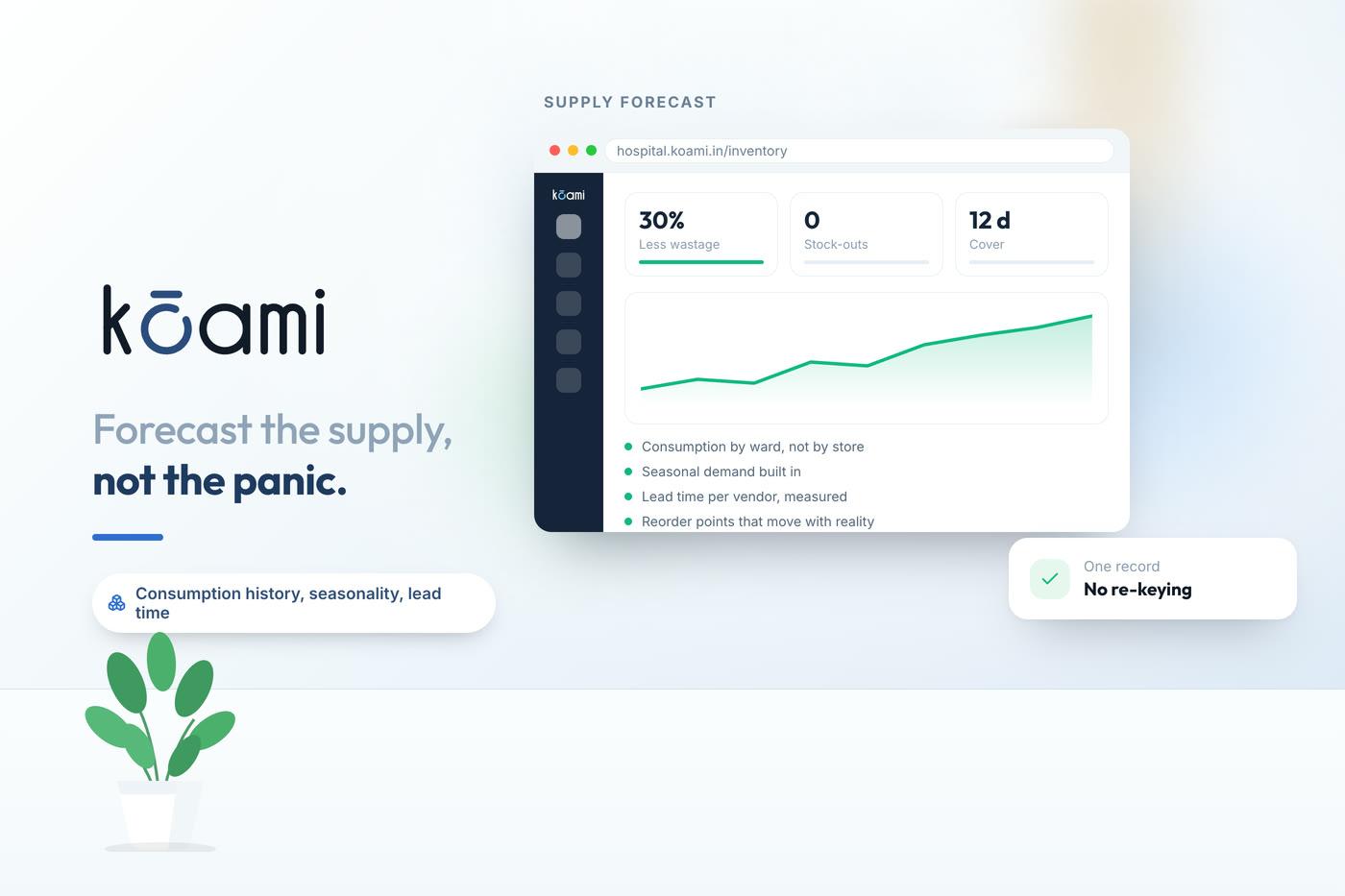
Kōami's inventory analytics classify items into these behaviours from consumption history rather than treating the whole formulary as one undifferentiated list.
The Reorder Point Is the Real Decision
Most of the value in supply forecasting collapses into one number per item: the reorder point, the stock level at which you place a new order. Set it too low and you stock out during the lead time. Set it too high and you tie up cash and shelf space in inventory that expires. The reorder point is not a guess; it is a calculation with three honest inputs.
- Average demand during the lead time - how much you expect to consume between placing an order and receiving it.
- Lead-time variability - because a supplier who quotes seven days but sometimes takes twenty is the real risk.
- Safety stock - the buffer sized to the demand variability and to how much you are willing to risk a stockout on that specific item.
The mistake labs and pharmacies make is using a single flat lead time for every supplier. In reality lead times have tails, and it is the tail - the delayed shipment, the customs hold, the manufacturer backorder - that causes the stockout. Forecasting has to model the variability, not just the average.
A reorder point built on average lead time protects you on an average day. Stockouts do not happen on average days.
Expiry Is the Forecast Nobody Runs
Stockouts get all the attention because they are visible and embarrassing. Expiry is the quieter loss, and in a hospital pharmacy it can be larger. A batch of a slow-moving drug bought in bulk to get a discount, sitting untouched until it crosses its expiry date, is money that was spent and then thrown away. Good supply analytics forecast expiry risk with the same seriousness as stockout risk.
This means watching two things together:
- Days of cover - how long current stock will last at the forecast consumption rate - flagged against the batch expiry dates you already hold.
- FEFO discipline - first-expiry-first-out - so that when stock does move, the batch nearest expiry leaves first, which no amount of forecasting achieves if the store issues from the front of the shelf.
Kōami surfaces items where days-of-cover exceeds shelf life, which is the early warning that you are about to write off stock. Catching it a month out means you can slow ordering or redistribute; catching it on the expiry date means you can only dispose of it.
Forecasts Are Proposals, Not Commands
The failure mode of every automated ordering system is the same: it generates a suggestion, the suggestion is occasionally absurd, a human overrides it, and after a few absurd suggestions the humans stop trusting all of them. The way to keep a forecast useful is to treat its output as a proposal a procurement officer reviews, with the reasoning visible.
- Show why the system suggests an order - the forecast, the current stock, the lead time, the safety buffer - so the officer can sanity-check it in seconds.
- Let known events be entered as inputs. A planned surgical camp or a seasonal outbreak is information the officer has and the history does not.
- Track forecast accuracy over time per item, so the items where the model is unreliable get more human attention and the items where it is dependable get less.
Kōami is built around this review-and-approve loop rather than silent automation, because a hospital procurement decision carries consequences that justify a human in the path.
Forecasting a supply pipeline well does not require exotic mathematics. It requires taking three ordinary questions seriously for every item that matters: how much will we use, how long and how reliably does resupply take, and what does it cost us to be wrong in each direction. Answer those with real data instead of habit, keep a competent human in the loop, and the panicked call to the distributor stops happening. That quiet absence of crisis is exactly what a good forecast is supposed to buy.
Follow Kōami on LinkedIn
Get the next guide on hospital operations, software and compliance in your feed, as soon as it is published.