Letting Nurses Swap Shifts Without Chaos
Published
Ask any charge nurse what actually happens when someone needs to swap a shift, and you will hear a story about WhatsApp. A message goes out to the ward group. Someone replies "I can take it." A third person, half-reading, assumes it is handled. The supervisor is looped in, or is not. Two weeks later the roster still shows the original name, the payroll run docks the wrong person, and nobody can reconstruct who agreed to what. Swaps are not the problem. Nurses covering for each other is a sign of a healthy team. The chaos comes from swaps happening in a channel the roster never sees.
The hidden cost of an informal swap
A shift swap looks like a private arrangement between two colleagues. In a hospital it is nothing of the sort. A single unmanaged swap can quietly break several things at once:
- Skill mix: the nurse taking over may not hold the competency the shift requires, so the unit is short on paper strength even though the headcount looks fine.
- Ratios: a swap that stacks one person into back-to-back shifts can breach rest rules and fatigue limits.
- Attendance: the person who actually worked is marked absent, and the person who did not is marked present.
- Pay: overtime, night differential and LOP all attach to the wrong name.
None of this shows up on the day. It shows up at month end, in a payroll dispute, and by then the evidence is a scroll of chat messages nobody wants to arbitrate.
What a governed swap looks like
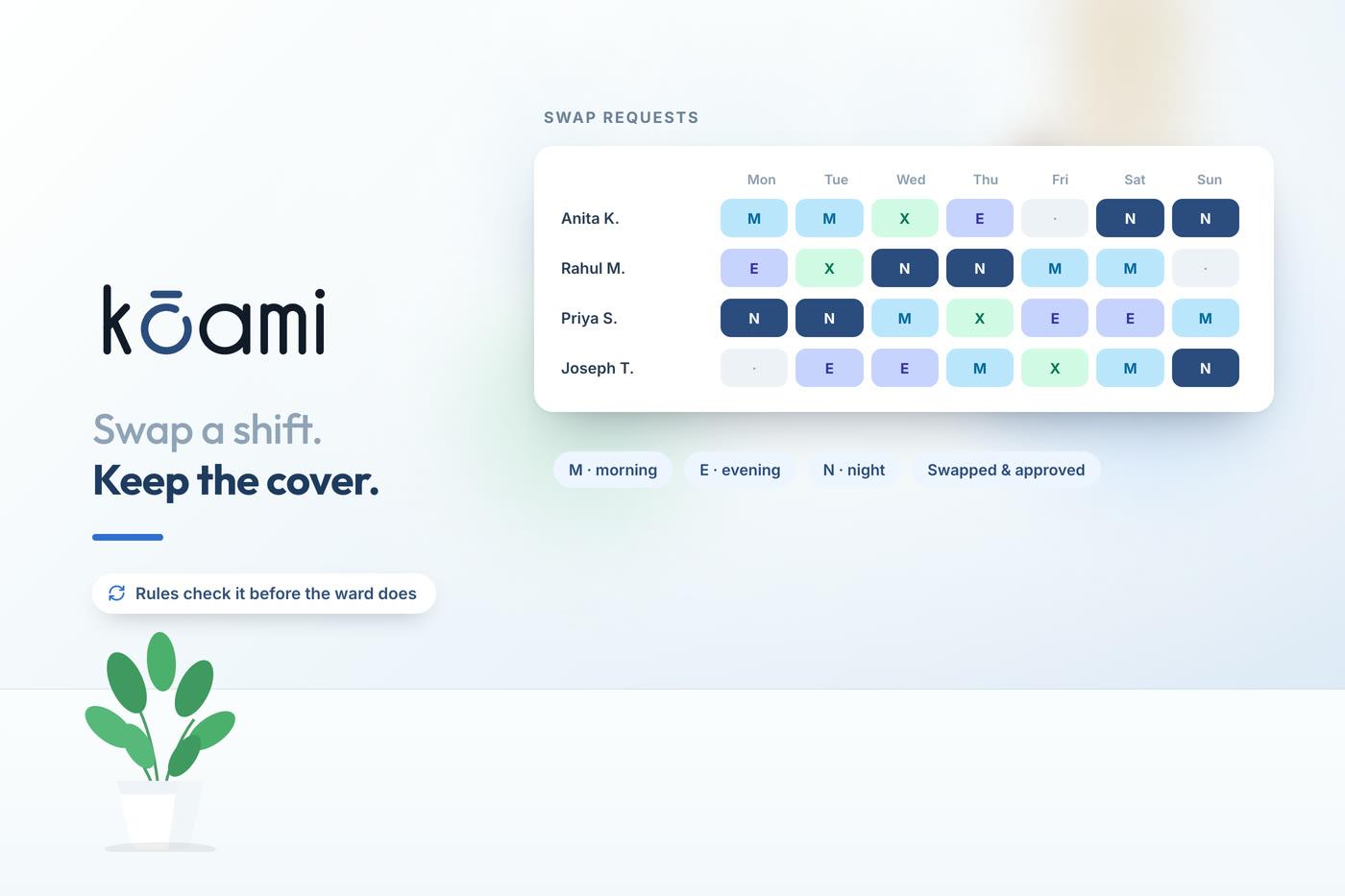
The fix is not to ban swaps. It is to give them a path that the roster and payroll can see. In the Kōami HRMS a swap is a small, structured transaction rather than a verbal agreement. A nurse offers a shift; eligible colleagues see it; one accepts; a supervisor approves or the rules approve automatically; the roster updates. The important word is eligible. The system only offers the shift to people who can legitimately take it:
- They hold the skill and competency the unit and shift require.
- They are not already rostered into a conflicting or adjacent shift.
- Taking it will not breach hours or minimum-rest rules.
- They are not on approved leave for that period.
A swap should be as easy as a WhatsApp message and as accountable as a signed form. Those two things are not in tension if the roster is doing the work.
By the time a swap is confirmed, it is already valid. Nobody discovers the skill-mix problem when the patient deteriorates.
Approvals that match how wards really run
There is a temptation to route every swap through a supervisor and call it governance. On a busy ward that just moves the bottleneck. The better model is tiered approval, where the level of scrutiny matches the risk of the swap:
- A like-for-like swap between two equally qualified nurses on the same unit can auto-approve within policy.
- A swap that changes the skill mix, crosses units, or triggers overtime routes to the supervisor.
- Anything that would breach a hard rule - rest, ratio, credential - is simply not offered in the first place.
This keeps humans in the loop where judgement is needed and out of the loop where it is just friction. Supervisors stop rubber-stamping the obvious and start spending their attention on the swaps that actually deserve a second look.
The payroll payoff
The strongest argument for governed swaps is the one you feel on the last day of the month. When a swap flows through the roster, the downstream arithmetic is automatic and correct. The nurse who worked the night gets the night differential. The one who gave up the shift is not marked absent and does not take an unearned LOP. Overtime, if the swap created it, is attributed to the person who actually earned it. There is no reconstruction, no arbitration, no digging through chat history.
Consider the alternative that most hospitals live with today. A swap made by phone means someone, somewhere, has to remember it and key it in. If they forget, the system confidently pays the wrong result. Every informal swap is a small debt that comes due at payroll, and the interest is paid in disputes and eroded trust.
Fairness people can see
Swaps also carry a quiet fairness dimension. In an informal system, the nurses with the best social connections get their shifts covered and the newer or quieter staff get stuck. A transparent swap board changes the dynamic: open shifts are visible to everyone eligible, not just to whoever is in the right WhatsApp group. Over time you can even see the pattern - who is always giving up shifts, who is always picking up extra, whether the load is shared or quietly dumped on the willing few. That visibility is worth as much to morale as it is to compliance.
Nurses will always need to trade shifts. Life does not fit neatly into a roster drawn up a fortnight ago. The question is whether those trades happen in the daylight, where the roster records them and the pay follows correctly, or in the shadows of a chat thread where they turn into next month's argument. Give people an easy, accountable way to swap, and they will use it - not because policy forces them, but because it is genuinely less hassle than the WhatsApp scramble it replaces.
Follow Kōami on LinkedIn
Get the next guide on hospital operations, software and compliance in your feed, as soon as it is published.