Overcoming Nursing Shortages with Dynamic Shift Allocation
Published
Every nursing superintendent knows the feeling of a Monday morning that has already gone wrong by 7 a.m. Two staff nurses have called in sick, one is on unplanned leave after a family emergency, and the medical ICU is running at census with a skill mix that no longer adds up. The shortage is real and structural, but a lot of the daily pain is not about how many nurses exist. It is about how the ones you have are matched to the shifts that need them. Dynamic shift allocation will not manufacture nurses out of nowhere. It will stop you from bleeding the ones you have.
The shortage is real, but the roster makes it worse
India runs well below the nurse-to-population ratios that professional bodies recommend, and the units that feel it most - critical care, emergency, dialysis, oncology day care - are exactly the ones where a wrong skill mix is dangerous, not merely inconvenient. Yet a surprising amount of avoidable strain traces back to how rosters are built. When a roster is drawn up a fortnight in advance on a spreadsheet and then patched by phone, three things happen:
- Senior nurses get loaded onto the shifts nobody else will take, and burn out faster.
- Gaps are filled by whoever answers the call, not by who is best suited or best rested.
- Overtime and agency spend balloon, because last-minute cover always costs more.
A static roster assumes a static hospital. Hospitals are not static. Census swings, acuity changes, and people are human.
What "dynamic" really means
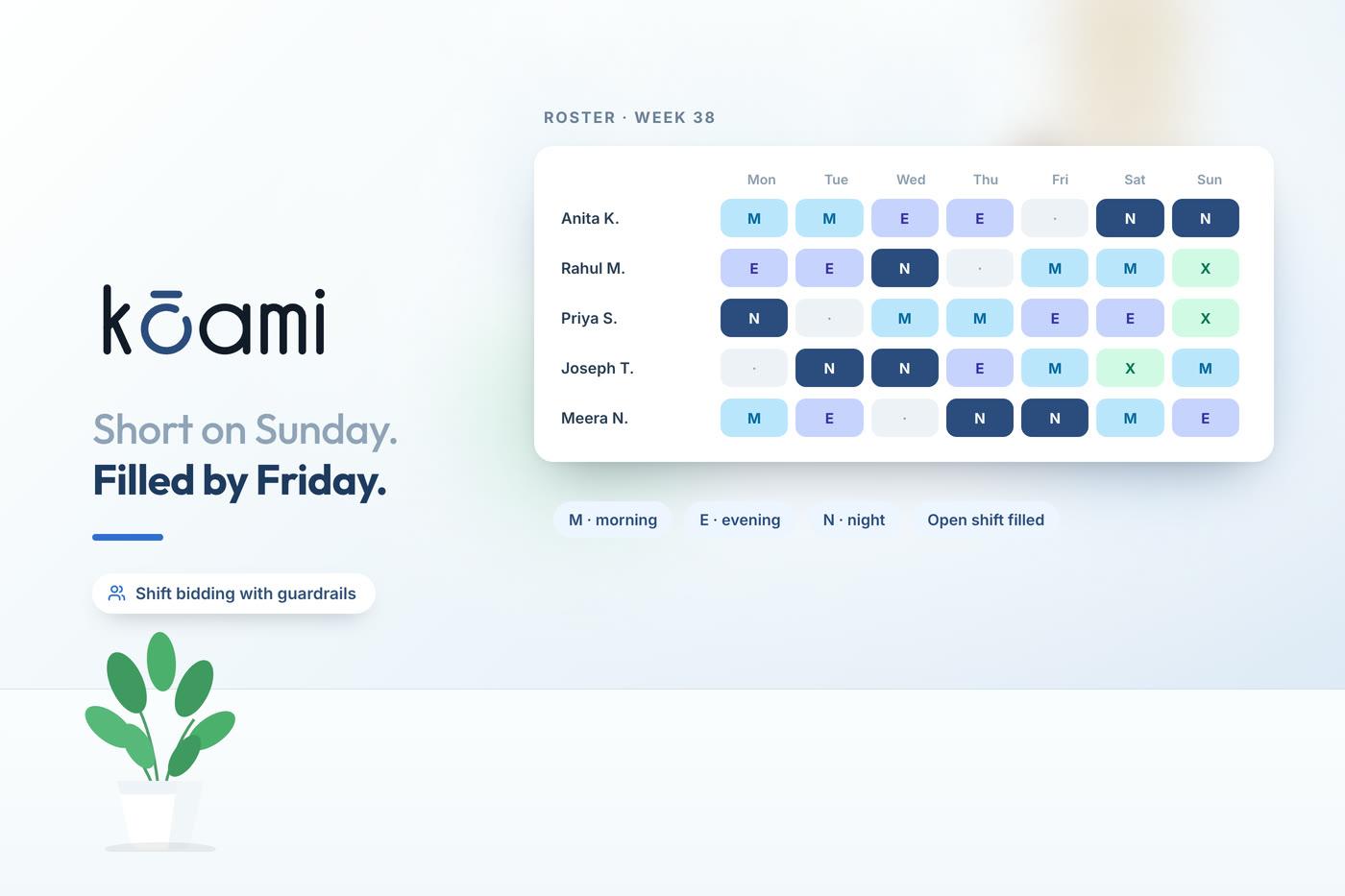
Dynamic allocation does not mean an algorithm barks orders at your nurses. It means the roster is a living object that reflects current reality and known constraints, and that filling a gap becomes a matter of matching rather than pleading. A good system holds a few things in its head at once:
- Skill and competency, so a paediatric-trained nurse is not auto-assigned to adult ICU by accident.
- Ratios and acuity, so the allocation respects the nurse-to-patient targets each unit is meant to hold.
- Fatigue and fairness, so nobody is silently rostered into a third night in a row.
- Statutory and contractual limits on hours and rest between shifts.
A roster is not a grid of names. It is a promise about who will be competent, present and rested when a patient deteriorates at 3 a.m.
When those constraints are encoded rather than carried in one supervisor's memory, the system can propose a valid fill in seconds and flag the ones that break a rule.
From gap to cover, in minutes
The workflow that matters is the one that plays out when a shift falls short. In the manual world it is a flurry of phone calls in an order that reflects who the supervisor remembers, not who is eligible. In Kōami's HRMS the same gap becomes a targeted broadcast: the open shift, with its unit, timing and any shift differential, goes to the nurses who are qualified, not on leave, not already at their hour limit, and not about to breach rest rules. The first suitable nurse to accept is confirmed, the roster updates, and the ripple effects - attendance expectation, overtime accrual, differential pay - are captured without a second data entry.
That last part matters more than it sounds. When cover is arranged by phone, the payroll consequences are reconstructed at month end from memory and half-remembered WhatsApp messages. When it flows through the roster, the LOP that should not have happened does not happen, and the extra-hours pay that was earned actually shows up.
Design the incentives, not just the grid
Technology can match a nurse to a shift. It cannot, by itself, make an unpopular shift attractive. The hospitals that get the most from dynamic allocation pair it with honest incentive design:
- A transparent shift differential for nights, weekends and short-notice cover, applied consistently rather than negotiated case by case.
- Visible fairness, so nurses can see that the hard shifts are shared rather than dumped.
- A predictable core roster with a smaller flexible layer on top, so people can plan their lives.
Nurses tolerate a hard schedule far better when it is visibly fair and honestly paid. The fastest way to worsen a shortage is to make your most capable people feel like the system quietly punishes competence with more work.
What to measure once it is running
If you cannot see it, you cannot manage it. A dynamic allocation approach earns its keep when it produces numbers a superintendent can act on:
- Time to fill an open shift, tracked as a trend rather than a war story.
- Overtime and agency spend as a share of total nursing hours.
- Distribution of unpopular shifts across the team, to catch quiet unfairness.
- Vacancy hours by unit and skill, so recruitment targets the real gaps.
These are the signals that turn "we are short-staffed" from a permanent complaint into a set of problems you can chip away at.
Recruitment pipelines take months, and the nursing shortage will not resolve on a hospital's timetable. What a hospital can control is whether its existing nurses are matched intelligently, paid correctly for the shifts they take, and treated fairly enough to stay. Dynamic shift allocation is not a slogan about doing more with less. It is a practical way to stop wasting the scarce, skilled, tired people already walking your wards - and, more often than not, to keep them from becoming next quarter's resignation.
Follow Kōami on LinkedIn
Get the next guide on hospital operations, software and compliance in your feed, as soon as it is published.