Why We Built Kōami as One Connected Ecosystem
Published
We kept walking into hospitals that were running four or five systems which could not talk to each other, and watching staff re-key the same patient into every one of them. A person would be registered at the front desk, typed again into the lab system, typed a third time at the pharmacy counter, and once more into the billing software before they were discharged. Every one of those keystrokes was a chance to introduce an error, and every reconciliation between the systems was a chance to lose money, time, or trust.
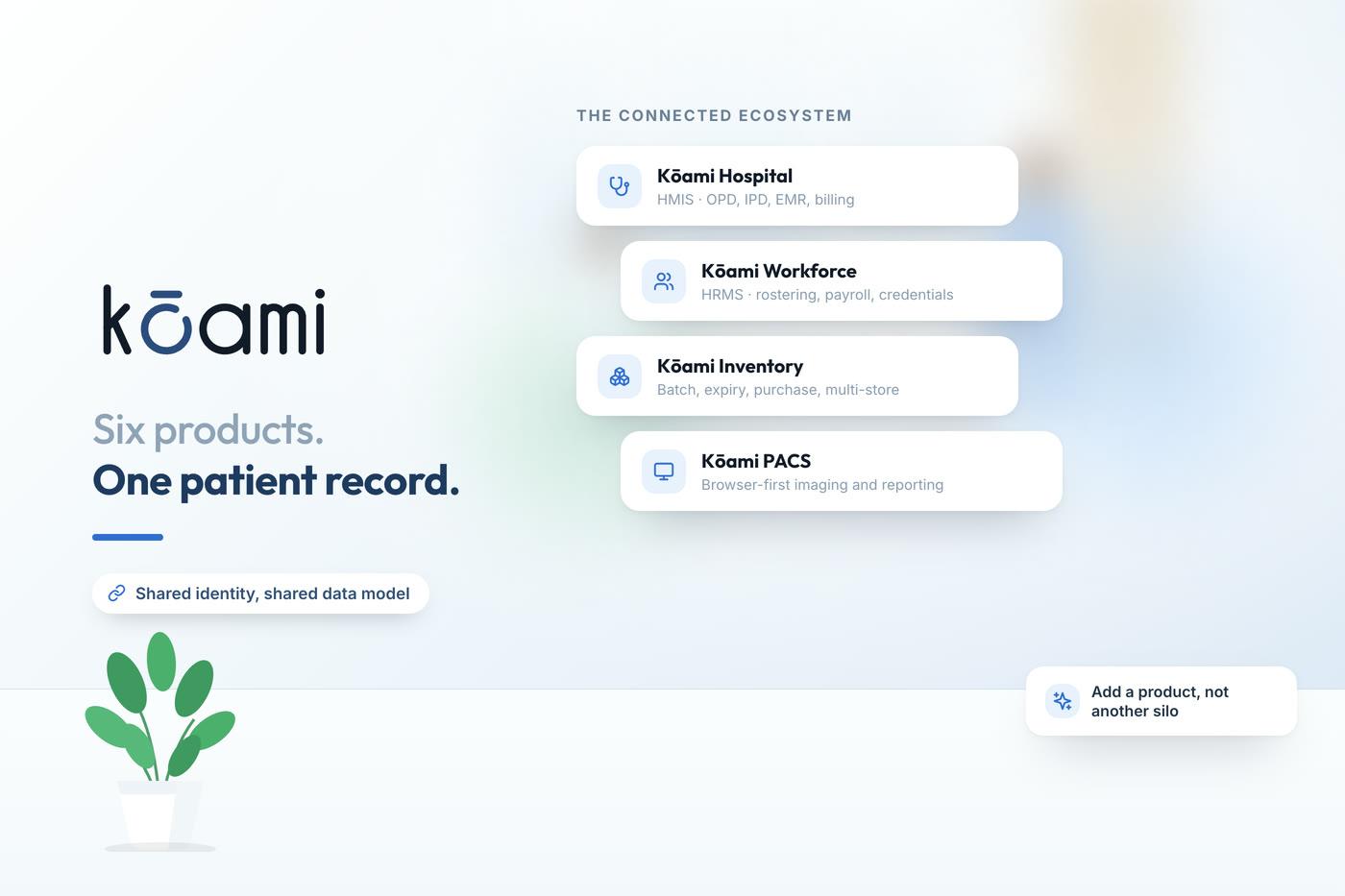
Kōami is our answer to that. It is a connected ecosystem of clinical-grade software - hospital operations, workforce, inventory, imaging and field service - that shares one identity and one data model, so the work flows instead of the paperwork. This piece explains the problem we set out to solve, the principles we built on, and how the pieces fit together in practice.
The real cost of disconnected systems
The bill for fragmentation rarely shows up as a single line item. It hides in the extra minutes at every counter, the duplicate records that have to be merged, the claims that bounce because a charge was captured in one system and billed from another. It shows up when a ward runs out of a consumable that the store thought it had, because the two were counting from different books.
Individually, none of these is a catastrophe. Together, across thousands of patients a month, they are the difference between a hospital that runs smoothly and one that is always fighting its own tools. The staff feel it first, because they are the ones bridging the gaps by hand.
A product is only as good as the seams between its parts - so we tried not to have any.
One identity, one data model
The foundation of the ecosystem is deliberately boring: a single identity and a single data model. A patient is registered once and carries the same Unique Medical Record across every product. A staff member has one account, one set of permissions, and one place their credentials live. An item of stock is the same item whether the ward is consuming it or the store is reordering it.
That shared spine is what lets the products behave like one system instead of five. When a discharge in the hospital module deducts consumables in inventory and frees a bed on the occupancy board, nobody has to reconcile anything - because there was only ever one event, seen from three angles.
Five products, each strong on its own
We did not want to force anyone to adopt everything at once. Each product stands on its own and solves a real problem the day you switch it on:
- Kōami Hospital connects registration, OPD, IPD, EMR, pharmacy, lab, radiology and billing to one patient record.
- Kōami Workforce handles rostering, geofenced attendance, statutory payroll and credential compliance for a round-the-clock hospital.
- Kōami Inventory keeps stock, batches and expiry under control, and reorders before anything runs out.
- Kōami PACS streams imaging studies to a browser-based viewer with AI-assisted findings and structured reporting.
- Kōami Field Service dispatches technicians and tracks SLAs so biomedical equipment stays up.
Most customers start with one - usually where the pain is loudest - and add the rest over time. Because they share the data model, each new product lights up already knowing your patients, your staff and your stock.
Interoperability, not a walled garden
A connected ecosystem is not the same as a closed one. Hospitals already run software they cannot and should not replace overnight, so Kōami is built to exchange data with the world around it through open REST APIs and webhooks. The goal is that adding Kōami never means ripping out something that already works; it means giving the pieces a common language.
Security as a foundation, not a feature
Because everything shares one identity, we could make security a property of the whole platform rather than a bolt-on per product. Single sign-on with multi-factor authentication, granular role-based access, and audit logging that spans every product mean the right people see the right data, and every access is accountable. Getting this right once, at the foundation, is far better than getting it slightly wrong five times.
What this looks like on a normal Tuesday
Consider an ordinary admission. A patient is registered once and admitted; orders, medicines and results flow through EMR, pharmacy and lab. The right clinicians are auto-rostered to the ward, their attendance captured on a geofenced check-in. Consumables are deducted from stock in real time, triggering an automatic reorder before the shelf runs low. An imaging study is read in the browser with AI findings alongside. A flagged biomedical device raises a work order, and a technician is dispatched before it fails. No one re-typed anything, and no one reconciled anything - the systems simply agreed, because they were never really separate.
The road ahead
We are early, and we are building alongside a first group of hospitals and clinics who are shaping the platform around how care actually works. That is the whole idea: start where the pain is, prove the value on real data, and let the ecosystem grow with you. If that sounds like the kind of partner you want, we would love to talk.
Follow Kōami on LinkedIn
Get the next guide on hospital operations, software and compliance in your feed, as soon as it is published.