WhatsApp Integration for Hospitals in India (2026): Reminders, Reports and Bills From Your HMS
Almost every Indian patient already uses WhatsApp, and most hospitals already use it too — just not on purpose. Front-desk staff confirm appointments from a personal phone. Lab reports are photographed and forwarded. A consultant's number circulates among patients, and the billing team sends bank details in a chat nobody else can see.
That informal WhatsApp is fast, and it is a problem: no record in the hospital system, no control over who holds patient data, and no way to know whether a report reached the right person. The answer is not to stop using WhatsApp. It is to connect it properly to the hospital management system, so that messages are sent by the system, from the hospital's verified number, and recorded against the patient.
Why are hospitals moving patient communication to WhatsApp?
Because patients read WhatsApp messages and ignore most SMS, and because a two-way channel lets a patient confirm, reschedule or ask a question without calling a busy front desk.
The operational case is simple. Missed appointments waste consultant time and OPD slots. Uncollected reports generate phone calls. Discharge instructions given verbally are forgotten by the time the patient reaches home. Each of these is a communication failure that a timely message, in the app the patient already opens, reduces.
What should a hospital management system send on WhatsApp?
Messages triggered by events already recorded in the HMS, across the patient's whole journey rather than only for appointments.
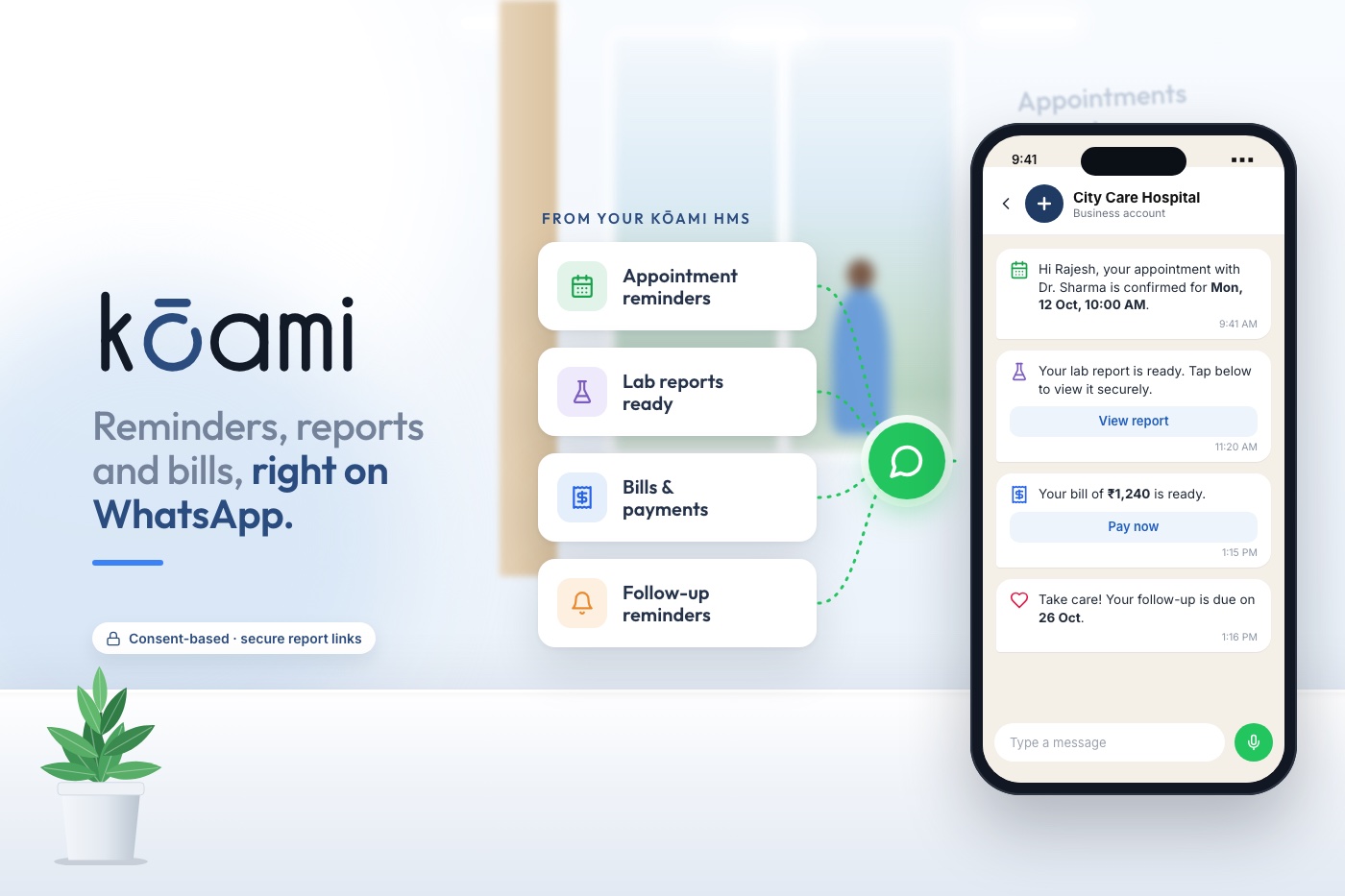
- Booking confirmation with the date, doctor, location and a map link.
- Appointment reminders a day before and a couple of hours before, with confirm and reschedule options.
- Queue updates telling the patient roughly when to arrive, which pairs well with an OPD token and queue system.
- Report ready notifications with a secure link rather than the report itself.
- Bill and payment messages with a UPI or payment link, and the GST receipt afterwards.
- Pre-admission instructions for planned surgery: fasting, documents, deposit and arrival time.
- Discharge summary and medication instructions, with the follow-up date.
- Follow-up recall when a review visit falls due, set by the doctor during the consultation.
- Feedback after the visit, short enough to answer with one tap.
Each message should exist because something happened in the hospital's own record. A message that is not tied to an event is usually marketing, which is a different category with different rules.
WhatsApp Business App or WhatsApp Business API: which does a hospital need?
The WhatsApp Business API, accessed through a Meta-approved Business Solution Provider. The free WhatsApp Business App runs on a single phone, cannot be connected to hospital software, and does not scale past a small clinic.
The practical differences:
- Automation. Only the API can be triggered by the HMS when an appointment is booked or a report is approved.
- Multiple staff. The API supports a shared inbox for the front desk; the app is tied to one device.
- Templates. Messages the hospital starts must use templates pre-approved by Meta, which keeps outbound messaging disciplined.
- Verified identity. The hospital sends from its own business number and name, not from a staff member's personal phone.
- Record keeping. Messages sent and their delivery status can be written back to the patient's record.
Several established messaging companies act as Business Solution Providers in India. The choice matters less than confirming that the provider signs a data processing agreement and that your HMS can connect to it through APIs or webhooks.
Can a hospital send lab reports and prescriptions on WhatsApp?
Yes, with the patient's consent and with care over how the document is delivered. The safer pattern is a notification carrying a secure, expiring link that asks for verification, rather than the report attached as a PDF.
The reason is practical. In many Indian families one phone number is shared, a number registered years ago may now belong to someone else, and a PDF forwarded once can travel anywhere. A link that opens only after an OTP or date-of-birth check keeps the convenience and removes most of the risk. It also lets the hospital see whether the report was actually opened.
What does the DPDP Act mean for hospital WhatsApp messages?
It means consent has to match the purpose, patient data must be protected with reasonable safeguards, and the hospital must be able to show what it sent and why.
In practice, under the Digital Personal Data Protection Act:
- Care messages and marketing are separate purposes. Consent to receive appointment reminders is not consent to receive health-camp promotions.
- Opt-out has to work. A patient who replies STOP should stop receiving that category of message, and the HMS should record that choice.
- Staff personal phones are the biggest risk. Patient data in a receptionist's personal WhatsApp sits outside the hospital's control, its audit trail and its retention policy.
- Processors need agreements. The messaging provider processes patient data on the hospital's behalf and should be contractually bound to protect it.
- Minimum content. A reminder does not need a diagnosis in it. Even the name of a department may say more than a patient wants a family member to read.
The substantive obligations under the DPDP Rules apply from 2027, but the habits — an official number, consent by purpose, minimum content — are cheapest to build now.
How much does WhatsApp messaging cost a hospital?
Meta charges per delivered template message at rates that differ by category — marketing messages cost the most, utility messages such as reminders and report alerts considerably less — and replies inside an open customer-service conversation are generally free. The Business Solution Provider adds its own platform fee.
Most hospital volume falls in the utility category, so the cost per message is typically a fraction of a rupee, but volume adds up: a hospital sending five messages per OPD visit and ten per admission can send tens of thousands a month. Take the current rate card from Meta's published pricing for India and your provider's quotation, and put both into the five-year software cost rather than discovering them after go-live.
What goes wrong with WhatsApp in hospitals?
Most failures come from treating WhatsApp as a broadcast tool rather than as part of the patient record.
- Too many messages. Patients mute a hospital that sends promotions alongside reminders, and then miss the reminder.
- Replies nobody reads. Two-way messaging creates questions, and without a staffed inbox patients wait and then call anyway.
- Messages not tied to the record. Reminders from a separate tool go to old numbers because the HMS was updated and the tool was not.
- The wrong recipient. Shared and recycled phone numbers send sensitive information to the wrong person.
- Rejected templates. Messages written like advertisements are refused by Meta, delaying launch.
- No measurement. Without a baseline, nobody knows whether reminders actually reduced no-shows.
Hospitals and messaging providers commonly report meaningful drops in missed appointments once reminders with one-tap confirmation are live. Record your own no-show rate for a month before switching reminders on, so you know what yours actually did.
How should a hospital roll out WhatsApp in 30 days?
Start with the two messages that save the most staff time, measure them, and add the rest once they work.
- Week 1: choose a Business Solution Provider, verify the hospital's business number and sign the data processing agreement.
- Week 2: connect the HMS events for appointment confirmation and reminders, and get the templates approved.
- Week 3: go live in one OPD department, with a named person answering replies.
- Week 4: compare no-shows and inbound calls against the baseline, then add report-ready and billing messages.
Retire the personal-phone habit in the same month. The official channel only protects patient data if it replaces the informal one.
Where Kōami fits
Kōami Hospital already records the events that hospital WhatsApp messages should be built on — appointments, queue tokens, approved lab reports, finalised bills, discharge and follow-up dates — against one patient record. Through open APIs and webhooks, those events connect to the WhatsApp Business Solution Provider your hospital chooses, so messages go out from your verified number when something actually happens, rather than from a separate tool working off a stale list.
Because Kōami is a premium suite priced to stay affordable, you are not buying a second patient-engagement platform to get there: OPD, IPD, billing, pharmacy and laboratory already share the record the messages come from, with role-based access and audit logs covering who sees what. To see how appointment, report and billing events would reach your patients, book a demo and bring your current no-show rate.