Foreign Patients in Indian Hospitals: The Desk Workflow
Published
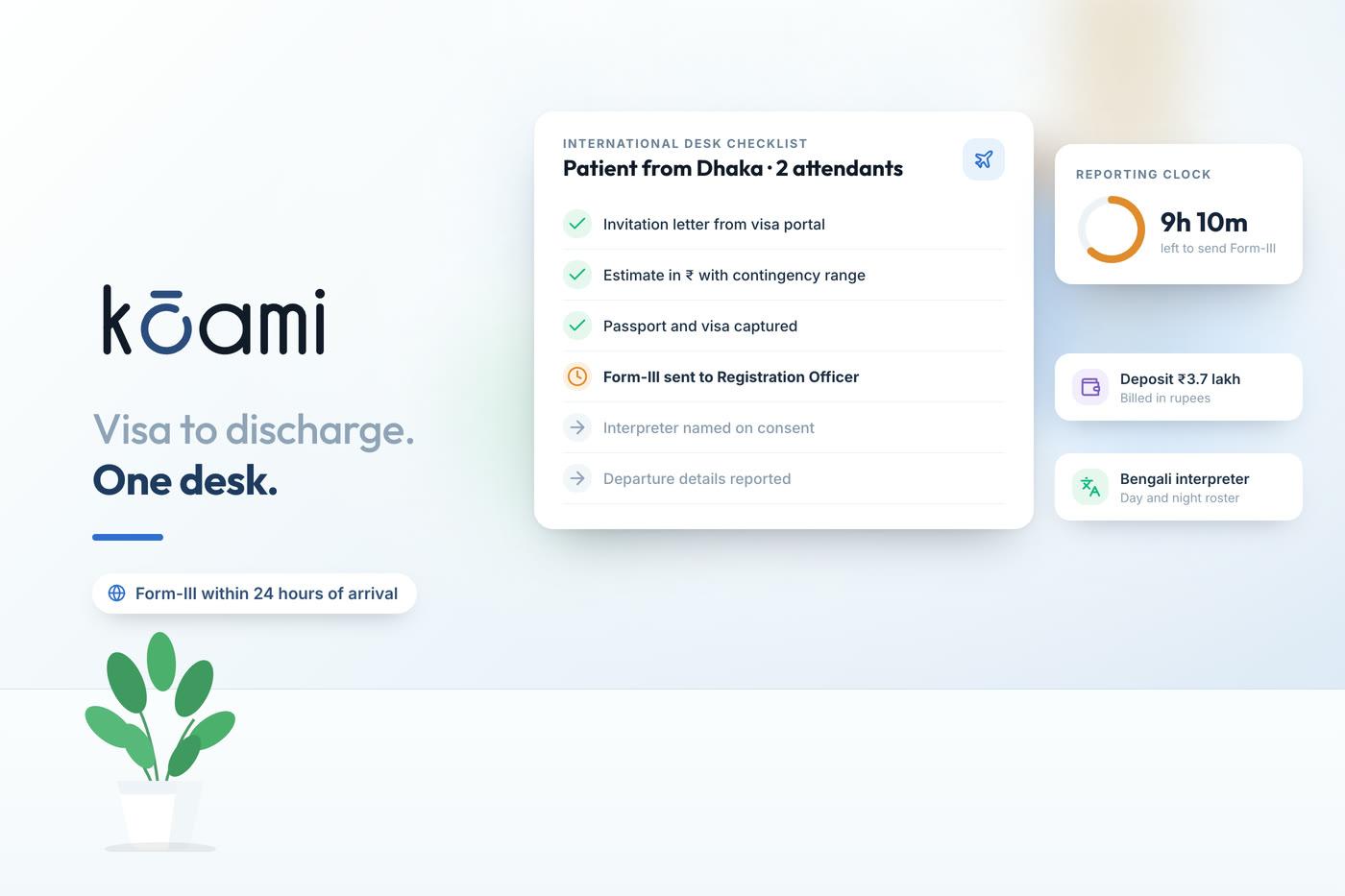
A patient from Dhaka lands at Hyderabad airport at 11 at night with her husband and her brother. The facilitator who sent her has her reports on WhatsApp, the surgeon saw them two weeks ago, and the hospital wrote a letter for the visa. What nobody has written down is who will receive her, who files the foreigner report before the 24-hour clock runs out, what the deposit is in rupees, and how the brother's room is billed. Those gaps are the international patient desk's real job.
This guide is for the head of an international patient desk, and the CFO who signs off on how that desk handles money. It covers each stage of a foreign patient's journey, the hospital's duties under the Immigration and Foreigners Act, 2025, and a checklist you can adapt. It is general information, not legal or tax advice: confirm current requirements with your local FRRO, your CA and your lawyer.
Before the visa: the hospital letter
For medical travel, the hospital's first deliverable is the invitation letter. The official e-Visa portal says an e-Medical visa application needs a copy of a letter from the hospital in India on its letterhead, giving the tentative date of admission or treatment and the patient's name, nationality and passport number. Applicants from eligible countries can apply online at least 4 days before arrival, within a 120-day window. Only two e-Medical Attendant visas are granted against one e-Medical visa.
The letter is no longer something a desk types up in Word. Indian missions now ask for an invitation letter generated by the hospital from the Medical and Ayush Visa portal on indianfrro.gov.in. The Consulate General of India in Auckland, for example, lists it as a mandatory document and sets out the hospital-side steps:
- Step 1: the hospital signs up on the Medical and Ayush Visa portal.
- Step 2: the registration form goes online to the concerned FRRO or FRO office for approval, and the hospital is told the result by email.
- Step 3: once approved, the hospital logs in and uses the 'Request for Medical Visa Invitation Letter' option for each patient.
If your hospital has never registered, do it before your first enquiry from abroad, not during it.
Visa validity and entries have changed over the years, and the official portal carries both an older 60-day answer in its FAQ and a one-year figure in its visa-type table. Do not quote validity from memory; name the visa type and point the patient to indianvisaonline.gov.in. Patients whose nationality is not eligible for e-Visa apply for a regular Medical visa through the Indian mission, and the same portal-generated letter applies.
Arrival and the 24-hour reporting duty
Many hospitals assumed foreigner reporting belonged to the hotel the attendants stayed in. The 2025 law makes the hospital's own duty explicit.
The Immigration and Foreigners Act, 2025 came into force on 1 September 2025 and repealed the Foreigners Act, 1946, the Registration of Foreigners Act, 1939 and two other older laws. Section 10 of the Act covers hospitals, nursing homes and other medical institutions. Rule 18 of the Immigration and Foreigners Rules, 2025 sets out how they comply. In plain terms, every hospital, nursing home or medical institution that provides medical, lodging or sleeping facilities must:
- Ask every foreigner, including an OCI cardholder, to give their particulars and sign on arrival, and record their departure date, time and onward address when they leave.
- Keep those records electronically for one year, available on demand to the Registration Officer, the District Magistrate or a police officer not below the rank of Head Constable.
- Record the particulars in English if the person in charge can, or otherwise in an Indian language, and explain the requirement to a foreigner who does not understand English if asked.
- Send a filled Form-III (the old Form C) electronically to the Registration Officer within 24 hours of the foreigner's arrival, through the designated portal (indianfrro.gov.in) or the Indian Visa Su-Swagatam app.
- Send departure details electronically after the foreigner leaves.
- Report any child born to a foreigner (one or both parents) and any death of a foreigner on the premises within seven days.
Two practical points. First, the Form-III itself has a 'Medical' purpose box and fields for passport, visa number and type, arrival and departure, so the desk needs the visa details in hand at admission, not after. Second, the duty attaches to the foreigner, not only the patient. If an attendant sleeps in the patient's room or in hospital-run accommodation, treat the attendant as reportable too, and confirm your local office's view on day-care and OPD-only visits.
The Rules are new and can be amended by notification, so before you freeze your SOP, check the current notified text and any guidance from your Registration Officer. For how Form-III works in day-to-day practice at a front desk, our guide to Form C and Form-III reporting covers the mechanics.
Separately, the patient may have their own registration duty. Under Rule 12, a foreigner on a visa of 180 days or less does not need to register unless they stay beyond 180 days or the visa endorsement says so. Long treatments such as transplants or oncology cycles can cross that line, so flag them at admission.
Estimates, deposits and billing in rupees
The money conversation happens before the patient flies, usually through a facilitator or a family member on WhatsApp. The estimate you send becomes the number the family raised or got a sponsor to approve, so a loose estimate turns into a dispute at discharge.
A useful international estimate has more lines than a domestic one:
- Package or itemised procedure charges, with what the package excludes written out.
- Expected length of stay by ward type, with the per-day rate beyond the package days.
- Pre-admission investigations that will be repeated here even if done at home.
- Attendant accommodation and food, if the hospital provides them.
- Interpreter charges, if billed.
- Discharge medicines for the travel period and the first weeks at home.
- A contingency line, stated as a range, with what triggers it.
Here is an illustrative example. A planned knee replacement package at ₹3,20,000 for five days, plus two extra days expected at ₹9,000, plus attendant stay at ₹2,500 a night for seven nights, plus ₹15,000 of discharge medicines, comes to ₹3,70,500. Add a contingency range of ₹40,000 to ₹60,000 and the family sees a base of about ₹3.7 lakh and a likely total of ₹4.1 to ₹4.3 lakh, not a single number that will almost certainly be wrong.
Ask for a deposit at admission that covers the base estimate, and raise interim bills during long stays so the balance never runs far ahead of the deposit. For sponsored patients, such as those referred by an overseas government through its embassy or by an overseas insurer, get the guarantee-of-payment letter before admission, record its limit and validity against the patient account, and track the claim like any other credit receivable.
Bill in rupees. Foreign exchange is governed by FEMA and RBI directions, so route foreign-currency receipts through your bank, as an authorised dealer, and through authorised money changers, rather than letting the cashier improvise with notes. Agree the process for cash, international cards and inward wire transfers with your bank and CA, and record the remittance reference against the patient's bill so finance can match it later. Wires take days, so do not hold a discharge waiting for one without a written arrangement.
On GST, health care services by a clinical establishment are exempt under Entry 74 of Notification 12/2017-Central Tax (Rate), and the entry describes the service and the provider rather than the patient's nationality. Items around the treatment, such as pharmacy sales, attendant food or cosmetic procedures, can be treated differently, so have your CA confirm each line on the international tariff.
The deposit, sponsor letter, interim bills and final settlement belong on one patient account. If your system cannot hold them, the desk runs a parallel spreadsheet, and that is where reconciliation breaks. Hospital billing software that handles deposits, sponsors and interim bills natively removes that second ledger.
Interpreters and coordinators
After money, language is the most common failure point. A patient who speaks only Bengali, Arabic or French cannot give informed consent through a facilitator's paraphrase on a phone call.
- Keep a roster of interpreters by language and shift, including on-call cover for nights and emergencies.
- Record the interpreter's name on every consent form they help with, along with the language used.
- Give each patient one named coordinator, reachable on WhatsApp, for the whole stay.
- Brief the ward on language, diet and religious practice at admission.
- If a facilitator referred the patient, record who it was and keep the written agreement with finance, so any fee is visible and auditable.
Discharge and follow-up abroad
For a foreign patient, discharge is a travel plan as much as a clinical event: flights are booked and the patient will soon be far from your doctors.
- Prepare the discharge summary in English, with key instructions translated or explained through the interpreter.
- Supply discharge medicines for the travel period, with a medicines list the patient can show at customs and to their local doctor.
- If the airline asks for a fitness-to-fly letter, have the treating doctor issue it in time for the booking.
- Hand over copies of imaging and reports, or give access through a portal, so the patient's local doctor sees the same record.
- Agree how follow-up will work, by whom and on what channel, and write it on the summary.
- Record the departure date, time and onward address, and send departure details to the Registration Officer.
A patient portal where reports and the discharge summary stay available avoids a month of email requests for scans after the patient has flown home.
The international desk checklist
This is the checklist we suggest an international desk adapts and pins up. Assign each line to a named role, not to 'the desk'.
Pre-arrival
- Hospital registered and approved on the Medical and Ayush Visa portal.
- Reports received, reviewed by the treating consultant, and opinion sent in writing.
- Estimate sent with inclusions, exclusions, ward days and a contingency range.
- Invitation letter generated from the portal with patient name, nationality, passport number and tentative admission date.
- Number of attendants confirmed (two at most on e-Medical Attendant visas).
- Sponsor or insurer guarantee letter received, with limit and validity, where applicable.
- Airport pickup, interpreter and attendant stay arranged.
Arrival day
- Passport and visa details captured at registration, for the patient and every attendant who will stay on the premises.
- Form-III particulars recorded and signed, and Form-III sent within 24 hours.
- Deposit received and receipted in rupees, with remittance reference if by wire.
- Language, diet and contact details passed to the ward.
During the stay
- Interim bills raised and explained to the family at agreed intervals.
- Consents taken with an interpreter, whose name is recorded.
- Stay length checked against the visa and the 180-day registration rule for long treatments.
- Any birth or death involving a foreigner reported within seven days.
Billing and discharge
- Final bill reconciled to deposit, interim payments and sponsor limit before the discharge day.
- Discharge summary, medicines list and report copies ready.
- Fitness-to-fly letter issued if the airline needs one.
- Departure details recorded and sent.
After departure
- Follow-up plan confirmed with the patient and their local doctor.
- Portal access working from abroad.
- Sponsor or insurer claim tracked to settlement.
- Feedback and referral source logged for the business team.
What the CFO should look at monthly
Five numbers keep an international desk honest:
- Enquiries to arrivals: how many written opinions turn into admissions.
- Estimate variance: final bill against the estimate's upper range, by procedure.
- Deposit cover: deposit received as a share of the final bill at discharge.
- Sponsor receivables: days from discharge to payment for embassy or insurer-backed patients.
- Reporting compliance: share of foreign admissions with Form-III sent within 24 hours.
The government's 'Heal in India' initiative, described in a May 2026 PIB note, includes an upgraded medical value travel portal. More arrivals make these five numbers matter more. For reaching patients abroad, see our guide to international SEO for healthcare.
Where software helps
Most failures above are handoff failures: registration has the passport, the ward has the language, billing has the deposit, and nobody has all three. Kōami is designed around one patient record that registration, the ward and billing all work from, so visa details, deposit and interim bills sit on the same account and the desk can see which foreign admissions still need a report filed.
If your international desk still runs on a spreadsheet beside the HMIS, we would be glad to walk through how this workflow looks on synthetic data. Book a demo: koami.in/book-demo
Frequently asked questions
- Does a hospital have to report a foreign patient to the FRRO?
- Yes, if it provides medical, lodging or sleeping facilities. Rule 18 of the Immigration and Foreigners Rules, 2025 requires the hospital to record the foreigner's particulars on arrival and send a filled Form-III electronically to the Registration Officer within 24 hours, through the designated portal or the Indian Visa Su-Swagatam app.
- Who issues the invitation letter for a medical visa to India?
- The treating hospital. Indian missions now ask for an invitation letter generated by the hospital from the Medical and Ayush Visa portal on indianfrro.gov.in, after the hospital has registered there and been approved by the local FRRO or FRO.
- How many attendants can come with an e-Medical visa patient?
- The official e-Visa portal says only two e-Medical Attendant visas are granted against one e-Medical visa.
- Are OCI cardholders covered by hospital foreigner reporting?
- Yes. Rule 18 says the hospital must record particulars of every foreigner, including an Overseas Citizen of India cardholder.
- Should a hospital bill foreign patients in foreign currency?
- Most hospitals bill in rupees and receive foreign payments through their bank. Dealing in foreign currency is governed by FEMA and RBI directions, so agree the cash, card and wire process with your bank and CA before the desk accepts anything other than rupees.
Sources
- Immigration and Foreigners Rules, 2025 (G.S.R. 596(E), Gazette of India, 1 September 2025)
- DIPR Nagaland: Police notification on reporting foreigners under the Immigration and Foreigners Act, 2025
- Indian Visa Online: e-Visa types, documents and FAQs (e-Medical and e-Medical Attendant)
- Consulate General of India, Auckland: Medical / Medical Attendant / Ayush Visa checklist
- Bureau of Immigration: Medical and Ayush Visa portal for hospitals
- PIB: Medical and Wellness Tourism in India (May 2026)
- Karnataka AAR ruling KAR ADRG 05/2018 quoting Entry 74, Notification 12/2017-Central Tax (Rate)
Follow Kōami on LinkedIn
Get the next guide on hospital operations, software and compliance in your feed, as soon as it is published.