Hospital Receivables Management: A Payer-Wise DSO Dashboard
Published
The receivables report says ₹9.1 crore outstanding, and most of it is under 90 days. The owner nods and moves on. What the single number does not show is that the cash counter's balances clear in two days while a scheme claim raised in June is still unpaid in October, and that one corporate client has not paid anything since March. A total ageing view averages your fastest payer with your slowest and hands you a number that describes nobody.
This article is for the hospital CFO and the owner who reads the monthly MIS. It sets out a payer-wise days sales outstanding (DSO) dashboard, the formulas behind it, how to build the ageing buckets so they can be trusted, and what to do at each stage of ageing. All numbers in the examples are illustrative.
Why total ageing misleads
Indian hospitals collect from very different payers. Cash and card patients pay at discharge. TPAs and insurers pay on cashless claims after their own review. PM-JAY and state schemes such as Aarogyasri pay through the State Health Agency. CGHS, ECHS, corporate tie-ups and PSUs pay against their own processes and budgets.
Put them in one ledger and the mix distorts everything. A hospital with a large cash share will always look healthy on blended DSO, even while its scheme dues double. A month with heavy scheme admissions will make DSO jump even if nothing about collections changed. You cannot act on a number when you cannot tell which payer moved it.
The fix is simple to state: calculate DSO and ageing separately for each payer type, and only then look at the total.
The formulas
Simple DSO
DSO tells you how many days of billing are sitting unpaid.
- DSO = outstanding at month end divided by (billing in the period divided by days in the period).
- For a rolling 90-day view: DSO = outstanding divided by (last 90 days' billing divided by 90).
Use the gross billed amount for the payer, before deductions, because that is what you are trying to collect. Exclude advances and deposits that have not yet been adjusted against a final bill.
Count-back DSO
The simple formula assumes billing is even across the period. In hospitals it rarely is: a scheme camp, a monsoon infection season or a new corporate contract can shift a month. The count-back method follows actual monthly billing instead.
- Step 1: take today's outstanding for the payer.
- Step 2: subtract the most recent month's billing and count that month's days.
- Step 3: keep subtracting earlier months, counting their days, while the remainder is larger than the next month's billing.
- Step 4: divide what is left by the next earlier month's billing, and multiply by that month's days.
- Step 5: add up the days.
Illustrative example for a scheme payer with ₹330 lakh outstanding. The last four months' billing, newest first, was ₹95 lakh, ₹90 lakh, ₹85 lakh and ₹80 lakh. Subtract ₹95 lakh (30 days), leaving ₹235 lakh. Subtract ₹90 lakh (30 days), leaving ₹145 lakh. Subtract ₹85 lakh (30 days), leaving ₹60 lakh. Divide ₹60 lakh by ₹80 lakh and multiply by 30 days to get 22.5 days. Count-back DSO is about 112 days. The simple formula on the same numbers gives 110 days, so here they agree. When billing swings sharply month to month, they will not, and count-back is the one to trust.
The payer-wise dashboard
This is the dashboard we suggest a CFO reviews every month. It has one row per payer type and the same columns in every row: billed in the last 90 days, outstanding, DSO, the five ageing buckets, and disallowance percentage. The figures below are for an illustrative 200-bed hospital, in ₹ lakh.
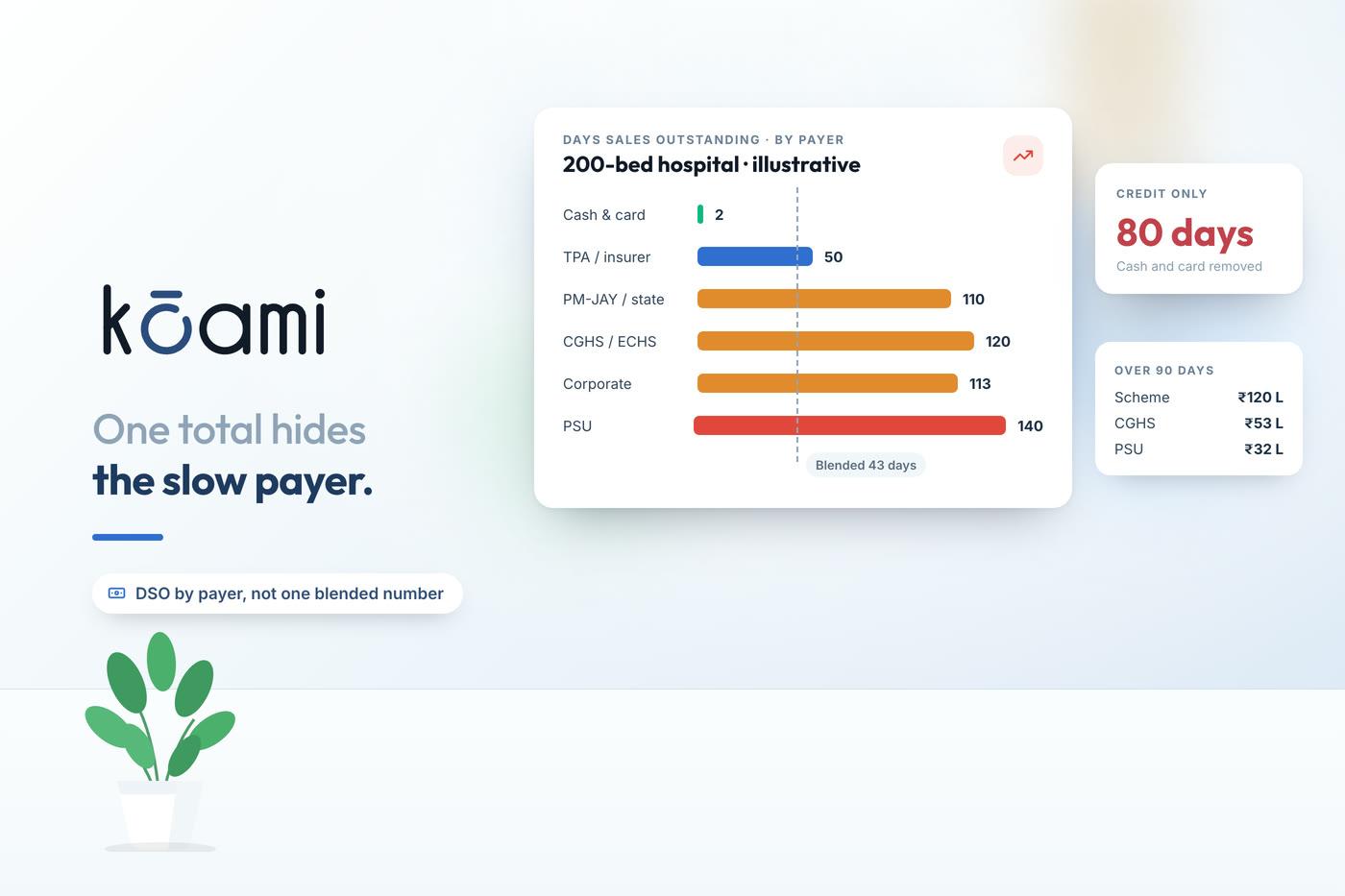
- Cash and card: billed ₹900; outstanding ₹18; DSO 2 days; 0-30 ₹10, 31-60 ₹4, 61-90 ₹2, 91-180 ₹1.5, over 180 ₹0.5; disallowance not applicable.
- TPA and insurer cashless: billed ₹540; outstanding ₹300; DSO 50 days; 0-30 ₹160, 31-60 ₹85, 61-90 ₹30, 91-180 ₹18, over 180 ₹7; disallowance 7%.
- PM-JAY and state schemes: billed ₹270; outstanding ₹330; DSO 110 days; 0-30 ₹80, 31-60 ₹70, 61-90 ₹60, 91-180 ₹85, over 180 ₹35; disallowance 4.5%.
- CGHS and ECHS: billed ₹90; outstanding ₹120; DSO 120 days; 0-30 ₹25, 31-60 ₹22, 61-90 ₹20, 91-180 ₹35, over 180 ₹18; disallowance 3%.
- Corporate credit: billed ₹60; outstanding ₹75; DSO 113 days; 0-30 ₹18, 31-60 ₹15, 61-90 ₹12, 91-180 ₹20, over 180 ₹10; disallowance 2%.
- PSU: billed ₹45; outstanding ₹70; DSO 140 days; 0-30 ₹14, 31-60 ₹13, 61-90 ₹11, 91-180 ₹20, over 180 ₹12; disallowance 1.5%.
- Total: billed ₹1,905; outstanding ₹913; blended DSO 43 days.
Now read it the way an owner should. Blended DSO is 43 days, which sounds comfortable. Strip out cash and card and the credit book is ₹895 lakh outstanding against ₹1,005 lakh billed, a DSO of about 80 days. The scheme row alone carries ₹120 lakh beyond 90 days. PSU and CGHS rows are small in billing but slow, and nearly half of the PSU balance is older than 90 days.
The 43-day figure was never wrong. It was just answering a question nobody needed answered.
Two extra columns worth adding
Two columns make the dashboard much more useful once the basics are stable:
- Hospital-side versus payer-side: split each row into not yet submitted, submitted and pending, queried, and approved but unpaid. Not yet submitted and queried are your own team's backlog. Approved but unpaid is the payer's.
- Discharged, not billed: a separate line for patients who have left but whose final bill has not been raised. This money is invisible in ageing because the clock has not started.
The hospital-side split matters because the most common finding in the first month is that a large slice of the 31 to 60 bucket was never submitted cleanly. That is a process fix, not a collections fight. Our article on claims first-pass rates covers how to get submissions right the first time.
Building the buckets so they can be trusted
A dashboard that finance does not trust gets ignored after two months. These rules keep it honest:
- Age every receivable from the final bill date, not the admission date or the claim approval date.
- Allocate every receipt to a specific bill. Unallocated receipts sitting on account make ageing look worse than it is, then suddenly better.
- Book deductions when the settlement advice arrives, against the bill, with a reason code. Do not leave the short-paid balance sitting as 'outstanding' for a year.
- Treat a rejected claim that is under appeal as its own status, not as normal outstanding.
- Reconcile the dashboard total to the general ledger every month. If the two differ, fix the dashboard before anyone reads it.
- Pull the data from billing, the claim tracker and bank receipts with UTR references, not from a spreadsheet someone updates by hand.
This is where most hospitals stall. Billing lives in one system, the TPA desk tracks claims in a spreadsheet, and bank receipts come from the accounts team at month end. When those three agree only after a week of manual matching, the dashboard is always a month late.
Escalation by bucket
Each bucket should have an owner and a default action. The thresholds below are illustrative starting points; set your own based on your payer mix.
- 0 to 30 days (billing and claim desk): confirm every claim is submitted, complete and acknowledged. Answer queries within one working day. Check that no discharged patient is waiting for a final bill.
- 31 to 60 days (claim desk lead): follow up on each open claim on the payer portal weekly. Chase approved-but-unpaid claims with the TPA's provider team. For schemes, confirm the claim has moved past each review stage.
- 61 to 90 days (billing head): call the insurer or TPA provider relations contact with a list, not one claim at a time. For schemes, raise the pending list with the district or State Health Agency coordinator. For corporates and PSUs, send a statement of account and ask for a payment date in writing.
- 91 to 180 days (CFO): written escalation, citing the payer's own published timelines where they exist. Review whether new credit should continue for a corporate or PSU client that is not paying. Decide on appeals for rejected claims.
- Over 180 days (CFO with owner and auditor): legal review for corporate and PSU balances, a provisioning decision under the policy agreed with your auditor, and write-off only under a board-approved policy with a named approver.
Speed at the front end shortens everything after it. If your 0 to 30 bucket is full of incomplete files, see our guide on reducing claim settlement time.
Context: public reports of delayed scheme dues
Scheme receivables are where most Indian hospital CFOs feel the strain, and the public record shows why it pays to track them separately.
- In a Rajya Sabha reply reported in April 2025, the Minister of State for Health said the National Health Authority's guidelines provide for payment of claims within 15 days of submission for intra-state hospitals and within 30 days for portability claims. The same reply said 609 private hospitals had voluntarily opted out of AB-PMJAY since 2018, and listed reasons that ranged from closures and staff shortages to package rates.
- In April 2026, an association of private hospitals in Jammu and Kashmir said about ₹275 crore was pending under the scheme, according to Medical Dialogues.
- In July 2026, the Himachal Pradesh High Court directed the State to release pending approved bills under AB-PMJAY (₹25.22 crore) and the state's HIMCARE scheme (₹11.03 crore) within three weeks, with interest at 1% of the claim amount per week after 15 days of delay, according to Verdictum's report of the order.
For insurers, IRDAI's Master Circular on Health Insurance Business of 29 May 2024 requires a decision on a cashless authorisation request within one hour of receipt, and final discharge authorisation within three hours of the hospital's request, and press coverage of the circular noted that insurers are to collect required documents from hospitals rather than from patients.
These timelines describe what payers are meant to do. Your dashboard tells you what they actually did, payer by payer, which is the evidence you need when you escalate. It is also what you need before deciding how much of your bed capacity to commit to any one payer. For the scheme workflow itself, see our guide to Ayushman Bharat claims.
A 30-minute monthly review
Once the dashboard exists, the review should be short and the same every month:
- Blended and credit-only DSO, against the last three months.
- Each payer row: has DSO moved by more than ten days, and why?
- Amount over 90 days by payer, and the top ten oldest balances by name.
- Hospital-side backlog: not yet submitted and queried, with the oldest item in each.
- Disallowance percentage by payer, and the top three deduction reasons.
- Discharged-not-billed count and value.
- Decisions: which escalations go out this month, and who signs them.
Treat the accounting choices behind provisioning and write-offs as matters for your auditor and CA. This article describes a management view, not accounting or legal advice.
Where software fits
The dashboard is only as good as the data under it. When the bill, the claim status and the bank receipt live in one system, payer-wise ageing is a report, not a month-end project. Kōami is designed that way: each bill carries its payer, its claim status and its receipts on one account, so the buckets and the hospital-side versus payer-side split come from the same records the billing team already works in. You can see how that fits with the rest of the revenue cycle on our hospital billing software page.
If you would like to see a payer-wise receivables view on synthetic data from a hospital like yours, we can walk you through it. Book a demo: koami.in/book-demo
Frequently asked questions
- How do you calculate DSO for a hospital?
- Divide the amount outstanding by the average daily billing for the period. For a 90-day view, DSO equals outstanding divided by (billing in the last 90 days divided by 90). Calculate it separately for each payer type, because a blended figure hides slow payers behind fast ones.
- What is the count-back method for DSO?
- Start with today's outstanding and subtract each month's billing, newest first, counting the days in every month you fully use up. The leftover is divided by the next month's billing to get a fraction of a month. It handles uneven monthly billing better than the simple average.
- What is the PM-JAY claim payment timeline for hospitals?
- In a Rajya Sabha reply in April 2025, the government said NHA guidelines provide for payment of claims within 15 days of submission for intra-state hospitals and within 30 days for portability claims. Actual payment depends on the State Health Agency.
- Which ageing buckets should a hospital use?
- Five buckets work for most hospitals: 0 to 30, 31 to 60, 61 to 90, 91 to 180 and over 180 days, aged from the final bill date. Keep discharged-but-not-billed cases as a separate line so they are not hidden.
- Should disallowances be shown on the receivables dashboard?
- Yes. Track deductions and rejections as a percentage of the amount claimed, by payer. A payer that pays quickly but deducts heavily can cost more than a slow one.
Sources
- Moneylife: 609 private hospitals opted out of AB-PMJAY, government reply in Rajya Sabha (April 2025)
- Medical Dialogues: J&K private hospitals report about Rs 275 crore pending under Ayushman Bharat (April 2026)
- Verdictum: Himachal Pradesh High Court, Maatri Medicity and Orthocare Hospital v. State of HP, 2026:HHC:29794
- IRDAI: Master Circular on Health Insurance Business, IRDAI/HLT/CIR/PRO/84/5/2024, 29 May 2024
- The Week: IRDAI issues new master circular on health insurance claims (May 2024)
Follow Kōami on LinkedIn
Get the next guide on hospital operations, software and compliance in your feed, as soon as it is published.