GST on Hospital Services in India: Exempt vs Taxable
Published
A hospital CFO once described GST to us as "ninety percent exempt and ten percent of my audit time". Most of what a hospital does is exempt healthcare. The remainder, including premium rooms, the outpatient pharmacy, the canteen, cosmetic procedures and space rented to others, is taxable, and each piece follows a different rule. The billing system has to know which is which on every line of every bill.
This guide is for the CFO and the billing head. It sets out what the GST law says about hospital services, with the notification or circular behind each rule, and then shows how to turn that into tax settings in your billing masters. It reflects the position after the rate changes that took effect on 22 September 2025.
This is general information, not tax advice. Rates and interpretations change. Have your chartered accountant review your tax configuration.
Healthcare services exemption: the definition that matters
The exemption sits at entry 74 of Notification No. 12/2017-Central Tax (Rate), the main exemption notification. It exempts "health care services by a clinical establishment, an authorised medical practitioner or para-medics" and ambulance transport of patients.
Three definitions in paragraph 2 of that notification decide most questions:
- Health care services means "any service by way of diagnosis or treatment or care for illness, injury, deformity, abnormality or pregnancy in any recognised system of medicines in India", including transport of the patient to and from a clinical establishment. It excludes "hair transplant or cosmetic or plastic surgery, except when undertaken to restore or to reconstruct anatomy or functions of body affected due to congenital defects, developmental abnormalities, injury or trauma".
- Clinical establishment covers hospitals, nursing homes, clinics and similar institutions, and also a place set up "to carry out diagnostic or investigative services of diseases". Standalone labs and imaging centres fall within it.
- Authorised medical practitioner means a practitioner registered with a council of a recognised system of medicine.
CBIC Circular No. 32/06/2018-GST adds three useful clarifications in paragraph 5. Services by senior doctors, consultants and technicians hired by hospitals, "whether employees or not", are exempt healthcare services. The entire amount charged to patients, "including the retention money and the fee/payments made to the doctors", is towards exempt healthcare. And food supplied to inpatients as advised by the doctor or nutritionist is part of the composite supply.
The September 2025 changes did not alter entry 74. Notification 16/2025-CT(Rate) amended the exemption list mainly to add individual health and life insurance; the healthcare entry stayed as it was.
Room rent: the ₹5,000 rule
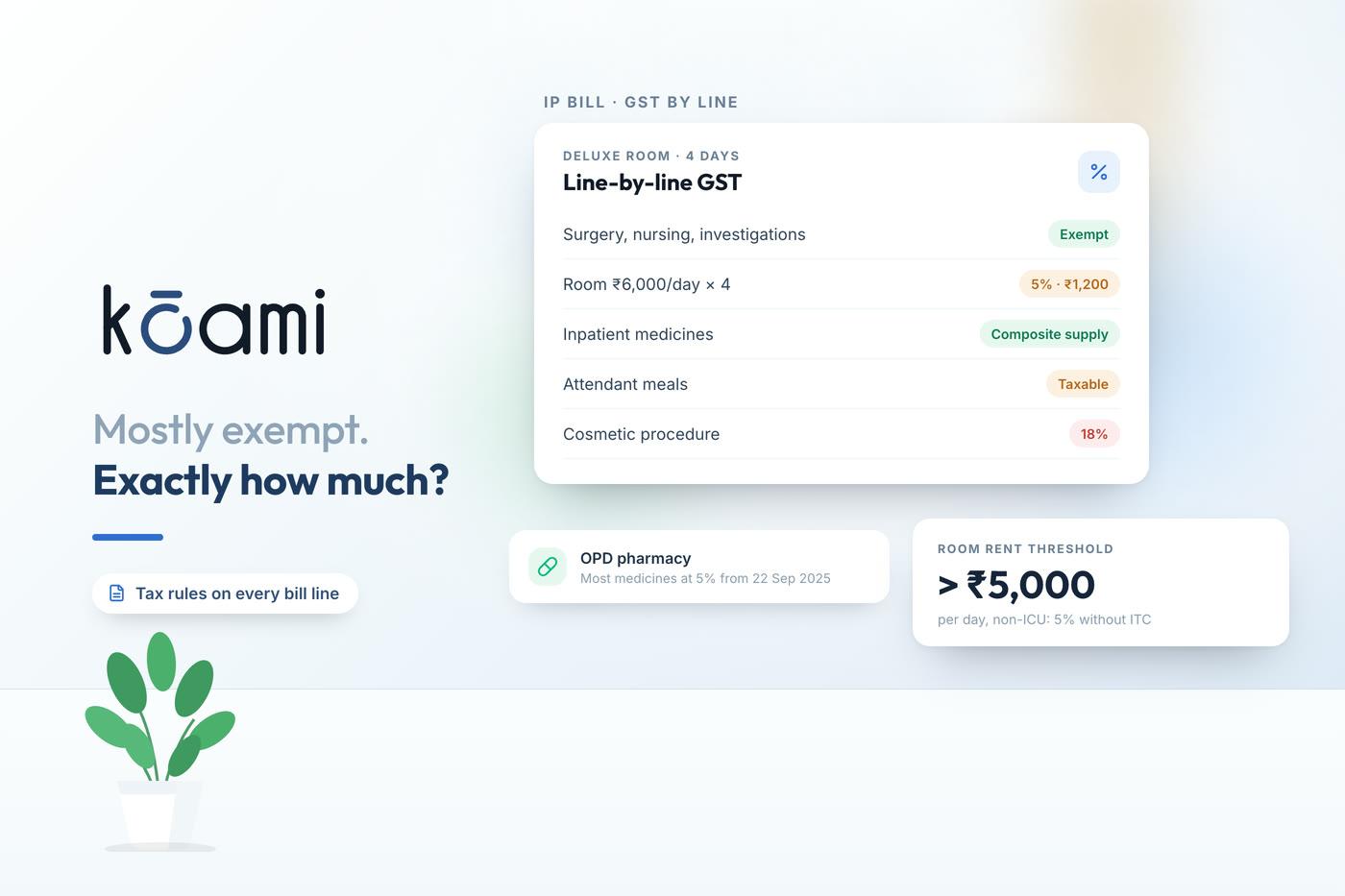
Since 18 July 2022, room charges above ₹5,000 per day have been carved out of the exemption. Notification 04/2022-CT(Rate) added a proviso to entry 74: the exemption does not apply to rooms, other than ICU, CCU, ICCU and NICU, "having room charges exceeding Rs. 5000 per day to a person receiving health care services". Notification 03/2022-CT(Rate) taxes those room charges at 5% (2.5% CGST plus 2.5% SGST), with the condition that input tax credit is not taken.
Points billing teams get wrong:
- The tax is on the whole room charge, not the excess over ₹5,000. The GST Council's 2022 press release describes it as taxed "to the extent of amount charged for the room".
- Exactly ₹5,000 is not "exceeding" ₹5,000. A ₹5,000 room stays exempt.
- ICU-type rooms are excluded whatever the tariff.
- Only the room charge is taxed. Doctor visits, nursing, drugs and procedures for the same patient remain exempt.
Worked example, illustrative: a patient spends 4 days in a deluxe room at ₹6,000 a day and 2 days in the ICU at ₹9,000 a day. Taxable room value is 4 × ₹6,000 = ₹24,000. GST at 5% is ₹1,200 (₹600 CGST, ₹600 SGST). The ICU days, surgery, drugs and investigations carry no GST. If your packages bundle a premium room into a single price, ask your CA how the room component should be identified, because the notification is written around room charges.
Pharmacy: inpatient-bundled vs OPD counter sales
The circular does not address medicines. The common position, supported by the Tamil Nadu Authority for Advance Ruling in the CMC Vellore Association case (Order No. 50/AAR/2019), is that "medicines, drugs, stents, consumables and implants used in the course of providing health care services to in-patients" form a composite supply of inpatient healthcare and are exempt. An advance ruling binds only the applicant, so treat it as persuasive and confirm with your CA.
Outpatient counter sales are a sale of goods and are taxable at the rate applicable to each product. From 22 September 2025:
- Most drugs and medicines moved from 12% to 5%.
- 33 lifesaving drugs moved from 12% to nil, and 3 more from 5% to nil, for cancer, rare diseases and other severe chronic conditions.
- Many medical, surgical and diagnostic devices, diagnostic kits and reagents, bandages and gloves moved to 5%.
Practical consequence: your item master's HSN codes and rates had to be updated from 22 September 2025. A pharmacy still billing at 12% is overcharging patients.
Cosmetic and elective procedures
Cosmetic or plastic surgery, and hair transplant, fall outside "health care services" unless they restore or reconstruct anatomy or function affected by congenital defects, developmental abnormalities, injury or trauma. Excluded procedures are taxed under S.No. 31 of Notification 11/2017-CT(Rate), human health and social care services, at 18% (9% CGST plus 9% SGST).
The test is the purpose of the procedure, not its name. A rhinoplasty after a road accident is reconstruction. The same procedure for appearance is cosmetic. Your billing should not decide this from the procedure code alone: the treating surgeon's documented indication should drive the tax flag.
Canteen, parking and other non-clinical income
- Food to attendants and visitors. Taxable (Circular 32/06/2018, para 5(3)). Restaurant-type supplies are generally taxed at 5% without ITC; confirm the classification with your CA. If the canteen is outsourced, the caterer charges tax and, as the circular notes, the hospital gets no ITC.
- Parking, space rented to pharmacies, banks or ATMs, advertising. These are not healthcare and are taxable at the rate for the service. Confirm the rate for each contract.
- Ambulance. Exempt under entry 74(b).
- Biomedical waste (as a cost). Treatment by a common biomedical waste facility for a clinical establishment moved from 12% to 5% with ITC from 22 September 2025.
- Individual health insurance premiums became exempt from 22 September 2025. This affects patients, not hospital billing.
The service-by-service GST matrix
Use this as a starting checklist for your tax masters. "Reference" is the source to show your auditor.
- Consultations, procedures, surgery, nursing, investigations. Exempt. Reference: 12/2017-CT(R) entry 74(a).
- Ambulance transport of patients. Exempt. Reference: entry 74(b).
- Standalone lab or imaging diagnostics. Exempt as healthcare by a clinical establishment. Reference: para 2(s) definition.
- Doctors' and consultants' fees through the hospital, retention money. Exempt. Reference: Circular 32/06/2018, para 5(1)-(2).
- Room charges up to ₹5,000 a day, and all ICU-type rooms. Exempt. Reference: entry 74 with 04/2022 proviso.
- Room charges above ₹5,000 a day (non-ICU). 5% without ITC on the full room charge. Reference: 03/2022 and 04/2022-CT(R).
- Food to inpatients on medical advice. Exempt (composite supply). Reference: Circular 32/06/2018, para 5(3).
- Food to attendants and visitors. Taxable. Reference: same para; rate per classification.
- Medicines, consumables, implants for inpatient treatment. Generally treated as exempt composite supply. Reference: TN AAR 50/AAR/2019 (persuasive).
- OPD pharmacy counter sales. Taxable at goods rates, mostly 5% from 22 Sep 2025, nil for 36 specified drugs. Reference: 56th Council rate changes.
- Cosmetic or plastic surgery, hair transplant (non-reconstructive). 18%. Reference: 11/2017-CT(R) S.No. 31; exclusion in para 2(zg) of 12/2017.
- Parking, rentals, advertising. Taxable at the service rate. Reference: confirm per contract.
Configuring tax rules in your billing system
The rules are not complicated. The failures come from billing masters that cannot tell an inpatient from a counter customer, or a ₹5,000 room from a ₹5,001 one. A setup that holds up in audit:
- Tax category on every service and item master entry: exempt healthcare, taxable service (with rate and ITC condition), goods (with HSN and rate).
- Room tariff rule: if the per-day room charge is above ₹5,000 and the room type is not ICU, CCU, ICCU or NICU, apply 5% to the room line only.
- Encounter flag on pharmacy issues: inpatient issues follow the encounter's composite treatment; OPD counter sales follow the item's goods rate.
- Indication flag for cosmetic procedures, set from the surgeon's documented indication.
- Separate documents: exempt supplies are billed on a bill of supply and taxable ones on a tax invoice; GST rules also allow a combined invoice-cum-bill of supply. Ask your CA which format suits your billing.
- Rate versioning: keep effective dates on every rate so bills before and after 22 September 2025 calculate correctly on reprint.
- Input credit: because most output is exempt, ITC on inputs used for exempt services is not available, and common credits must be apportioned under the CGST Act and Rules. Your accounts team needs the exempt and taxable turnover split by month, which only clean billing data gives.
When billing, pharmacy and the room board share one patient encounter, these rules can be applied automatically line by line, and the monthly exempt-vs-taxable report comes straight out of the bills. Kōami's billing module is designed this way: tax settings sit on the masters and the encounter type travels with each issue, so an OPD counter sale and a ward issue of the same drug can be taxed differently without manual edits. For how itemised and package bills interact, see package vs open billing and charge capture.
Before your next GST return: a quick audit
- Pull ten bills with room charges above ₹5,000: is GST on the full room charge only?
- Pull ten OPD pharmacy bills dated after 22 September 2025: are rates 5% or nil where applicable, not 12%?
- Check one cosmetic and one reconstructive case: does the tax follow the documented indication?
- Check attendant food and canteen sales: taxed?
- Confirm your bill of supply and tax invoice formats with your CA.
If you want to see how tax categories, room rules and encounter types work together on a live bill, book a demo.
Frequently asked questions
- Is GST applicable on hospital room rent?
- Room charges above Rs 5,000 per day for a patient receiving healthcare are taxable at 5% without input tax credit, under Notifications 03/2022 and 04/2022-CT(Rate), in force since 18 July 2022. ICU, CCU, ICCU and NICU rooms are excluded. The 5% applies to the full room charge, not only the amount above Rs 5,000.
- Is GST charged on medicines given to inpatients?
- Hospitals generally treat medicines, consumables and implants used for inpatient treatment as part of a composite supply of healthcare, which is exempt. The Tamil Nadu AAR in the CMC Vellore case (Order 50/AAR/2019) held this, but an advance ruling binds only the applicant, so confirm your position with your CA. Outpatient pharmacy sales are taxable at the rates for goods.
- Is cosmetic surgery taxable under GST?
- Yes. The definition of health care services excludes hair transplant and cosmetic or plastic surgery, except when done to restore or reconstruct anatomy or functions affected by congenital defects, developmental abnormalities, injury or trauma. Excluded procedures fall under the general entry for human health services at 18%.
- Did the September 2025 GST rate changes affect hospital services?
- The exemption for healthcare services in entry 74 and the room-rent rule were not changed. What changed were goods rates: most medicines moved to 5%, 36 specified lifesaving drugs to nil, and many medical devices and diagnostic kits to 5%. Biomedical waste treatment by a common facility moved from 12% to 5% with ITC.
- Is food served in a hospital taxable?
- Food supplied to inpatients as advised by the doctor or nutritionist is part of the composite healthcare supply and not separately taxable (CBIC Circular 32/06/2018, para 5(3)). Food sold to outpatients, attendants or visitors is taxable.
Sources
- Notification No. 12/2017-Central Tax (Rate), entry 74 and definitions in para 2 (as originally issued, 28 June 2017)
- Notification No. 11/2017-Central Tax (Rate), service rates including S.No. 31 (Heading 9993)
- Notification No. 03/2022-Central Tax (Rate), inserting S.No. 31A (room charges above Rs 5,000)
- Notification No. 04/2022-Central Tax (Rate), proviso to entry 74 for room charges
- CBIC Circular No. 32/06/2018-GST, 12 Feb 2018 (para 5: doctors, retention money, food to inpatients)
- PIB release on the 56th GST Council recommendations (rates effective 22 Sep 2025), hosted by GST Council
- GST Council Newsletter, September 2025 (Notifications 15/2025 and 16/2025-CT(Rate))
- Tamil Nadu AAR Order No. 50/AAR/2019, CMC Vellore Association (medicines and implants to inpatients)
Follow Kōami on LinkedIn
Get the next guide on hospital operations, software and compliance in your feed, as soon as it is published.