Aarogyasri Empanelment, Pre-Auth and Claims for Hospitals
Published
Ask any billing head in a Telangana network hospital what slows Aarogyasri money down and you rarely hear "the Trust rejected the case". You hear about a photograph that wasn't taken at discharge, a patient whose age on the ration card does not match the case sheet, a pre-auth that sat pending because the CT report was uploaded as a blurred phone picture, or an "on bed" status that was not updated for three days.
These are data-capture problems. This guide is for hospital owners and billing heads in Telangana who are empanelled under Rajiv Aarogyasri or thinking about it. It walks through how the scheme works for a hospital, what the Trust's own SOPs say about pre-authorisation and claims, and ends with a field-by-field capture sheet you can use to check your registration, ward and billing screens.
A note on sources: we have used the Rajiv Aarogyasri Health Care Trust's own published scheme pages, FAQs and SOPs, and Telangana government documents. Some SOPs on the Trust's site were written before the scheme's 2023 expansion and still mention older limits, so timelines below should be read as the Trust's published process and confirmed with your district coordinator.
How does Rajiv Aarogyasri work for an empanelled hospital?
Rajiv Aarogyasri is a cashless scheme run by the Rajiv Aarogyasri Health Care Trust for families below the poverty line in Telangana. The Trust's scheme page states cover of up to ₹10 lakh per family per year and lists 1,672 treatments under the "converged scheme". The state government raised the limit from ₹5 lakh to ₹10 lakh with effect from 9 December 2023. The Socio-Economic Outlook 2026 adds that 163 new procedures were added to the treatment basket and puts the network at 1,538 empanelled hospitals.
Since May 2021 the scheme has run together with Ayushman Bharat PM-JAY and is co-branded "Ayushman Bharat PM-JAY Rajiv Aarogyasri". For a hospital desk this means two related systems: the Trust's own portal and the NHA's Transaction Management System. The Trust's homepage links to both. Which one a case runs through depends on the beneficiary and scheme rules, so your desk needs to know which is which for each patient.
The key people on the hospital side are:
- Aarogyamithra: a Trust-side facilitator at the scheme kiosk at reception who verifies eligibility documents, registers the patient, takes the digital photograph, facilitates admission and pre-auth, and handles discharge counselling.
- MEDCO (Medical Coordinator): an allopathic doctor nominated by the hospital who is responsible for all workflow entries in the Trust portal.
- Network Team Leader and District Manager: Trust field staff who check registers, kiosks and on-bed status.
What does empanelment require?
The Trust's revised scheme guidelines on empanelment (Chapter 7, dated January 2023) set out what a hospital needs. The headline requirements:
- Registration under the Telangana allopathic private medical care establishments law and, where relevant, the PCPNDT Act; private hospitals need a ROHINI ID.
- At least 50 beds with 60 sq ft spacing; 20 beds for ENT, ophthalmology, thalassemia and standalone dialysis.
- Casualty with at least 5% of beds (minimum three), ICU with at least 10% (minimum five), post-operative ward with at least 5% (minimum three), each with monitors, defibrillators, crash carts and central oxygen and suction as described.
- A separate scheme OPD, separate male and female wards, and at least 25% of bed strength in each speciality allocated to scheme patients.
- A 50 sq ft Aarogyasri kiosk at reception, near the entrance.
- A doctor nominated as MEDCO.
- Hospitals fully accredited by NABH are auto-empanelled if they apply, with inspection within three months for continuation.
Specialty-specific manpower and equipment are in the guideline's annexures. Applications are online, and the guidelines note that applications with incomplete eligibility information are liable to be rejected.
Pre-authorisation: documents and photographs
The Trust's Network Hospital SOP describes the MEDCO's pre-auth duty plainly: obtain online pre-authorisation "by uploading all the required documents like white ration card / patient photo / necessary reports like x-ray film, surgical profile, ct". The Aarogyamithra then sends the pre-auth to the Trust within ten minutes of the MEDCO updating it.
The Trust's Pre-Authorisation and Claims SOP describes what happens next:
- Pre-auth requests are scrutinised at three levels: pre-auth executive, specialist, and a Trust doctor for final approval, within 12 hours of submission.
- A query on an incomplete request can be raised no more than once at each level; a query allows an extra six hours, for final approval within 18 hours.
- In emergencies the hospital obtains telephonic pre-authorisation through the Trust's dedicated lines, only after confirming the case is within the scheme. It is provisional and must be followed by a regular pre-auth within 24 hours.
- Pre-authorisation runs 24x7, all year.
The FAQ adds that in an emergency the patient gets 48 hours to produce the eligibility card.
Practical rule for the desk: upload evidence that a specialist can read on screen. The approval is based on "online evidence of diagnosis and choice of treatment". A cropped, legible report scan with the patient's name visible is worth more than a full-page phone photo taken at an angle.
Admission-day data capture that avoids rework
Most claim queries can be traced back to the first two hours of the admission. Get these right and the rest of the stay is mostly routine.
- Identity exactly as on the eligibility card. Name spelling, age and gender must match the card, the case sheet and every report. The Trust offers a "change management" request to fix age, sex or photo mismatches, which tells you how often this happens.
- Card type and number recorded in a structured field, not in free text.
- Package code chosen from the scheme list at the time of pre-auth, with the rate it carries.
- Admission type: planned or emergency, and if emergency, the time of telephonic intimation. The SOP expects surgery within 24 hours of telephonic intimation.
- Bed and ward allocated and the online "on bed" status updated. The SOP asks for online on-bed status to match actual on-bed daily.
Discharge, follow-up and claim submission
Discharge under Aarogyasri has more evidence requirements than a typical cash discharge. From the Trust's SOPs and FAQ:
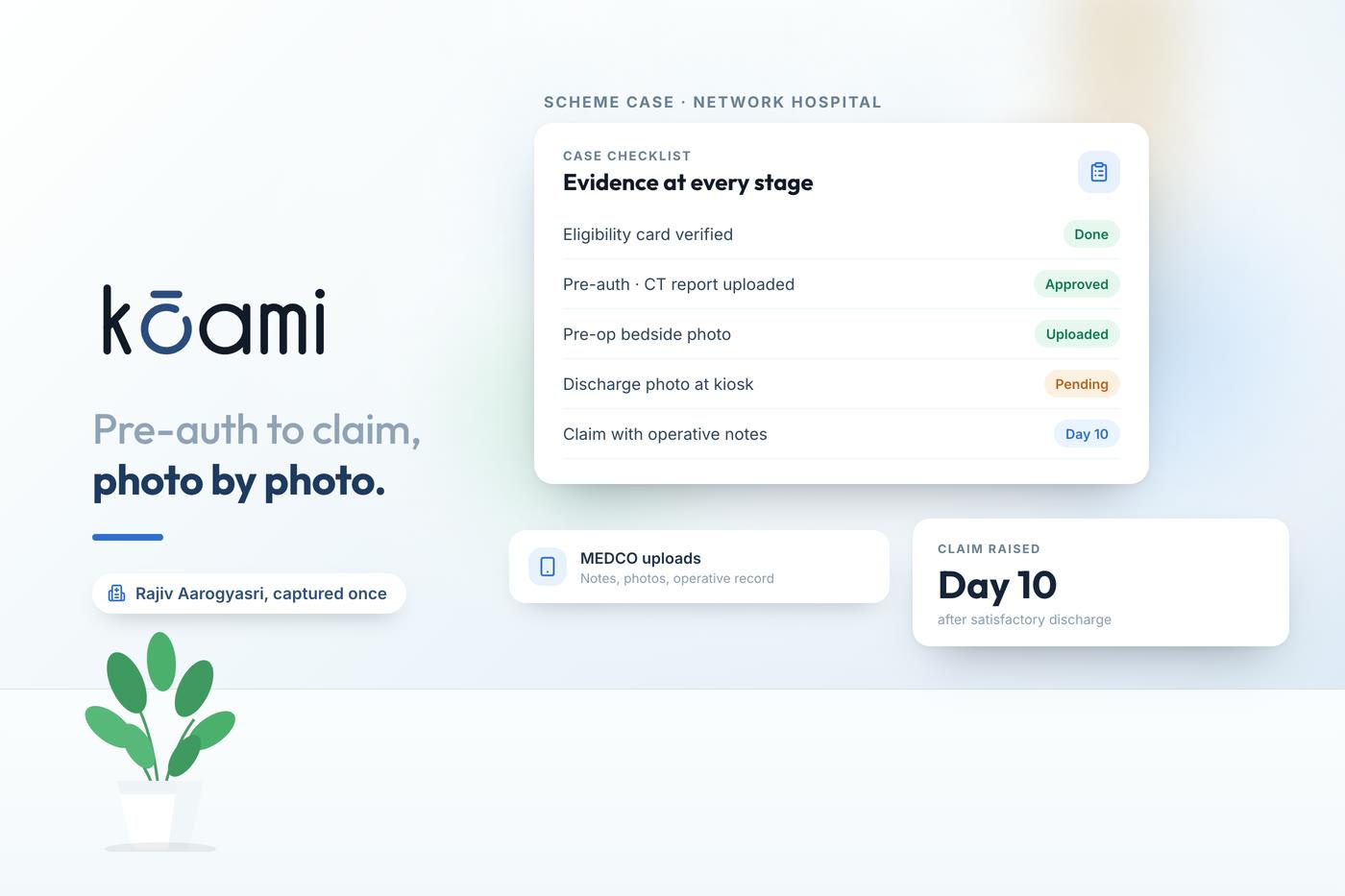
- Photographs uploaded by the MEDCO: pre-operative bedside, immediate post-operative, and the wound at the time of discharge.
- A discharge photograph at the kiosk with the patient, the Aarogyamithra and the MEDCO, showing the transport charges, ten days of medicines and the satisfaction letter.
- Discharge summary with follow-up advice, ten days of post-discharge medication, and transport charges at RTC fare from the mandal headquarters.
- Follow-up from the 11th day for one year for 125 listed follow-up procedures, with details updated online within 24 hours of each follow-up visit.
Claims, per the Trust SOP, rest on three conditions: a granted pre-auth for the listed therapy (including changes intimated to the Trust), a claim amount within the pre-auth amount plus any enhancement, and evidence that the therapy was performed, for example "an intra-operative photograph or a scar photograph linking the identity of the patient with the therapy or case sheet". The hospital raises the claim after ten days of satisfactory discharge, uploading operative notes, post-operative details and the case sheet. The SOP describes four levels of scrutiny and settlement within seven days, with seven extra days if a claim is returned for clarification.
Common reasons claims get queried
We have not seen a published Trust analysis of query reasons. From the SOP requirements above, these are the gaps most likely to cause a query or return:
- Identity mismatch between card, case sheet and photographs
- Missing or unclear photographs at one of the required stages
- Change in procedure during the stay that was not intimated or enhanced
- Claim amount above the pre-auth plus approved enhancements
- Operative notes or post-operative details missing at claim stage
- On-bed status that does not match the case sheet dates
- Telephonic intimation not followed by a regular pre-auth within 24 hours
The capture sheet: field by field, stage by stage
Use this to audit your screens and registers. If a field is captured on paper only, it is a likely source of rework.
Registration and eligibility
- Patient name, age, gender exactly as on the card
- Card type (food security card, Aarogyasri health card, other) and number
- Patient photograph taken at the kiosk
- Referral source: PHC, health camp, call centre, direct walk-in or emergency
- Scheme route: Trust portal or NHA TMS
Pre-authorisation
- Provisional diagnosis and planned therapy
- Package code and package amount
- Supporting reports uploaded (imaging, lab, surgical profile), each legible and named
- Emergency: telephonic intimation time and reference; regular pre-auth time (within 24 hours)
- Pre-auth submitted time, query time, query answer time, approval time
Inpatient stay
- Bed number and online on-bed update date
- Daily clinical notes, pre- and post-operative
- Change of therapy or enhancement request, with reason and time
- Operative notes, with surgeon and date
Discharge
- Pre-op bedside, immediate post-op and wound photographs
- Kiosk discharge photograph with patient, Aarogyamithra and MEDCO
- Discharge summary with follow-up advice
- Ten days of medicines issued, transport charges paid, satisfaction letter signed
Claim and follow-up
- Claim raised date (after ten days of satisfactory discharge)
- Documents attached: operative notes, post-op details, case sheet
- Claim status at each scrutiny level; return reason and response date
- Payment received date and amount, matched to the claim
- Follow-up visits for eligible procedures, updated within 24 hours
Reconciling Aarogyasri with PM-JAY in one hospital
A hospital empanelled under the converged scheme often handles Aarogyasri, PM-JAY, the state employees' health scheme and private insurance in the same week. Mixing them is how receivables get lost.
- Keep one payer master with each scheme as a separate payer, so receivables age separately.
- Record the route (Trust portal or TMS) for every case at registration, so the desk logs into the right system.
- Load package masters per scheme and version them when the Trust revises rates. Do not overwrite last year's rates; claims from the old period still need them.
- Reconcile weekly: pre-auths approved vs claims raised vs payments received, by scheme. Cases discharged more than ten days ago with no claim raised are the first list to chase.
Our posts on PM-JAY empanelment and Ayushman Bharat claims cover the national side.
Where a connected system helps
The capture sheet is long because the scheme asks for evidence at every stage. When registration, the ward, OT notes, pharmacy issue and billing share one patient record, most fields are captured once and reused: the operative note feeds the claim, the issue of ten days of medicines is recorded where it happens, and the claim checklist can show what is missing before submission. Kōami keeps scheme cases on the same patient record as clinical and billing data and can track each case's pre-auth, discharge and claim dates, so the billing head sees one list of what is stuck and why. It works alongside the Trust and NHA portals; it does not replace them.
This guide summarises the Trust's published documents for general information. Scheme rules, package lists and timelines change. Confirm current requirements with Rajiv Aarogyasri Health Care Trust and your district coordinator.
If you run a network hospital in Telangana and want to see how scheme cases look on one patient record, book a demo.
Frequently asked questions
- What is the coverage under Rajiv Aarogyasri in Telangana?
- The Trust's scheme page states cover of up to Rs 10 lakh per family per year for eligible BPL families. The Telangana government raised the limit from Rs 5 lakh to Rs 10 lakh with effect from 9 December 2023.
- What are the minimum bed requirements for Aarogyasri empanelment?
- The Trust's revised empanelment guidelines (January 2023) ask for at least 50 beds with 60 sq ft spacing, and 20 beds for ENT, ophthalmology, thalassemia and standalone dialysis. They also set percentages for casualty, ICU and post-operative beds and require at least 25% of beds in each speciality for scheme patients. Check the current version with the Trust before applying.
- Who is the MEDCO in an Aarogyasri hospital?
- The Medical Coordinator is an allopathic doctor nominated by the hospital who is responsible for all workflow entries in the Trust portal: online OP and IP status, pre-authorisation uploads, clinical notes, photographs, discharge and claim documents.
- Which photographs does an Aarogyasri claim need?
- The Trust's network hospital SOP asks the MEDCO to upload pre-operative bedside, immediate post-operative and wound-at-discharge photographs, and a discharge photograph at the Aarogyasri kiosk with the patient, the Aarogyamithra and the MEDCO. The claims SOP treats an intra-operative or scar photograph linking patient identity to the therapy as evidence of performance.
- When can a hospital raise an Aarogyasri claim?
- The Trust's claims SOP says the network hospital raises the claim after 10 days of satisfactory discharge, uploading operative notes, post-operative details and the case sheet. Timelines in the published SOPs may have been revised since the scheme's expansion, so confirm with the Trust.
Sources
- Rajiv Aarogyasri Scheme, Rajiv Aarogyasri Health Care Trust, Government of Telangana
- Guidelines, Manuals and SOPs (Pre-Authorisation and Claims SOP; Network Hospital SOP; Revised Scheme Guidelines Chapters 7 and 8 on Empanelment, Jan 2023), Rajiv Aarogyasri Health Care Trust
- Frequently Asked Questions, Rajiv Aarogyasri Health Care Trust
- Telangana State Formation Day press release (Aarogyasri cover raised to Rs 10 lakh from 9 Dec 2023), Government of Telangana, June 2024
- Telangana Socio-Economic Outlook 2024, Planning Department (Box 3.4 and section 3.3.13)
- Telangana Socio-Economic Outlook 2026, Planning Department (section 9.5.1)
Follow Kōami on LinkedIn
Get the next guide on hospital operations, software and compliance in your feed, as soon as it is published.