Schedule H1 Register Format for Hospital Pharmacies
Published
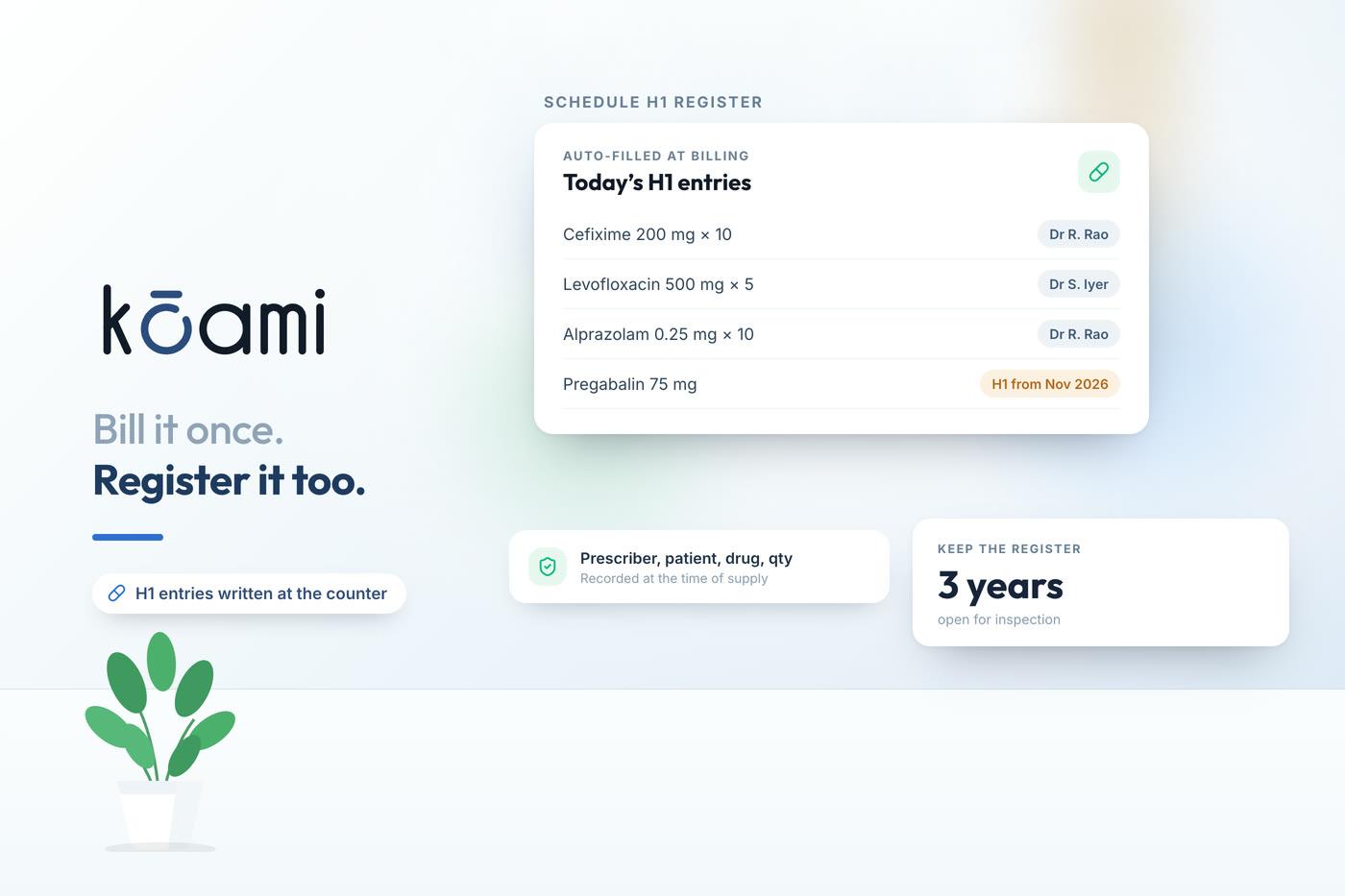
It is 9:30 on a Monday at the hospital's retail pharmacy. The queue has eleven people in it. A patient's attendant hands over a discharge prescription with cefixime, levofloxacin and alprazolam on it. The pharmacist bills it in under a minute. Writing the three H1 entries into the register by hand, with the prescriber's name and address, the patient's name, the drug and the quantity, takes longer than the billing. On a busy day the register gets filled in at 6 pm from the day's bills, which is exactly what the rule says not to do: entries must be made "at the time of the supply".
This guide is for pharmacy managers and pharmacists in charge at hospital pharmacies. It explains what Schedule H1 covers, what the register must contain, how long to keep it, what has changed on the list through 2026, and how to make the register a by-product of billing rather than a second job.
What does Schedule H1 cover?
Schedule H1 was added to the Drugs and Cosmetics Rules (now titled the Drugs Rules, 1945) by G.S.R. 588(E) dated 30 August 2013, coming into force six months after publication, which is why 1 March 2014 is usually quoted. It brought third- and fourth-generation antibiotics, anti-tuberculosis drugs and certain habit-forming drugs under tighter retail control than ordinary Schedule H drugs. The schedule applies to the listed substances, their salts and preparations, excluding preparations for topical or external use (other than ophthalmic, ear and nose preparations).
The original 2013 list had 46 entries, including alprazolam, cefixime, cefpodoxime, ceftriaxone, codeine, diazepam, imipenem, isoniazid, levofloxacin, meropenem, midazolam, moxifloxacin, rifampicin, tramadol and zolpidem. Since then CDSCO has notified these changes:
- Oxytocin moved from Schedule H to H1: G.S.R. 795(E), 21 August 2018.
- Tapentadol added: G.S.R. 258(E), 7 April 2021, in force from 1 November 2021.
- Oseltamivir and Zanamivir added: G.S.R. 95(E), 5 February 2024.
- Pregabalin added as entry 51: G.S.R. 377(E), 13 May 2026. The notification says it comes into force 180 days after publication in the Gazette, which falls in mid-November 2026.
- Oral formulations containing more than 12% alcohol v/v in packs above 30 ml added as entry 52: G.S.R. 607(E), 8 July 2026, in force six months after publication, around January 2027.
So in late October 2026, 50 entries are in force, with two more about to take effect. A draft notification in August 2026 proposed adding further drugs; drafts are not law until finally notified. Check CDSCO's gazette notifications page before you update your item master.
Labelling you should see on the pack
Rule 97 requires H1 drugs to carry the symbol Rx in red at the top left of the label and a warning in a box with a red border: "SCHEDULE H1 DRUG – WARNING: It is dangerous to take this preparation except in accordance with the medical advice. Not to be sold by retail without the prescription of a Registered Medical Practitioner." At goods receipt, a pack without this label for an H1 drug is worth a question to the supplier.
Required register fields
Rule 65(3)(1)(h) is short and specific: "the supply of a drug specified in Schedule H1 shall be recorded in a separate register at the time of the supply giving the name and address of the prescriber, the name of the patient, the name of the drug and the quantity supplied and such records shall be maintained for three years and be open for inspection."
Four things follow from that sentence:
- Separate register. H1 entries are not mixed into the general prescription register.
- At the time of supply. Not at end of day.
- Four mandatory data items. Prescriber name and address, patient name, drug name, quantity.
- Three years, open to inspection.
Rule 65 applies to holders of retail licences in Forms 20, 20-A, 20-B, 20-F, 20-G, 21 and 21-B, which covers most private hospital pharmacies. Supplies by doctors to their own patients and by government hospitals are dealt with under Schedule K, with their own conditions. If your hospital supplies H1 drugs to inpatients through a ward-issue system rather than over the counter, ask your state drugs control authority how they expect those supplies to be recorded.
Template: a Schedule H1 register format
The rule sets a minimum. A format that satisfies it and also helps your own audits:
- Serial number (continuous, never reused)
- Date and time of supply
- Bill or invoice number
- Patient name (and UHID for hospital patients)
- Prescriber name
- Prescriber address (hospital address for in-house consultants; clinic address for outside prescribers)
- Prescriber registration number (not required by the rule, but useful for verification)
- Drug name, strength and dosage form
- Batch number and expiry
- Quantity supplied
- Prescription reference: OP number, IP number or scanned prescription ID
- Pharmacist who dispensed (name or ID)
The first six data items after the serial number cover the rule's four requirements. The rest make it possible to trace a supply to a prescription and a batch, which is what you need when a quantity looks wrong or a batch is recalled.
Retention period
Three years for the H1 register under Rule 65(3)(1)(h). Two related periods in the same rule:
- Rule 65(7): other registers and records under Rule 65 are kept for at least two years from the last entry, unless otherwise provided.
- Rule 65(9)(b): signed orders for Schedule H, H1 or X drugs supplied to doctors or hospitals are kept for two years.
Our medical records retention schedule lists these alongside clinical, PCPNDT and NDPS periods.
Audit findings that recur
We have not seen published national data on H1 inspection findings. From the rule itself, these are the gaps an inspector can test in minutes:
- Entries written up at end of day from bills, with times that do not match the bills
- Prescriber address missing, or "Dr. X" with no full name
- Quantities in the register that do not match the bill or the stock movement
- Drugs added to Schedule H1 since 2013, such as oseltamivir, tapentadol or oxytocin, not flagged as H1 in the item master, so their sales never reach the register
- Registers older than three years destroyed early, or current registers kept off-site and not available for inspection
- Sales of H1 drugs without a valid prescription on file
Audit checklist for the pharmacist in charge
Run this monthly, and before any inspection:
- Item master: every Schedule H1 drug flagged, including 2018, 2021 and 2024 additions; pregabalin flagged from its effective date; alcohol-containing oral liquids above 12% in packs over 30 ml reviewed before January 2027
- Sample 20 H1 bills from the month: each has a matching register entry with all four mandatory fields
- Entry times match bill times
- Register quantities match stock movement for three sampled H1 drugs
- Prescriptions on file for sampled entries
- Registers for the last three years available on the premises
- New pharmacists trained on H1 entries during induction
Auto-filling the register at the point of sale
The register only needs four data items, and all of them already exist at the moment of billing: the prescriber is on the prescription, the patient is on the bill, the drug and quantity are the line item. The manual register exists because those facts live in the billing system and the register lives in a book.
When the item master knows which drugs are H1, the counter can do the work:
- Flag at item level. Each H1 drug carries a flag in the item master, with an effective date so that pregabalin, for example, starts being recorded on the right day.
- Block the sale without prescriber details. If an H1 item is on the bill, the prescriber name and address must be filled before the bill can close.
- Write the entry at billing time. The register line is created from the bill, with the same timestamp, so "at the time of the supply" is met by design.
- Print or export on demand. A date-range register for the inspector, in the format above, in seconds.
- Link to the prescription. For hospital patients, the OP or IP prescription is already in the EMR; for outside prescriptions, a scan is attached to the bill.
There is a clinical reason to want this too. NABH's 6th edition standards expect an antimicrobial usage policy (IPC.3.e) and an antimicrobial stewardship programme that "monitors the use of antimicrobial agents" (IPC.3.f). Many H1 drugs are exactly the antibiotics a stewardship committee watches. A register built from bills is also a ready-made dataset for that committee.
Kōami's pharmacy module records the prescriber and patient against each billed line, so controlled-drug registers can be produced from the same transactions that move stock. Our guides on the NDPS register and batch and expiry control cover the related disciplines.
Watch list for 2026–27
- Mid-November 2026: pregabalin becomes an H1 drug. Flag it and brief staff.
- Around January 2027: oral formulations containing more than 12% alcohol in packs above 30 ml join Schedule H1.
- Drafts in progress: CDSCO has published draft rules in 2026 on further H1 additions, antimicrobial label markings and CCTV at retail counters. Track whether they are finally notified.
This guide is general information, not legal advice. Your state drugs control authority's directions apply to your licence.
If you want to see an H1 register generated straight from counter billing, book a demo.
Frequently asked questions
- What details must be recorded in a Schedule H1 register?
- Rule 65 of the Drugs Rules, 1945 requires the supply of a Schedule H1 drug to be recorded in a separate register at the time of supply, giving the name and address of the prescriber, the name of the patient, the name of the drug and the quantity supplied. The patient's address is not required by the rule.
- How long must the Schedule H1 register be kept?
- Three years, and it must be open for inspection, under Rule 65 of the Drugs Rules, 1945.
- How many drugs are in Schedule H1 now?
- The 2013 schedule had 46 entries. Oxytocin, Tapentadol, Oseltamivir and Zanamivir were added later, giving 50 entries in force in October 2026. Pregabalin (entry 51) was notified in May 2026 to take effect 180 days after publication, and oral formulations with more than 12% alcohol in packs above 30 ml (entry 52) take effect six months after July 2026.
- Does the H1 register apply to hospital pharmacies?
- Rule 65 applies to retail licences in Forms 20, 20-A, 20-B, 20-F, 20-G, 21 and 21-B, which most private hospital pharmacies hold. Government hospitals and doctors supplying their own patients are dealt with under Schedule K, which has its own conditions. Check with your state drugs control authority how inpatient supplies are to be recorded.
- Can the Schedule H1 register be maintained electronically?
- The rule requires a separate register with specified details, kept for three years and open to inspection. Many pharmacies keep it electronically. Confirm with your state drugs control authority that your electronic format, printouts and signatures meet their expectations before you stop keeping a paper register.
Sources
- Drugs and Cosmetics Act 1940 and Drugs Rules 1945, consolidated (Rule 65, Rule 97, Schedule H1), CDSCO
- G.S.R. 588(E), 30 Aug 2013: Drugs and Cosmetics (Fourth Amendment) Rules, 2013 inserting Schedule H1, CDSCO
- G.S.R. 95(E), 5 Feb 2024: Oseltamivir and Zanamivir added to Schedule H1, CDSCO
- G.S.R. 377(E), 13 May 2026: Drugs (Second Amendment) Rules, 2026 adding Pregabalin to Schedule H1, CDSCO
- G.S.R. 607(E), 8 Jul 2026: Drugs (Tenth Amendment) Rules, 2026 on oral formulations with more than 12% alcohol, CDSCO
- CDSCO Gazette Notifications index (amendments to Schedule H1)
- NABH Accreditation Standards for Hospitals, 6th Edition (IPC.3.e and IPC.3.f on antimicrobial policy and stewardship)
Follow Kōami on LinkedIn
Get the next guide on hospital operations, software and compliance in your feed, as soon as it is published.