Antimicrobial Stewardship Data: AWaRe, DOT, DDD in Hospitals
Published
The antimicrobial stewardship committee meets on the second Thursday. The clinical microbiologist brings the antibiogram. The pharmacist brings last month's antibiotic purchases in rupees. The ICU head brings a sense that carbapenem use has gone up. Forty minutes later, nobody can say how many patient-days of meropenem were given last month, in which units, or whether that is more than in March. The committee agrees to look into it, and the minutes say the same thing the next month.
This piece is for the AMS lead, usually the clinical microbiologist or an infectious diseases physician, working with the hospital pharmacist. It covers how to classify antibiotic use by WHO AWaRe group, how to calculate days of therapy (DOT) and defined daily doses (DDD) without counting errors, how to run restricted-antibiotic approvals so they produce data, and a monthly report template you can adapt. It is about data and workflow. It does not recommend any drug for any indication; that belongs to your antibiotic policy and your clinicians.
Why stewardship needs data, not just a policy
Most hospitals have an antibiotic policy document. Fewer can show what happened after it was approved. The NABH 6th edition hospital standard, effective from 1 January 2025, asks for both: IPC.3.e requires an appropriate antimicrobial usage policy to be established and documented, and IPC.3.f requires the hospital to implement an antimicrobial stewardship programme and monitor the use of antimicrobial agents. The NABH KPI annexure adds one stewardship-related indicator every hospital reports: the percentage of surgical cases receiving appropriate prophylactic antibiotics within the specified time frame, judged against hospital policy.
ICMR's Antimicrobial Stewardship Program Guideline (2018) is more specific about measurement. Among its process measures it lists the amount of antibiotic in DDD per 100 bed days, compliance with empiric guidance, appropriate de-escalation, appropriate IV-to-oral switch and compliance with surgical prophylaxis. It states that the outcome of the AMSP will be based on days of therapy per 1,000 patient days, including the proportion of antibiotic prescription, de-escalation, intervention rate and acceptance rate. It also recommends that clinicians review antibiotics 48 hours after prescription, the antibiotic time-out.
The national context has moved too. The Union Health Ministry launched the National Action Plan on Antimicrobial Resistance 2.0, covering 2025 to 2029, on 18 November 2025. For a hospital, that plan does not change your monthly arithmetic, but it does mean stewardship data will be asked for more often, by more people.
AWaRe categories in brief
WHO's AWaRe classification sorts antibiotics into three groups based on their impact on antimicrobial resistance. WHO's 2019 release described them this way:
- Access: antibiotics with activity against a wide range of commonly encountered susceptible pathogens, with lower resistance potential than the other groups
- Watch: antibiotics with higher resistance potential, including most of the highest-priority agents among the critically important antimicrobials for human medicine
- Reserve: antibiotics that should be reserved for confirmed or suspected infections due to multidrug-resistant organisms
WHO published the current classification for evaluation and monitoring of use on 5 September 2025, and it is updated every two years by the WHO Expert Committee on Selection and Use of Essential Medicines. That update cycle matters operationally: if an antibiotic moves group between editions and you overwrite the tag in your item master, your 12-month trend breaks silently. Store the AWaRe group with its edition year.
On targets, the UN General Assembly's political declaration on AMR (resolution 79/2, 7 October 2024) aims, by 2030 and taking into account national contexts, for at least 70 per cent of overall human antibiotic use globally to be Access group antibiotics. WHO's earlier programme of work carried a country-level target of at least 60 per cent. Both are population targets. A tertiary referral hospital with a large ICU will not look like a national average, and should not pretend to. Use the AWaRe split to watch your own direction of travel, unit by unit.
Days of therapy and defined daily doses
ICMR's guideline describes the two measures plainly. DOT is the aggregate sum of days for which any amount of a specific antimicrobial agent is administered or dispensed to a particular patient, divided by a standardised denominator of patient days. DDD aggregates the total grams of each antibiotic purchased, dispensed or administered in a period and divides by the WHO-assigned DDD.
The WHO Collaborating Centre defines the DDD as the assumed average maintenance dose per day for a drug used for its main indication in adults, and is explicit that it is a unit of measurement, not a recommended or prescribed dose. The DDD values themselves come from the WHO ATC/DDD Index.
The counting rules that cause most errors:
- One DOT per patient, per agent, per calendar day, however many doses were given that day
- Two agents on the same day count as two DOT. Combination therapy shows up, which is the point
- Count from administration records (eMAR or nursing medication charts), not from orders and not from pharmacy issues
- Use the same patient-day definition every month. Decide once whether day cases and the day of discharge are in the denominator, and write it down
- ICMR notes DDD is not appropriate for children or for patients with reduced drug excretion such as renal impairment; use DOT for paediatric units
A worked calculation (illustrative)
A 150-bed hospital records 3,600 patient days in September. All numbers below are illustrative.
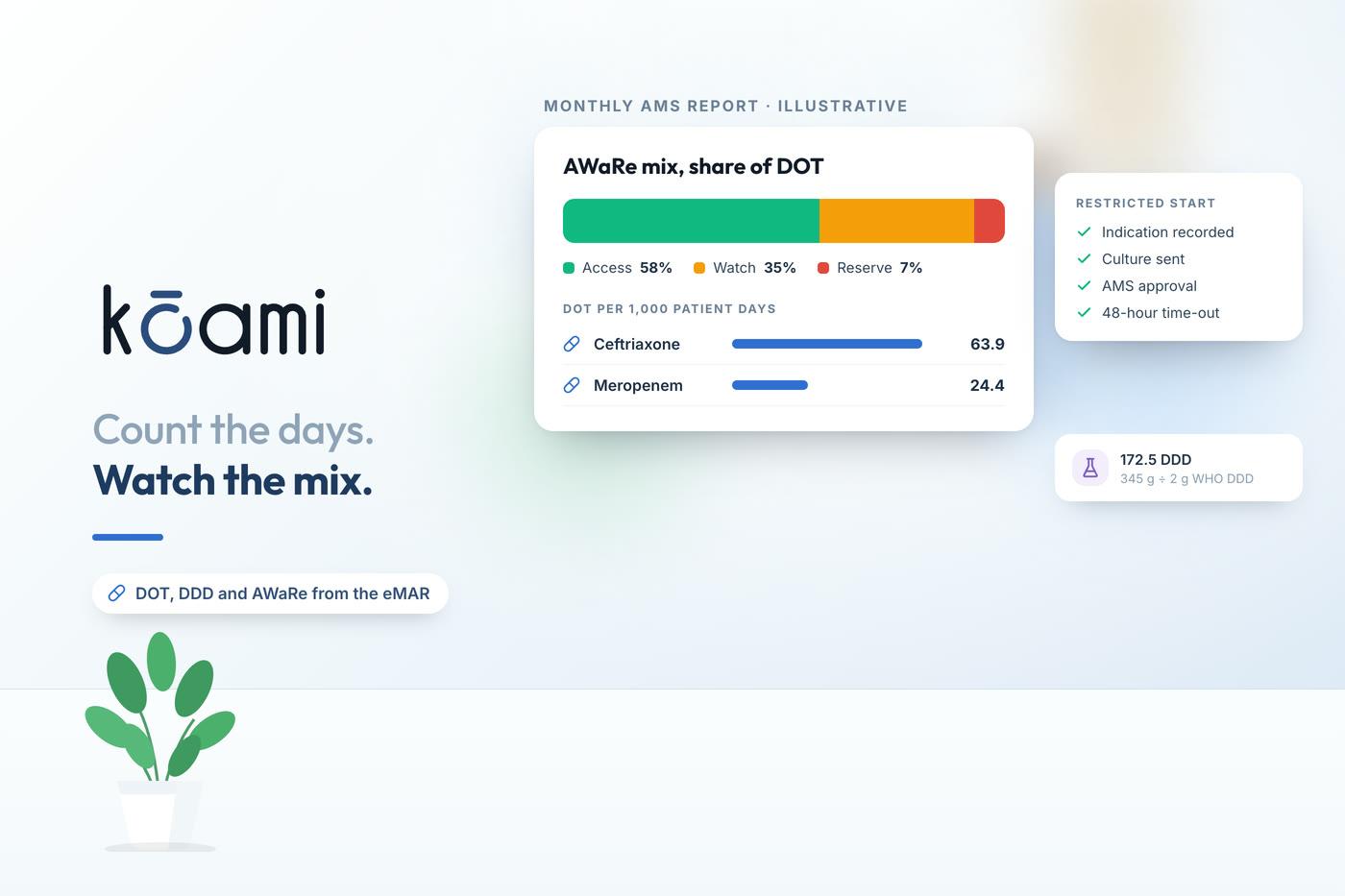
- Ceftriaxone: 52 patients received it for a combined 230 calendar days. Total administered: 345 g. WHO DDD for parenteral ceftriaxone: 2 g
- Meropenem: 14 patients for a combined 88 days. Total administered: 228 g. WHO DDD for parenteral meropenem: 3 g
DOT per 1,000 patient days:
- Ceftriaxone: 230 divided by 3,600, x 1,000 = 63.9
- Meropenem: 88 divided by 3,600, x 1,000 = 24.4
DDD per 100 bed days:
- Ceftriaxone: 345 g divided by 2 g = 172.5 DDD; 172.5 divided by 3,600, x 100 = 4.8
- Meropenem: 228 g divided by 3 g = 76 DDD; 76 divided by 3,600, x 100 = 2.1
Notice that ceftriaxone shows 230 DOT but only 172.5 DDD. That gap appears whenever the dose actually given differs from the WHO DDD. Neither number is wrong. They answer different questions: DOT tells you how many patient-days of exposure occurred, DDD tells you how much drug was consumed in a standard unit that is comparable with published studies. Report both, and do not compare DDD across units with very different dosing, such as paediatrics and adult ICU.
The restricted-antibiotic approval workflow
ICMR lists formulary restriction and pre-authorisation as one of six strategic approaches, alongside prospective audit and feedback. In many hospitals restriction exists on paper and approvals happen over a phone call that leaves no record. A workflow that produces data looks like this:
- Step 1: The prescriber orders an antibiotic your policy marks as restricted. The order screen asks for the indication, whether cultures were sent, and the sample ID
- Step 2: The request routes to the AMS team member on call, with the patient's recent cultures, renal function and current antibiotics on one screen
- Step 3: The approver records approve, modify or decline, with a reason code. Your policy defines how urgent cases are handled so that approval never becomes a source of delay in care
- Step 4: Pharmacy dispenses against an approval reference, and the approval carries an expiry date tied to the review you have set
- Step 5: At 48 hours, the system prompts the treating team for the antibiotic time-out ICMR recommends: continue, change, de-escalate or stop, with the reason recorded
- Step 6: When a culture and sensitivity result is released, the treating team and AMS team are notified, the same way critical results reach the right person
Every step creates a time stamp. Approval turnaround, the proportion approved or modified, time-out documentation and acceptance of AMS recommendations come out of that log without anyone keeping a separate register.
If your pharmacy also sells Schedule H1 drugs against prescriptions, Rule 65 of the Drugs and Cosmetics Rules, as amended by G.S.R. 588(E) of 30 August 2013, requires a separate register recording the prescriber's name and address, the patient's name, the drug and the quantity supplied, kept for three years. Several antibiotics are on Schedule H1. The same dispensing record can feed both the register and your AMS data, as we discuss for controlled drugs in our NDPS register piece.
A monthly AMS report template
Adapt this to your committee. Each section should fit on one page.
Section 1: Denominators and data quality
- Month, hospital, units included
- Patient days, admissions, AWaRe edition used
- Percentage of antimicrobial administrations with a recorded administration time
- Known gaps (units still on paper charts, downtime days)
Section 2: Consumption
- DOT per 1,000 patient days, hospital-wide and by unit (ICUs, medical wards, surgical wards, paediatrics)
- DDD per 100 bed days, adult units only
- Top ten agents by DOT, with month-on-month change
- 12-month run chart for the top five agents
Section 3: AWaRe mix
- Share of total DOT in Access, Watch and Reserve, hospital-wide and by unit
- Reserve-group DOT listed by patient episode for committee review
- Antibiotics not yet mapped to an AWaRe group (should be zero)
Section 4: Restriction and review
- Restricted requests: number, approved, modified, declined
- Median approval turnaround in minutes
- Percentage of patients with a documented 48-hour time-out
- Percentage of restricted starts with a culture sent before the first dose
Section 5: Process indicators
- Surgical prophylaxis within the specified time frame (NABH KPI)
- Appropriate de-escalation and IV-to-oral switch, from prospective audit
- AMS interventions made and percentage accepted
Section 6: Microbiology and cost
- Key resistance trends from the microbiology lab, prepared by the microbiologist
- Antimicrobial spend in rupees by AWaRe group, with the caveat that cost tracks price, not use
Section 7: Actions
- Each finding, owner, due date and status of last month's actions
Getting the data without double work
The calculations above are only as good as three pieces of master data: every antimicrobial in the pharmacy item master carries its ATC code, its WHO DDD with route, its strength in grams per unit, and its AWaRe group with edition year. Once those exist, DOT comes from administration records, DDD from administered or dispensed grams, and patient days from the census. Nobody should be re-typing drug names into an Excel sheet on the second Wednesday of the month.
Kōami is built so that the pharmacy item master can hold these attributes, administration is charted at the bedside, and the restricted-antibiotic request, approval and 48-hour review sit in the same order workflow, so the monthly AMS report reads from records that already exist. Ward stock movement still matters for DDD when administration data is incomplete, which is why clean ward indents and returns are part of stewardship data too.
If your committee wants to see this running on synthetic data, our pharmacy management software page is a starting point, and we can walk your microbiologist and pharmacist through the report. Book a demo: koami.in/book-demo
Frequently asked questions
- What is the difference between DOT and DDD in antimicrobial stewardship?
- Days of therapy (DOT) counts each day a patient received any amount of a specific antimicrobial, regardless of dose. Defined daily dose (DDD) converts the total grams used into WHO's assumed average adult maintenance dose per day. ICMR's AMSP guideline notes that DDD is not appropriate for children or patients with reduced drug excretion such as renal impairment, where DOT is the better measure.
- What is the WHO target for Access antibiotics?
- The UN General Assembly's 2024 political declaration on AMR aims, taking into account national contexts, for at least 70 per cent of overall human antibiotic use globally to be WHO Access group antibiotics by 2030. It is a global and national population target, not a benchmark for an individual tertiary hospital, so track your own trend by unit.
- Which AWaRe classification should a hospital use?
- Use the latest WHO AWaRe classification, which WHO published on 5 September 2025 and updates every two years through its Expert Committee on Selection and Use of Essential Medicines. Record the version in your item master so trends are not distorted when an antibiotic changes group.
- Does NABH require an antimicrobial stewardship programme?
- Yes. In the 6th edition hospital standard, IPC.3.e requires a documented antimicrobial usage policy and IPC.3.f requires the hospital to implement an antimicrobial stewardship programme and monitor the use of antimicrobial agents. The KPI annexure also includes the percentage of surgical cases receiving appropriate prophylactic antibiotics within the specified time.
- Should DOT be calculated from orders or from administration records?
- From administration records wherever possible. A drug ordered but not given, or issued to a ward and returned, should not count as a day of therapy. Pharmacy issue data can be used for DDD when administration data is unavailable, but net off returns first.
Sources
- WHO: AWaRe classification of antibiotics for evaluation and monitoring of use, 2025
- WHO: WHO releases the 2019 AWaRe Classification Antibiotics (group definitions)
- United Nations General Assembly A/RES/79/2: Political declaration of the high-level meeting on antimicrobial resistance (7 October 2024)
- WHO Collaborating Centre for Drug Statistics Methodology: DDD definition and general considerations
- ICMR: Antimicrobial Stewardship Program Guideline (2018)
- NABH Accreditation Standards for Hospitals, 6th Edition (IPC.3.e, IPC.3.f and KPI annexure)
- PIB: Union Health Minister launches National Action Plan on Antimicrobial Resistance 2.0 (2025-29)
- NHSRC: Schedule H1 register format, G.S.R. 588(E) dated 30 August 2013
Follow Kōami on LinkedIn
Get the next guide on hospital operations, software and compliance in your feed, as soon as it is published.