The Pharmacy Counter Queue: The Last Wait Before a Patient Goes Home
Published
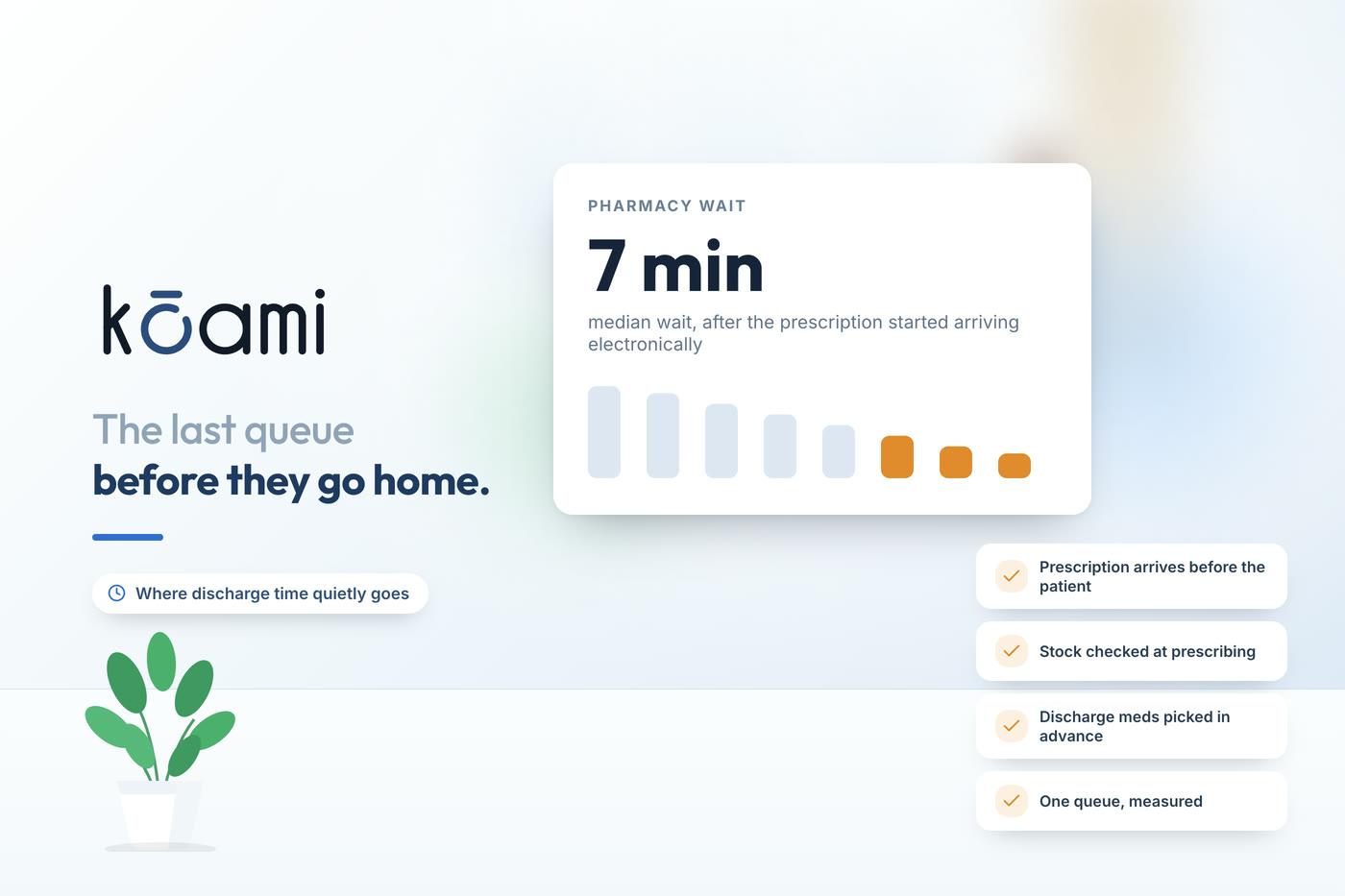
A patient can have an excellent consultation, a fast investigation and a smooth billing experience, and still leave the hospital annoyed, because the last thirty-five minutes of their visit were spent standing at the pharmacy counter. It is the final interaction, which means it is disproportionately what they remember and what they describe to other people.
It is also, unusually for a hospital queue, mostly a design problem rather than a resourcing one.
Why is the hospital pharmacy queue so slow?
Because each transaction contains several small delays that compound, and the counter is the only place where all of them become visible.
Watch a single dispense and count the pauses. The pharmacist deciphers or re-keys the prescription. Searches for each item by name, from a list where three brands look similar. Discovers one item is out of stock and consults about substitution. Checks whether the patient is an inpatient, an outpatient or a scheme patient, because that changes the price and the payer. Enters batch details. Bills. Takes payment. Prints. Explains the dosage.
Nine steps, each thirty to ninety seconds. The queue is not caused by any one of them.
Which of those steps can actually be removed?
Four, and together they account for most of the time.
- Re-keying the prescription. If prescribing is electronic, the dispense screen opens with the items already on it. This single change is usually worth more than the other three combined.
- Searching for the item. The prescription should carry the item identity, not a printed name to be matched by eye.
- Discovering a stock-out at the counter. The prescriber should see availability while prescribing, and the counter should know before the patient arrives.
- Recomputing price and payer. The tariff, the scheme rate and the payer split should be applied automatically from the patient's record.
What remains — the clinical check, the batch selection, the payment, and the counselling — is work that should take time. The goal is not a fast pharmacist. It is a pharmacist who spends their minutes on the parts that need a pharmacist.
A pharmacy queue is usually a prescribing problem observed thirty metres downstream. Fix what arrives at the counter and the counter stops being the bottleneck.
What does electronic prescribing change in practice?
It removes the transcription step, the legibility risk and the search, and it lets availability be known before the patient walks over.
When a consultation ends with an electronic prescription tied to the patient's record, the pharmacy has the order before the patient has left the consulting room. For outpatients that means the dispense can be prepared while the patient walks the corridor. For inpatients it means the ward's requirement reaches pharmacy without a runner and a register.
It also removes an entire class of error. A handwritten prescription misread at the counter is one of the most common medication incidents in any hospital, and it is eliminated rather than reduced by not having a handwritten prescription.
The substitution case is worth designing deliberately. When the prescribed brand is unavailable, the pharmacist should be able to record what was actually dispensed against what was prescribed, so the clinical record shows the truth rather than the intention.
How does stock design affect the queue?
A stock-out discovered at the counter costs far more time than one prevented in the store, because it stops a queue rather than a shelf.
Three things prevent it:
- Reorder points calculated from actual consumption and lead time, rather than a static minimum typed in years ago, so fast-moving items are reordered before they run out
- Visibility of stock at the point of prescribing, so a clinician can be told at the moment of writing rather than the patient being told at the counter
- Batch and expiry handled by the system rather than by the pharmacist's judgement, with first-expiry-first-out applied automatically at issue
The reorder mechanics are in reorder points that prevent stock-outs and the expiry discipline in FEFO.
What about inpatient pharmacy, which is a different problem?
Inpatient dispensing should never involve the patient's family standing at a counter at all.
In many hospitals a relative is sent to the pharmacy to buy medicines for an admitted patient, several times a day. This is a queue the hospital created and can remove. Ward stock, indents issued against the ward, and consumption recorded against the patient at administration take the family out of the loop entirely and produce a more accurate medication record as a by-product.
It also fixes the discharge delay caused by returning unused medicines, because if consumption was recorded as it happened there is very little to return and reconcile. The mechanics are in ward indents that reconcile themselves, and the discharge consequence in cutting hospital billing time.
What should a pharmacy measure?
Five numbers, at peak hour rather than as a daily average.
- Counter service time, median and ninetieth percentile
- Queue length by hour of day
- Stock-outs at the point of dispensing, counted as events
- Substitutions made, and whether they were recorded against the prescription
- Time from prescription written to dispense completed, for outpatients
The third is the one that most directly explains a bad afternoon, and it is the one most hospitals do not record because it happens verbally.
How Kōami removes the wait at the counter
Pharmacy in Kōami Hospital sits on the same record as prescribing, billing and stock, which is what removes the re-keying, the searching and the recomputing.
- Electronic prescribing means the dispense screen opens with the prescribed items already on it, tied to the patient's UMR, so there is nothing to transcribe and nothing to search for.
- OP, IP, OT and central pharmacy run on one stock backbone, so availability is a single truth rather than four registers, and a ward indent, a theatre issue and a counter sale all deduct from the same stock.
- Batch and expiry control with first-expiry-first-out is applied at issue by the system, and the NDPS register is generated from the transactions rather than maintained separately.
- Point-of-sale billing and returns run inside the same flow, with the tariff, scheme rate and payer split applied from the patient's record instead of being recomputed at the window.
- Kōami Inventory drives reorder points from real consumption with automatic purchase orders and shortage alerts, so the stock-out is prevented in the store rather than discovered at the counter.
- Ward indents and consumption are recorded against the patient as care happens, which takes the family out of the queue and makes the discharge reconciliation nearly empty.
The pharmacy queue is the cheapest patient-experience win available to most hospitals, because almost all of it is removable without hiring anyone. If you want to see where your own minutes go, a demo against one of your real prescriptions is the fastest way to find out.
Follow Kōami on LinkedIn
Get the next guide on hospital operations, software and compliance in your feed, as soon as it is published.