Reorder Points That Prevent Stock-Outs
Published
Every hospital store has two failure modes, and they are mirror images of each other. In one, a critical item runs out at the worst possible moment - a suture size mid-procedure, a reagent the lab needs before the morning run, a drug the ward assumed was always there. In the other, a cupboard is quietly stacked with six months of something that expires in three, capital tied up in stock nobody will use in time. Both come from the same root: someone is guessing when to reorder, and human guessing does not scale across thousands of line items. Reorder points exist to replace the guess with arithmetic, and arithmetic that runs by itself does not forget, does not go on leave, and does not panic-order.
What a reorder point actually is
A reorder point (ROP) is the stock level at which you place a new order. It is not a vibe or a gut feel; it is a number you can calculate, and it rests on three inputs you already have or can measure:
- Average daily consumption - how fast the item actually moves, not how fast you think it does.
- Lead time - how long the vendor genuinely takes from purchase order to goods received, in practice, not on paper.
- Safety stock - the buffer that absorbs the normal variation in both of the above.
The core relationship is simple: ROP equals average daily usage multiplied by lead time, plus safety stock. When on-hand quantity falls to the ROP, you order enough to bring stock back up toward a defined maximum. That min/max/ROP framing is the whole discipline in one line. The hard part is not the formula. It is keeping the inputs honest and acting on the trigger every single time.
Why min/max beats intuition at scale
A charge nurse can eyeball reordering for the dozen items she touches every day. She cannot do it for the several thousand SKUs a hospital carries across pharmacy, consumables, lab reagents, and OT sets. At that scale, intuition degrades into a mix of over-ordering the familiar and under-ordering the rare-but-critical.
Stock-outs are rarely a supply problem. They are almost always a signal problem - nobody saw the level fall until it was already too late.
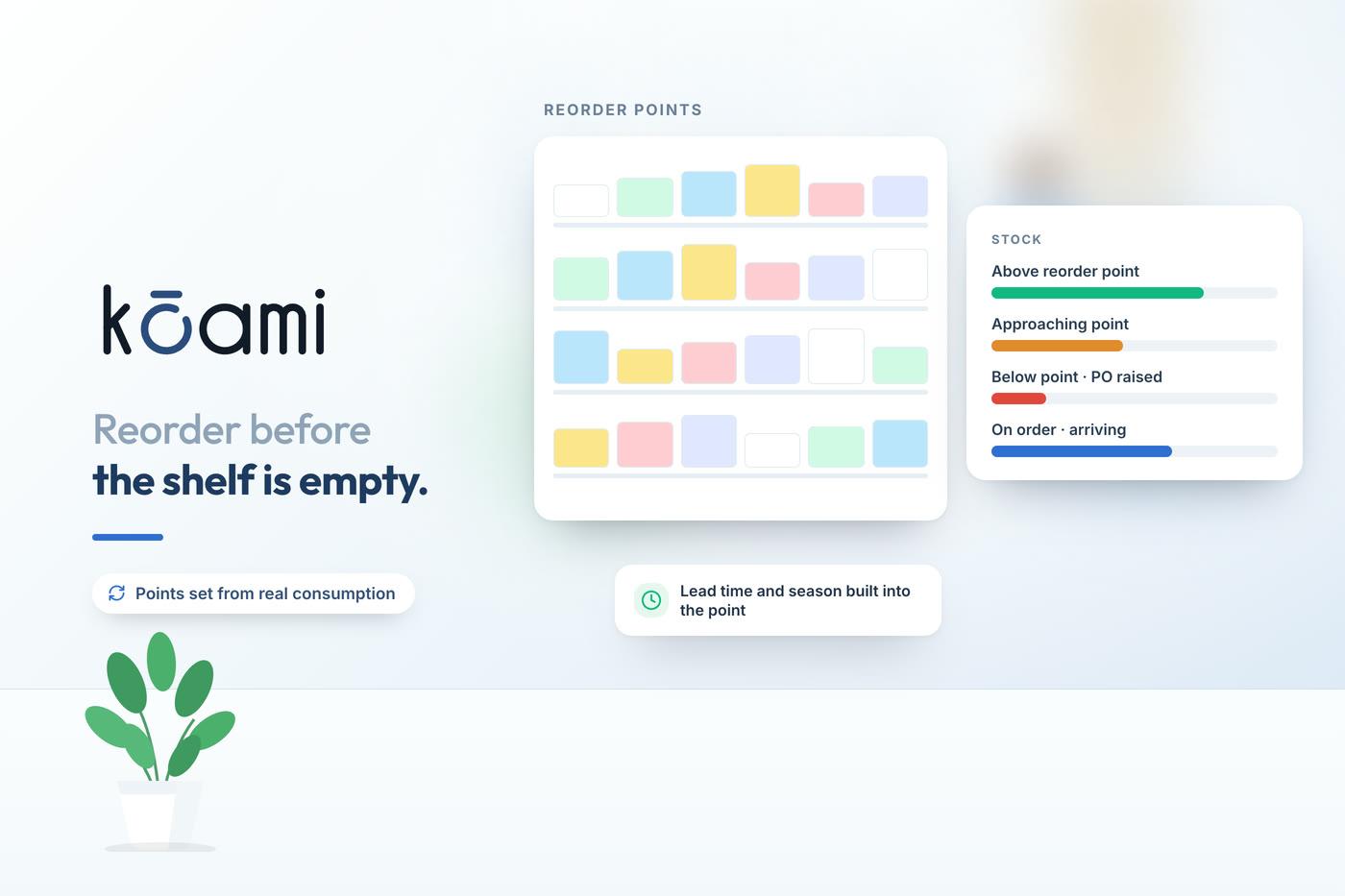
Setting a minimum and a maximum per item turns thousands of judgement calls into thousands of rules that the system checks continuously. The minimum is your ROP; the maximum caps how much you hold so you do not swing into overstock. Kōami watches on-hand quantity against those thresholds in real time and raises the reorder the moment stock crosses the line, so the trigger does not depend on a person happening to open the right cupboard on the right day.
The payoff is not just fewer stock-outs. It is fewer emergency purchases at bad prices, less expired stock written off, and a store manager who spends time on exceptions instead of on counting.
Consumption is not constant, so the numbers must move
The quiet failure of static reorder points is that they are set once and never revisited. Consumption is seasonal and situational. A dengue season spikes certain reagents and fluids. A new surgeon joining the OT changes the demand for a particular set of consumables overnight. A single high-volume month can shift the true average well away from the number someone typed in last year.
Reorder points have to breathe with demand. That means recalculating average daily consumption on a rolling basis rather than freezing it, and reflecting real observed lead times rather than the vendor's optimistic quote. When a vendor who used to deliver in three days is now taking eight, the safety stock and ROP for their items should rise to match, automatically, before that slippage becomes a shortage.
- Recompute average usage on a moving window so trends are captured early.
- Track actual lead time per vendor and per item, and feed it back into the ROP.
- Flag items whose consumption pattern is changing sharply for a human to review.
- Separate steady movers from lumpy, unpredictable ones - they need different buffers.
Kōami keeps this loop running so the thresholds stay tied to reality instead of drifting into fiction the moment they are set.
From trigger to purchase order without the scramble
A reorder trigger that only sends an email is half a solution. The point is to shorten the distance between "stock is low" and "replenishment is on its way." When on-hand crosses the ROP, the system should be able to draft the purchase order itself - the right item, the right quantity to reach maximum, the preferred vendor, the last agreed price - and put it in front of the person who approves it.
That person is still in control. What changes is that they are approving a well-formed order rather than assembling one from scratch under time pressure. For low-value, high-frequency items, the approval can be light; for expensive or clinically critical ones, it stays deliberate. Because Kōami connects inventory to procurement, the drafted PO carries straight through to the vendor, and when the goods arrive the GRN posts back against stock, which updates on-hand, which keeps the next ROP calculation accurate. The loop closes on itself.
Multi-store hospitals get an extra benefit here. Before raising an external order, the system can check whether another branch or central store is holding surplus, and suggest a transfer instead of a purchase. That turns dead stock in one location into a stock-out prevented in another.
Getting started without boiling the ocean
You do not need perfect data to begin, and waiting for it is how these projects die. Start with the items that hurt most when they run out - the critical, fast-moving, or expensive ones - and set defensible min/max levels using whatever consumption history exists. Let the system run, watch where it over- and under-corrects, and tighten from there. The numbers get better precisely because they are being used.
The goal is not a warehouse that is never wrong. It is a store where the boring, repetitive vigilance is handled by arithmetic that never sleeps, so that the pharmacist and the store manager are freed to deal with the genuine exceptions - the recall, the shortage, the new procedure - that actually need a human. Reorder points that run themselves are not about clever software. They are about making sure nobody ever again discovers a stock-out by reaching for an empty shelf.
Follow Kōami on LinkedIn
Get the next guide on hospital operations, software and compliance in your feed, as soon as it is published.