Best Hospital Inventory and Pharmacy Software in India (2026)
Published
Ask a hospital finance head where the money leaks and they will name consumables before they name anything else. Ask the pharmacy in the same hospital and they will describe a different problem: not leakage, but firefighting. Stock-outs of things that should never run out, expiry write-offs of things that were over-ordered, and a ward indent process that consumes half of somebody's day.
Both descriptions are of the same failure. The hospital is running its supply chain on records that are updated after the fact rather than as events happen. Software fixes that only if it is chosen for the right reasons, and hospital inventory has a few that general-purpose inventory software does not cover.
Why can't a hospital use ordinary inventory or ERP software?
Because hospital stock is regulated, batch-controlled, expiry-bound and dispensed against a patient, and general inventory software treats it as quantity on hand.
Four differences matter.
- Batch and expiry are not optional attributes. A hospital must know which batch was dispensed to which patient, because that is what a recall depends on and what a drug authority will ask for.
- Consumption is clinical. Stock moves when a nurse administers a dose or a theatre opens an implant, not when a storekeeper issues it. If the system only records store issues, ward stock becomes invisible.
- Some categories are legally controlled. Narcotic and psychotropic substances carry register obligations under the NDPS rules. Blood products, vaccines and reagents carry their own conditions, including cold chain.
- Charges are attached. In most Indian hospitals a consumable used on a patient must reach the bill. An inventory system that does not connect to billing creates revenue leakage that nobody can quantify.
Every hospital that cannot say which ward is holding how much stock right now is over-ordering somewhere and stocking out somewhere else, usually at the same time.
What should a hospital inventory system actually do?
Nine things. The first four are where most systems are weak.
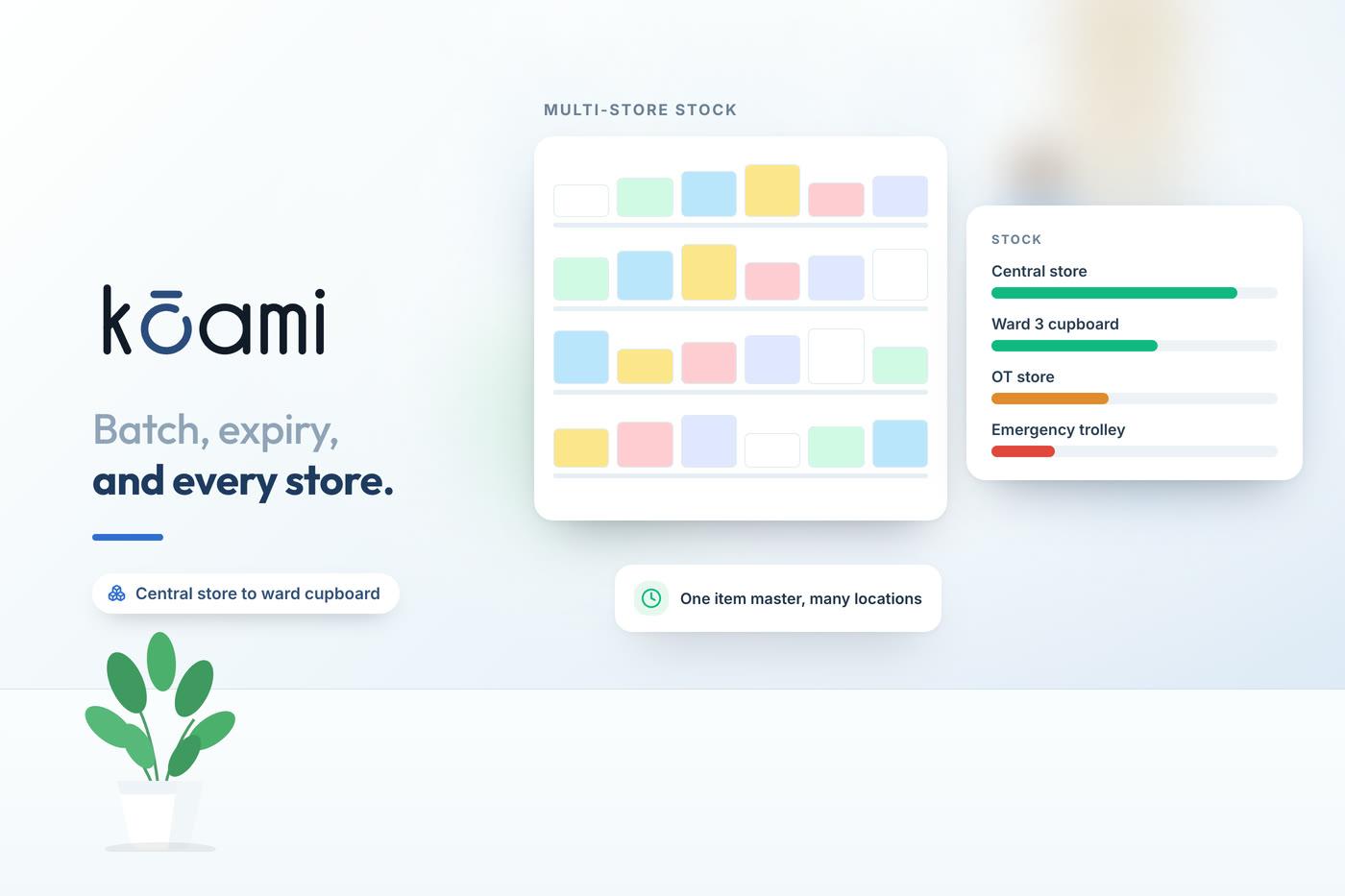
- Multi-store, multi-branch structure. Main store, sub-stores, pharmacy counters, ward floor stock, theatre, and each branch, with stock visible across all of them.
- Ward-level consumption. Indents raised from the ward, issued against the indent, consumed against a patient, and reconciled without a monthly stock-take being the only truth.
- FEFO enforcement. First expiry, first out, applied at the point of issue by the system rather than by the storekeeper's judgement.
- Reorder logic that reflects reality. Reorder levels calculated from consumption history and lead time, differentiated by criticality, rather than a static minimum somebody typed in three years ago.
- Procure to pay. Indent, purchase requisition, approval, purchase order, goods receipt with batch capture, quality check, invoice matching and vendor payment, with the three-way match enforced.
- Statutory registers. NDPS register generated from live transactions, not maintained separately.
- Charge capture. Consumables and implants used on a patient reaching that patient's bill automatically.
- Vendor and rate management. Rate contracts, comparison at purchase, and vendor performance on delivery time and rejection rate.
- Expiry management ahead of time. Alerts early enough to return goods under the vendor's return terms, not a write-off report afterwards.
How do you tell a real hospital pharmacy module from a retail one?
Look at what happens between the prescription and the bill.
Retail pharmacy software sells a product to a walk-in customer. A hospital pharmacy dispenses against an inpatient order, from a ward stock or a counter, sometimes with the drug returned unused, sometimes with the charge going to a package rather than to the patient, sometimes against a scheme that pays differently.
The behaviours to test are the returns and reversals. Dispense a medicine to an inpatient, then cancel it because the order changed. A good system reverses the stock, reverses the charge, keeps both in the audit trail, and leaves the batch record correct. A weak system leaves you with a manual adjustment and a discrepancy at month end.
Also test substitution. When the prescribed brand is unavailable and an equivalent is dispensed, the system should record what was actually given, because that is the record that matters clinically and legally.
What questions should be in the demo?
Bring a real ward and a real drug list.
- Raise an indent from a ward, issue against it, and show me the ward's current holding.
- Dispense a controlled substance and show me the NDPS register entry it produced.
- Dispense a medicine to an inpatient, then cancel it. Show the stock ledger and the bill.
- Receive a purchase order with two batches and different expiry dates, then issue and show me which batch went out.
- Show me every item expiring in ninety days, by store, with the vendor return terms.
- Show me consumption for a theatre implant reaching a patient bill.
- Recalculate reorder levels from the last six months of consumption.
- Transfer stock between two branches and show both ledgers.
- A batch is recalled. List every patient who received it.
That last one is the question that most clearly separates systems built for hospitals from systems adapted to them.
What does it cost, and where do hospitals overspend?
Inventory is usually priced as a module of a hospital system or as a standalone supply chain product, and the standalone route is where the cost surprises live.
A standalone system needs integration with billing for charge capture, with the HMS for patient identity, and often with accounting for vendor payment. Each is a project. The integrated route trades some depth for the absence of those interfaces, which for most hospitals under three hundred beds is the better trade.
Where hospitals genuinely overspend is on scanning hardware bought before the process is agreed, and on barcode projects that stall halfway. Barcoding at receipt and at dispensing is transformative, but only if the whole chain is barcoded. Half a chain is more work than none.
How does this connect to the rest of the hospital?
Inventory touches billing, clinical orders, theatre, biomedical equipment and finance, and every one of those connections is a place where separate systems leak.
The clearest example is charge capture. When pharmacy and billing are the same system, a dispense creates a charge. When they are separate, a dispense creates a file that somebody imports, and the difference between the two shows up in the annual accounts as consumables consumed but not billed.
The second is theatre. Implants and high-value consumables opened in an operating theatre are the single largest source of untracked expenditure in most hospitals, because the recording happens in a register during a procedure. A system that lets theatre staff record consumption at the point of use, on a screen that takes seconds, recovers more money than any procurement negotiation.
Where Kōami Inventory fits
Kōami Inventory is the supply chain product inside the wider platform: indents, procurement, batch and expiry tracking with FEFO, multi-store and multi-branch stock, and vendor management.
The reason it exists as part of a platform rather than a standalone product is the connection described above. Dispensing creates the charge. Theatre consumption reaches the bill. The NDPS register comes from the transactions rather than from a parallel book. Ward stock is visible because the ward is in the same system.
If you run a large distribution operation across many sites and need deep procurement analytics, a dedicated supply chain platform will go further than any hospital system's module. If your problem is that stock, billing and the wards do not agree with each other, that gap is the thing worth closing first.
Follow Kōami on LinkedIn
Get the next guide on hospital operations, software and compliance in your feed, as soon as it is published.