Keeping the NDPS Register Audit-Ready
Published
There is a particular kind of quiet in a hospital pharmacy when the drug inspector is due and someone remembers the narcotics register has not been reconciled in a fortnight. Controlled substances carry a weight that ordinary stock does not. The rules under the NDPS framework are strict, the penalties are personal, and the register is the document that stands between a compliant pharmacy and a very bad afternoon. Keeping it audit-ready is not a periodic scramble. It is a discipline that either lives in your daily workflow or does not exist at all.
Why the narcotics register is different
Ordinary stock tolerates a bit of slack. A few units of paracetamol unaccounted for is a variance to investigate, not a legal problem. Narcotic and psychotropic substances - the scheduled drugs governed by NDPS - tolerate nothing. Every unit received, dispensed, administered, wasted, or returned has to be accounted for, in sequence, with a running balance that always ties out.
The register is a continuous ledger, not a snapshot. It records each transaction against a drug, with the quantity, the date, the source or destination, the person responsible, and the balance remaining after the movement. The defining property is that the balance is never allowed to drift. Physical count and register balance must agree, every time, for every scheduled drug.
- Every movement recorded, in order, with no gaps in the sequence
- A running balance that reconciles to physical stock on demand
- The responsible person named for each transaction
- Nothing edited away silently after the fact
Capture the entry where the movement happens
The register fails when it is maintained separately from the actual work - a paper book updated at the end of the shift from memory and scraps of paper. Every gap between the movement and the record is a chance for the two to diverge, and divergence in a narcotics register is exactly what an inspection is looking for.
The fix is to make the register entry a byproduct of the transaction itself. When a scheduled drug is received, dispensed to a ward, administered to a patient, or wasted, the register entry is created at that moment, from that action, with the balance recalculated automatically. No parallel book, no end-of-day reconstruction, no arithmetic done by hand under time pressure.
A narcotics balance you calculate by hand at closing is a balance you will eventually get wrong.
Kōami records controlled-substance movements as they happen and maintains the running balance continuously, so the register is a live reflection of stock rather than a document someone has to rebuild before an audit.
Two-person control and the trail it leaves
Controlled drugs conventionally demand more than one set of hands. Witnessed administration, witnessed wastage, dual-signature receipts - the point is that no single person can move a scheduled substance without a second person attesting to it. This is as much protection for the staff as it is control over the stock; a clean witnessed trail is what clears a nurse or pharmacist when a count comes up short somewhere else.
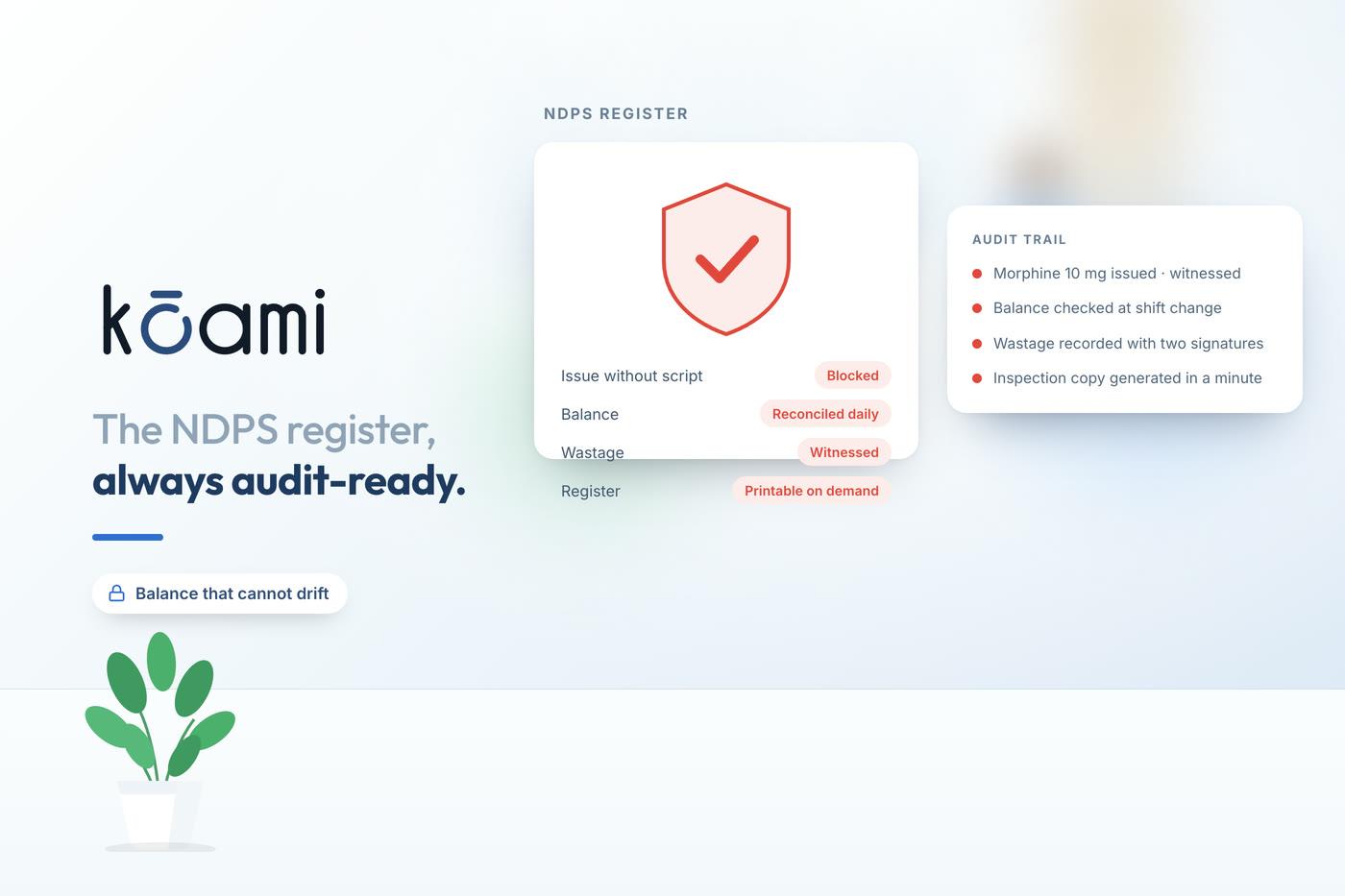
The register should carry that structure, not sit beside it. Where a movement requires a witness, the record should capture both people. Where wastage occurs - a partial ampoule, a discontinued dose - it should be recorded as its own witnessed event, not quietly absorbed into a balance.
- Capture both the responsible person and the witness on movements that require it
- Record wastage as an explicit, witnessed transaction with a reason
- Keep amendments as visible corrections with their own trail, never as overwrites
- Tie each entry to the specific batch it moved, so recalls and discrepancies trace cleanly
The test of a good register is not that it never contains a correction. Corrections happen. The test is that every correction is visible, attributed, and explained, so an auditor reads a story rather than finding a hole.
Ready on demand, not after a scramble
Audit-ready is a state, not an event. A register that is genuinely continuous is ready at any moment, because there is no backlog to clear and no reconciliation to perform before someone can look at it. That is the whole objective: to remove the pre-inspection panic by making the register correct all the time instead of correct just before it is examined.
That readiness rests on a few plain properties. The balance ties to physical stock now, not after an afternoon of catch-up. The sequence is unbroken. Every entry names its person. Every discrepancy that ever arose has a recorded investigation and resolution attached, so there are no unexplained gaps waiting to be discovered. When the register can be produced and reconciled on request, an inspection becomes a review of good records rather than a test of how fast you can assemble them.
- A balance that reconciles to physical count without preparation
- An unbroken transaction sequence with no missing entries
- Every discrepancy logged, investigated, and closed on the record
- The whole ledger retrievable on demand, for any drug and any period
Controlled substances are the part of pharmacy where process discipline and legal exposure sit closest together. The register is where that discipline is proven. Build it into the daily flow of receiving, dispensing, administering, and wasting - captured at the moment of movement, witnessed where it must be, corrected in the open - and audit-readiness stops being a thing you prepare for. It becomes the ordinary condition of the register, which is exactly where you want it.
Follow Kōami on LinkedIn
Get the next guide on hospital operations, software and compliance in your feed, as soon as it is published.