Medical Records Retention Period in India: A Schedule
Published
Every few months a medical records officer gets the same request from facilities: the record room is full, can we shred everything older than five years? The honest answer is "it depends on the file", and in most hospitals nobody has written down which files depend on what. The rules exist, but they sit in a medical ethics regulation, a diagnostic-techniques act, drug rules, waste rules, a radiation rule and an IVF law, each with its own period and its own trigger date.
This article puts those rules on one page. It is written for the medical records officer, the NABH coordinator and the CIO who has to configure the archive. Every row in the schedule below names its source. Where we could not find a statutory period, we say so rather than inventing one.
Last reviewed: 21 October 2026. Retention law changes. Re-check each source before you shred anything.
Why isn't there one single number?
Because each record is governed by the law that created it. A discharge summary exists because of medical practice rules. A Form F exists because of the PCPNDT Act. A Schedule H1 entry exists because of the Drugs Rules. A waste register exists because of the Bio-Medical Waste Rules. Each law sets its own minimum, and the minimums range from two years to a worker's lifetime.
Three things make it harder than it looks:
- Trigger dates differ. Some periods run from the start of treatment, some from the last entry in a register, some from the end of a legal case.
- Legal proceedings override periods. Several rules say: keep for X years or until proceedings end, whichever is later.
- Minimums are not recommendations. The law says how long you must keep a record, not how long it is useful. A three-year minimum for inpatient records sits awkwardly next to a two-year consumer limitation period that runs from when the cause of action arises, which can be long after discharge.
IPD and OPD records: what the regulations and NABH expect
The baseline for clinical records is clause 1.3.1 of the Indian Medical Council (Professional Conduct, Etiquette and Ethics) Regulations, 2002: "Every physician shall maintain the medical records pertaining to his / her indoor patients for a period of 3 years from the date of commencement of the treatment". Clause 1.3.2 adds that when a patient, an authorised attendant or a legal authority asks for the records, they "shall be issued within the period of 72 hours".
NMC notified new Registered Medical Practitioner (Professional Conduct) Regulations in August 2023, but those were put in abeyance the same month. The 2002 regulations continue to apply. If NMC notifies new conduct regulations, this row is the one to update first.
NABH's 6th edition hospital standards (effective January 2025) do not set a number. Under IMS.6 the hospital "retains patient's clinical records, data and information according to its requirements", the retention process must provide "expected confidentiality and security", and destruction must follow written guidance. In other words, NABH expects you to have a written retention policy and to follow it. The surveyor will ask to see it.
For OPD records the 2002 regulations do not set a separate period. Most hospitals apply the same policy to OPD notes that form part of the patient's longitudinal record.
Medico-legal cases: keep for longer
We could not find a central statute that fixes a retention period for MLC registers and case files. What is clear is that a medico-legal record may be needed for as long as the case is alive, which can be many years. Common institutional practice is to keep MLC records until all related proceedings have concluded, and many hospitals keep them permanently.
Our suggestion: write an explicit MLC line into your policy, agreed with your legal adviser, and flag MLC cases in your system so that a general purge can never touch them. Also check whether your state has issued its own guidance.
PCPNDT, NDPS and Schedule H1 registers
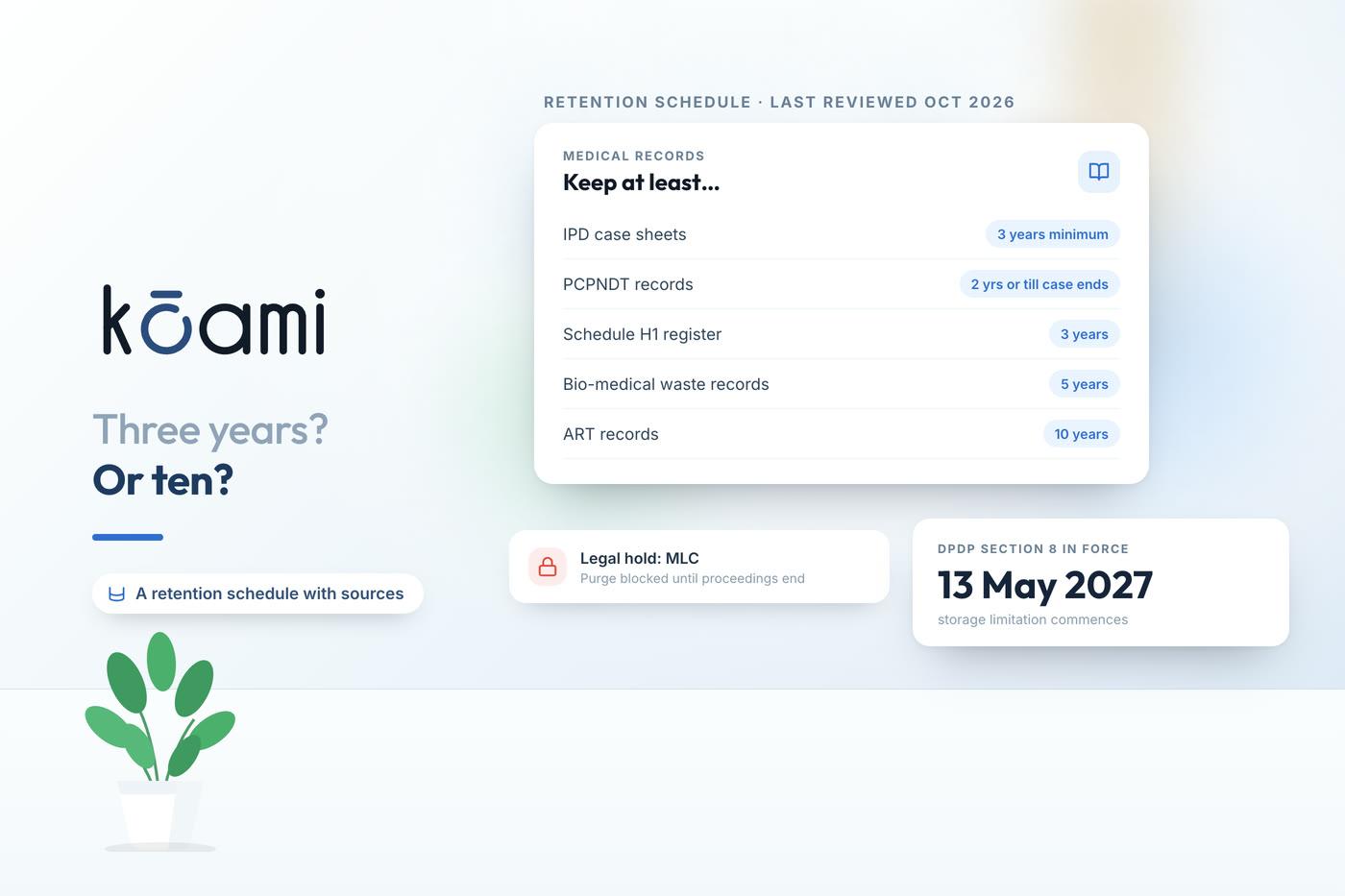
- PCPNDT records. Rule 9(6) of the PCPNDT Rules, 1996 requires all case records, consent forms, reports, sonographic images and referral letters to be preserved for two years from the date of the procedure or counselling. If legal proceedings are started, they must be kept until final disposal or until two years have passed, whichever is later. Rule 9(7) adds that records kept on computer must be preserved as an authenticated printout. Form F itself is under Rule 9(4).
- NDPS (essential narcotic drugs at Recognised Medical Institutions). The patient-wise dispensing record and the receipt and disbursement record are commonly required to be kept for two years from the date of last entry, as summarised in the National Cancer Grid's RMI guidelines. Confirm the current text of the NDPS Rules with your state drugs controller. Our NDPS register guide covers the daily discipline.
- Schedule H1. Rule 65(3)(1)(h) of the Drugs Rules, 1945: the H1 register must be maintained for three years and be open for inspection.
- Other pharmacy registers. Rule 65(7): except where otherwise provided, registers and records under Rule 65 must be preserved for at least two years from the date of the last entry.
Blood centre, ART, radiation and waste records
- Blood centre records. Schedule F Part XII-B of the Drugs Rules lists donor records, master records, transfusion reaction records and others, and says these "shall be kept by the licensee for a period of five years".
- ART clinics and banks. Section 23(c) of the Assisted Reproductive Technology (Regulation) Act, 2021 requires records to be kept for at least ten years, after which they are transferred to the National Registry. If proceedings are pending, records are kept until final disposal.
- Radiation workers' dose records. Rule 24(2) of the Atomic Energy (Radiation Protection) Rules, 2004: dose and health surveillance records are preserved during the worker's working life and afterwards until the worker reaches or would have reached 75, or for not less than 30 years after the work ends, whichever is later. Rule 26(b) leaves patient dose records to a period specified by the competent authority.
- Bio-medical waste records. Rule 14(1) of the BMW Management Rules, 2016: records of generation, collection, storage, transportation, treatment and disposal are kept for five years. Incineration and autoclave operation records also have a five-year requirement.
The retention schedule, row by row
Print this, add your hospital's internal period next to each legal minimum, and have the medical superintendent sign it off. "Legal minimum" is what the source requires. "Typical policy" is a suggestion many hospitals adopt; it is not a legal requirement.
Clinical records
- Inpatient case sheets and discharge summaries. Legal minimum: 3 years from start of treatment. Source: MCI Ethics Regulations 2002, cl. 1.3.1. Typical policy: much longer, often 7 to 10 years or more, because complaints and audits can arrive later.
- Issue of records on request. Within 72 hours. Source: cl. 1.3.2.
- OPD records. No separate statutory period found. Typical policy: same as inpatient where they form part of the patient record.
- MLC registers and files. No central statutory period found. Typical policy: until all proceedings end; many keep permanently. Decide with legal counsel.
Diagnostic and specialty records
- PCPNDT records, Form F, images, consents. Legal minimum: 2 years, or until proceedings end, whichever is later; electronic records also as authenticated printouts. Source: PCPNDT Rules 1996, Rule 9(6), 9(7).
- ART records. Legal minimum: 10 years, then transfer to the National Registry; longer if proceedings are pending. Source: ART Act 2021, s. 23(c).
- Radiation worker dose records. Working life, then to age 75 or 30 years after the work ends, whichever is later. Source: AERB RP Rules 2004, Rule 24(2).
Pharmacy and blood
- Schedule H1 register. Legal minimum: 3 years. Source: Drugs Rules, Rule 65(3)(1)(h).
- Other Rule 65 registers and records. Legal minimum: 2 years from last entry, unless otherwise provided. Source: Rule 65(7).
- NDPS RMI records. Commonly 2 years from last entry. Source: NDPS Rules as summarised by NCG RMI guidelines; confirm current text.
- Blood centre records. Legal minimum: 5 years. Source: Schedule F Part XII-B.
Facility records
- BMW registers, manifests, treatment records. Legal minimum: 5 years. Source: BMW Rules 2016, Rule 14(1).
- Equipment, calibration and maintenance records. No single statutory period found for most equipment. Typical policy: life of the asset plus a defined period, because these support incident and medico-legal reviews.
Digital archiving: retention vs DPDP storage limitation
The Digital Personal Data Protection Act, 2023 adds a second question to every row: when must you stop keeping it? Section 8(7) says a data fiduciary shall erase personal data once it is reasonable to assume the purpose is no longer being served, "unless retention is necessary for compliance with any law for the time being in force". Clinical records with statutory retention periods fall within that exception, but only for as long as the other law requires.
Timing matters. The DPDP Rules were notified on 13 November 2025 (G.S.R. 846(E)). Section 8 of the Act and Rules 3 and 5 to 16 commence eighteen months later, on 13 May 2027. When they apply:
- Rule 6(1)(e) asks fiduciaries to retain logs and personal data for one year as part of security safeguards, unless another law requires otherwise.
- Rule 8(3) sets a minimum of one year for retaining personal data, traffic data and processing logs for specified purposes.
- The Third Schedule's fixed erasure timelines cover large e-commerce, gaming and social media platforms. Hospitals are not a listed class.
What this means in practice: a retention schedule that only lists minimums is no longer enough. Each row also needs an end point and a method, for example "review at year 10, erase or anonymise unless flagged for MLC or litigation". A record kept forever "just in case" will be harder to defend once Section 8 is in force. See our DPDP Act guide for hospitals for the consent and notice side.
Building the schedule into the system
A paper policy fails when the archive does not know it exists. The practical steps:
- Tag every record type at creation with its retention class (clinical, PCPNDT, H1, blood, BMW, ART and so on).
- Store the trigger date: start of treatment, last entry, or end of proceedings.
- Use legal holds. An MLC flag or a pending complaint should block any purge automatically.
- Log destruction. Who approved it, which records, which date, which method. IMS.6 expects destruction "in accordance with the written guidance".
- Keep access logs for retained records, since retention without confidentiality fails IMS.6.
When registration, the EMR, pharmacy, the PCPNDT register and the waste log share one system, each record carries its own class and dates from the start, and a review list for the record room is a report rather than a manual hunt. Kōami keeps an audit trail of who accessed or changed a record and when, which is the evidence a retention policy relies on.
A checklist before you shred anything
- Is the record type in your signed retention schedule?
- Has the legal minimum passed from the correct trigger date?
- Is there an MLC flag, complaint, litigation hold or insurance dispute on the patient or record?
- For PCPNDT and ART records: are any proceedings pending?
- Has the destruction been approved in writing by the person your policy names?
- Will you log what was destroyed, when and how?
This schedule is general information, not legal advice. State rules and later notifications can change these periods. Have your legal adviser review your final policy.
If you would like to see how record classes, legal holds and access logs work in a connected hospital system, book a demo.
Frequently asked questions
- How long must a hospital keep inpatient medical records in India?
- The baseline is clause 1.3.1 of the 2002 medical ethics regulations: indoor patient records for three years from the date treatment began. That is a minimum for the physician, not a recommendation. Because consumer complaints, medico-legal cases and accreditation reviews can arrive later, most hospitals set a longer internal period.
- How long should MLC records be kept?
- We could not find a central statute that sets a fixed retention period for medico-legal case records. Many hospitals keep them until all legal proceedings have ended, and often permanently. Treat this as an institutional policy decision made with your legal adviser, and record it in your retention policy.
- How long are PCPNDT records kept?
- Rule 9(6) of the PCPNDT Rules: two years from the date of the procedure or counselling, or until final disposal of any legal proceedings, whichever is later. Records kept on computer must also be preserved as authenticated printouts under Rule 9(7).
- Does the DPDP Act force hospitals to delete patient records?
- Section 8(7) requires erasure once the purpose is served, unless retention is necessary to comply with another law. Clinical records with statutory retention periods are covered by that exception. Section 8 and most DPDP Rules commence on 13 May 2027, so now is the time to write the policy.
- Can a hospital keep medical records only in digital form?
- Mostly yes, with care. Rule 9(iv) of the Clinical Establishments (Central Government) Rules 2012 expects EMR/EHR as determined by government, and NABH asks for secure retention and controlled destruction. Some registers have specific format rules, for example PCPNDT's authenticated printouts, so check each register before going fully paperless.
Sources
- Indian Medical Council (Professional Conduct, Etiquette and Ethics) Regulations, 2002, clauses 1.3.1 and 1.3.2, NMC
- Pre-conception and Pre-natal Diagnostic Techniques Rules, 1996, Rule 9 (NHSRC copy)
- Drugs and Cosmetics Act 1940 and Rules 1945 (Rule 65; Schedule F Part XII-B), CDSCO
- Bio-Medical Waste Management Rules, 2016 (Rule 14), CPCB
- Atomic Energy (Radiation Protection) Rules, 2004 (Rules 24 and 26), AERB
- Digital Personal Data Protection Act, 2023 (Section 8(7)), MeitY
- Digital Personal Data Protection Rules, 2025, G.S.R. 846(E), 13 Nov 2025, MeitY
- NABH Accreditation Standards for Hospitals, 6th Edition (IMS.6)
Follow Kōami on LinkedIn
Get the next guide on hospital operations, software and compliance in your feed, as soon as it is published.