Electronic Consent Forms in Indian Hospitals: Valid or Not?
Published
The question usually reaches the medical superintendent's desk in one of two ways. The IT team wants to move consent forms to tablets because scanned paper is unreadable and half the forms in the MRD are missing a witness signature. Or the hospital's lawyer, reviewing a complaint, asks whether the consent on the screen would stand up if the case went to a consumer commission. Both are fair. The short answer is that Indian law does not forbid electronic consent, but it also does not make a finger-drawn squiggle on a tablet automatically equivalent to a signature. What protects the hospital is the same thing that always did: real informed consent, plus proof of who agreed to what, when.
This is general information, not legal advice. Laws, notifications and court interpretations change, so have your hospital's lawyer approve the consent policy before rollout.
What Indian law actually recognises
Three layers matter: the IT Act, the evidence law, and the law on what makes consent valid in the first place.
The IT Act, 2000. Section 4 says that where a law requires information to be in writing, an electronic form satisfies it if it is accessible for later reference. Section 5 says that where a law requires a signature, an electronic signature affixed in the prescribed manner satisfies it. Section 2(1)(ta) defines an electronic signature as authentication by a technique specified in the Second Schedule, including a digital signature. Section 3A lets the government add reliable techniques to that schedule, and section 10A says a contract is not unenforceable only because it was formed electronically.
The First Schedule lists what the Act does not apply to: negotiable instruments other than cheques, powers of attorney, trusts, wills, and contracts for the sale or conveyance of immovable property. Medical consent forms are not on that list.
The Bharatiya Sakshya Adhiniyam, 2023, which repealed the Indian Evidence Act, 1872, says in section 61 that an electronic record cannot be denied admissibility only because it is electronic. Section 63 sets the conditions for computer output to be admitted and requires a certificate, in the format given in the Schedule, which includes a part for the party and a part for an expert, with a hash value of the record.
What makes consent valid. In Samira Kohli vs Dr. Prabha Manchanda (2008), the Supreme Court held that consent must be real and valid: the patient must be competent, consent voluntarily, and have adequate information about the nature, purpose, risks and alternatives. Consent for a diagnostic procedure is not consent for therapeutic surgery. No signature technology fixes a consent that was never properly explained.
NABH's expectation. The 6th edition hospital standards list informed consent among patient rights before transfusion, anaesthesia, surgery, research protocols and other invasive or high-risk procedures (PRE.2.g). PRE.4 requires that consent follows statutory norms, covers the procedure, risks, benefits, alternatives and who will perform it, in a language the patient understands, defines who can consent for a patient who cannot decide, and is taken by the person performing the procedure.
Three ways to sign on a screen, and what each proves
Aadhaar eSign
eSign is the online electronic signature service run under the Controller of Certifying Authorities. The signer authenticates through e-KYC with an OTP or biometric, a short-validity certificate is issued, and only the hash of the document is sent for signing. The CCA's FAQ states these signatures are legally valid when operated under the Second Schedule and its guidelines. This is the method that most clearly meets the IT Act's definition.
The catch in a hospital is practical. The signer needs an Aadhaar-linked mobile in hand, the hospital needs an integration through a licensed eSign service provider under a commercial agreement, and an attendant signing for a patient signs with their own identity. It suits planned admissions and elective surgery better than a 2 am emergency.
Drawn signature on a tablet
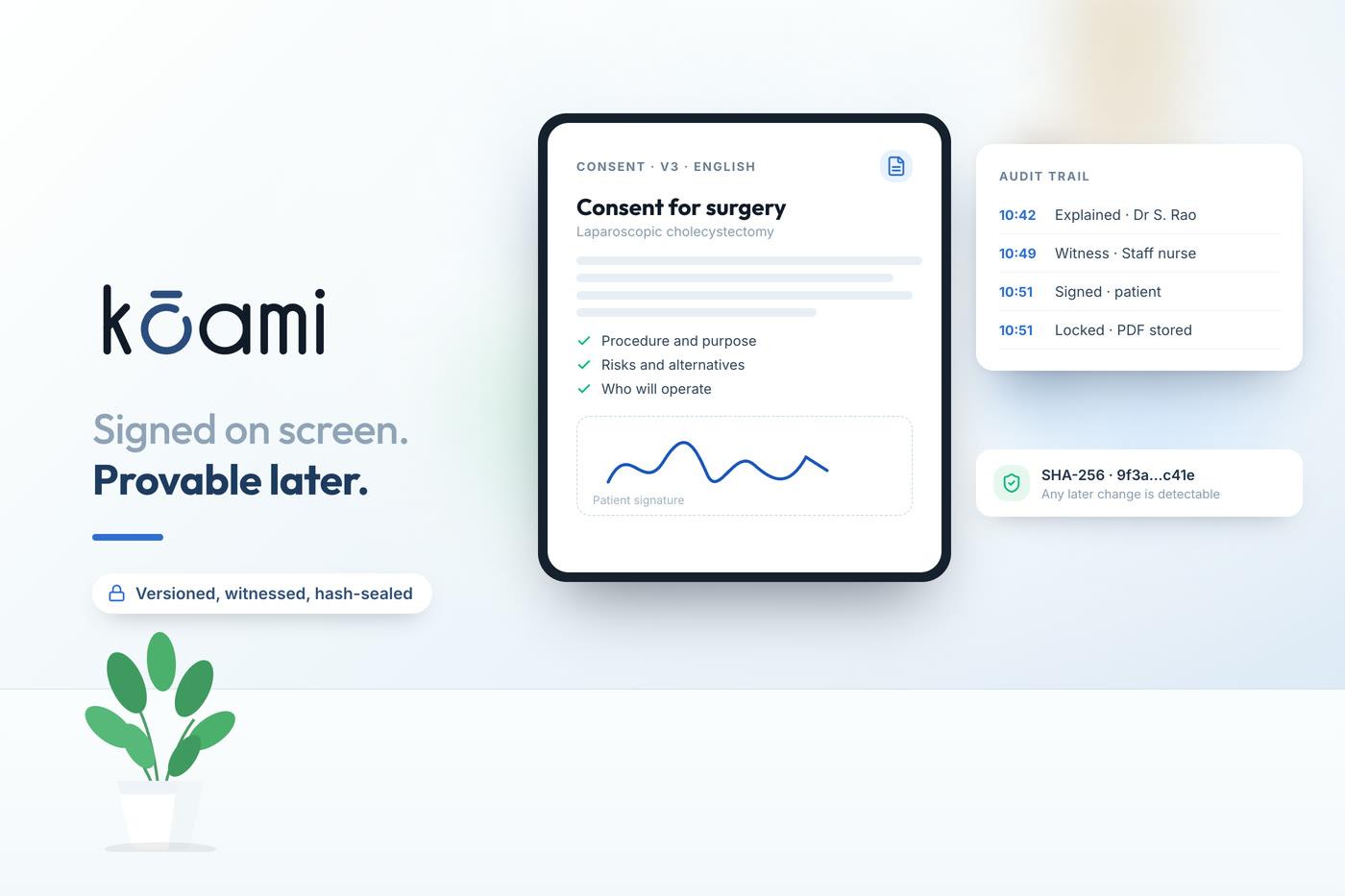
This feels familiar to patients and staff. Legally, it is an electronic record evidencing consent rather than an electronic signature under section 2(1)(ta). Its value depends almost entirely on the audit trail: who verified the signer's identity, which version of the form was on screen, the time, the device, the doctor who explained, and whether the record could have been altered later.
OTP click-to-accept
An OTP proves that someone controlled a mobile number at a moment. In Indian families where one phone serves five people, that is weak evidence of who agreed. It works for low-risk general consent and for recording explicit teleconsultation consent, not for surgery.
The decision table by consent type
Use this as a starting draft for your lawyer and quality team, not as a final policy.
General consent at registration or admission
- Suitable method: OTP or drawn signature on a tablet.
- Language and witness: show the form in the patient's chosen language; no witness usually needed.
- Paper: not required once your policy is approved.
Telemedicine consultation
- Suitable method: the Telemedicine Practice Guidelines 2020 (section 3.4) treat consent as implied when the patient initiates the consultation. Explicit consent is needed when a health worker, doctor or caregiver initiates it, and can be recorded in any form, including email, text or an audio or video message.
- Language and witness: log the message or recording in the patient's record.
- Paper: not needed.
Procedure, surgery and anaesthesia
- Suitable method: drawn signature with the explaining doctor authenticated by their own login, or Aadhaar eSign for planned surgery.
- Language and witness: NABH expects the surgeon to obtain surgical consent (COP.14.c), the anaesthesiologist to obtain anaesthesia consent (COP.13.d), consent for procedural sedation (COP.12.b), and consent by the person performing other procedures (COP.7.e). Record the language version and a witness.
- Paper: offer it on request; run paper alongside for the first few weeks of a pilot.
Blood transfusion, high-risk procedures and research
- Suitable method: drawn signature plus witness, or eSign where available.
- Language and witness: record the specific risks explained, not just a tick box. Research consent follows the protocol approved by the ethics committee and the clinical trial rules that apply.
- Paper: keep paper for research unless the ethics committee approves the electronic process.
Consents where a specific law prescribes the form
- Examples to check with your lawyer: prenatal diagnostic procedures, termination of pregnancy, organ donation and transplantation, HIV testing, and clinical trials. Each has its own statute or rules.
- Suitable method: use the exact prescribed form.
- Paper: keep wet-ink paper, scanned into the record, unless your lawyer confirms an electronic version satisfies that law.
Refusal of treatment and discharge against medical advice
- Suitable method: drawn signature plus witness, or eSign.
- Language and witness: these are the consents most often disputed later, so record what was explained and who was present.
- Paper: many hospitals keep a signed paper copy as well. Decide this with your lawyer.
Patients who cannot read or sign
- Suitable method: thumb impression on paper with a witness. An on-screen thumb trace is not the same thing.
- Language and witness: read the form aloud in the patient's language and record who read it.
- Paper: yes.
The audit trail that makes an electronic consent defensible
If you remember one section, make it this one. An electronic consent is only as strong as the evidence wrapped around it. Capture, for every consent:
- Patient identity: UHID and two identifiers, checked by a named staff member.
- Signer identity and relationship when it is not the patient, with the ID document type seen.
- Form template ID, version number and language, plus a PDF of exactly what was on screen.
- A hash of that PDF, so any later change is detectable.
- Server timestamps in IST for opening, explaining and signing.
- The logged-in user of the doctor who explained and the staff member who witnessed.
- The signature image, OTP transaction reference or eSign response.
- Device ID and location, such as Ward 4B tablet 2.
- No edit after signing: a correction is a new version that references the old one.
- A named person and process for issuing the section 63 certificate if the record is ever needed in court.
Our piece on audit trails in hospital software goes deeper on making logs tamper-evident. One more distinction: consent to treatment is not the same as consent to process personal data. The DPDP obligations sit alongside, covered in DPDP Act for hospitals.
When to keep paper
Even a fully digital hospital keeps a paper path for:
- Network or power downtime, with a rule that paper consents are scanned and linked within the shift.
- Statutory forms where the law prescribes a format.
- Patients who can only give a thumb impression.
- Patients who simply prefer paper.
- The pilot period, when both run in parallel and an auditor compares them.
A 30-day rollout that will not embarrass you
- Week 1: lawyer and quality manager approve the policy and the decision table above.
- Week 2: digitise three forms first, usually general consent, surgical consent and anaesthesia consent, in English, Hindi and Telugu or your local languages.
- Week 3: pilot on one surgical ward with paper in parallel; train doctors on explaining before tapping.
- Week 4: audit 50 consents for completeness, witness, language and hash; fix gaps before expanding.
Kōami's EMR is designed to version consent templates by language and procedure and to store each signed consent as a locked document with the explaining doctor, witness, timestamps and hash attached, so the MRD can retrieve the whole trail in one view. Whichever system you use, check that it does the same before you move consent off paper. If you are retiring paper more broadly, our guide to the paperless hospital in India covers the rest of the record.
If you want to see how a versioned, multilingual consent workflow looks on synthetic patients, we will walk your medical and legal team through it. Book a demo: koami.in/book-demo
Frequently asked questions
- Is a consent form signed on a tablet legally valid in India?
- No Indian law we are aware of bars electronic consent for treatment, and the Bharatiya Sakshya Adhiniyam says an electronic record cannot be refused as evidence only because it is electronic. A drawn signature on a tablet is not an electronic signature as defined in the IT Act, so its weight depends on the audit trail around it. Have your hospital's lawyer approve the policy.
- Is Aadhaar eSign required for medical consent?
- No law we found requires Aadhaar eSign specifically for treatment consent. It is the method that best fits the IT Act's definition of an electronic signature, and the Controller of Certifying Authorities describes eSign signatures as legally valid when operated under the Second Schedule and its guidelines.
- Can telemedicine consent be taken by SMS or email?
- Yes, under the Telemedicine Practice Guidelines 2020, consent is implied when the patient initiates the teleconsultation, and explicit consent, needed when a health worker, doctor or caregiver initiates it, can be recorded in any form, including email, text or an audio or video message.
- Who should take surgical and anaesthesia consent?
- The NABH 6th edition standards say informed consent is obtained by the surgeon before the procedure (COP.14.c), by the anaesthesiologist for anaesthesia (COP.13.d), and generally by the person performing the procedure (PRE.4.e).
- Which consents should stay on paper?
- Keep paper, or a certified scan of a wet-ink original, where a specific law prescribes a consent form, where the patient can only give a thumb impression, during system downtime, and wherever your lawyer has not yet approved the electronic version.
Sources
- Information Technology Act, 2000 (updated), India Code: sections 2(1)(ta), 3, 3A, 4, 5, 10A and First Schedule
- Controller of Certifying Authorities: eSign Online Electronic Signature Service
- Controller of Certifying Authorities: eSign FAQ
- The Bharatiya Sakshya Adhiniyam, 2023 (Gazette of India): sections 61, 63 and the Schedule certificate
- Samira Kohli vs Dr. Prabha Manchanda, Supreme Court of India, 16 January 2008
- NABH Accreditation Standards for Hospitals, 6th Edition (effective 1 Jan 2025): PRE.2, PRE.4, COP.7, COP.12 to COP.14
- Telemedicine Practice Guidelines, 25 March 2020 (section 3.4, patient consent)
Follow Kōami on LinkedIn
Get the next guide on hospital operations, software and compliance in your feed, as soon as it is published.