Vaccine Temperature Logs in Hospitals: Cold Chain Guide
Published
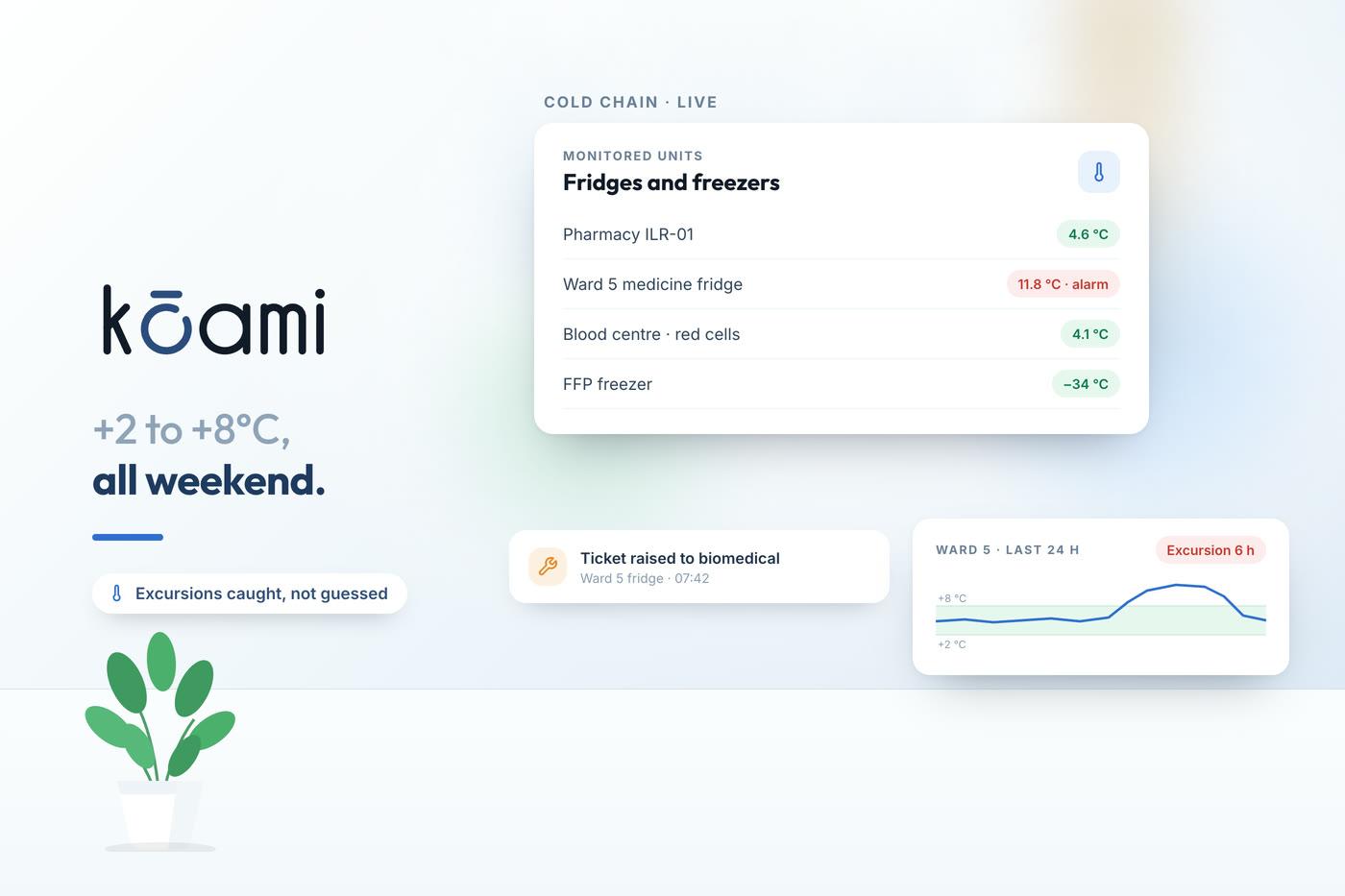
Monday, 7:40 am. The ward nurse opens the medicine fridge and the display reads 13°C. The power to that wall socket tripped some time on Sunday. Inside are insulin pens for six patients, two vials of hepatitis B vaccine and an expensive biologic for a patient on day care. The temperature log on the door shows a reading of 5°C at 8 pm on Saturday and nothing since, because the weekend staff did not know the log was theirs to fill.
Nobody can now say how long the fridge was warm. That is the real problem. A temperature log that only records two moments a day cannot tell you whether an excursion lasted forty minutes or thirty hours, and that difference decides whether the stock is used or thrown away.
This guide is for pharmacy in-charges, blood centre medical officers and nursing superintendents who share responsibility for temperature-sensitive products. It covers what needs a cold chain in a hospital, the storage ranges that apply, manual versus sensor logging, an excursion SOP, the records auditors ask for, and how temperature alerts should connect to maintenance.
What needs a cold chain in a hospital?
More than most hospitals list in their cold chain SOP. The main groups:
- Vaccines, both programme (UIP) and private, in pharmacy, paediatrics, maternity and staff health.
- Insulin, in the pharmacy store and in every ward fridge.
- Blood components: red cells, platelets, plasma and cryoprecipitate in the blood centre or blood storage centre.
- Other refrigerated medicines: biologics, some antibiotics after reconstitution, oxytocin, certain eye drops, and products whose labels say "store at 2–8°C".
- Laboratory reagents and kits with specified storage temperatures.
The storage ranges that apply
- Vaccines: the MoHFW Immunization Handbook for Health Workers asks for the ice-lined refrigerator to be kept between +2°C and +8°C for vaccines and diluents, with temperature monitored "twice daily regularly including on Sundays/holidays". It also asks for manufacturer, batch number and expiry to be noted in the stock register, and says no other drugs or non-UIP vaccines should be stored in the ILR used for programme vaccines.
- Insulin: WHO's 2024 note on insulin thermostability says intact vials and cartridges should be stored between 2°C and 8°C, protected from heat and freezing, and once opened can be kept at ambient temperature for approximately four to six weeks. In-use periods differ by product; follow the insert.
- Blood components: the Drugs Rules guidelines for blood centres (Schedule F Part XII-B, as amended by G.S.R. 166(E) of March 2020) specify 2–6°C for packed red cells; 20–24°C with continuous gentle agitation for platelets, for not more than five days; and not warmer than minus 30°C for fresh frozen plasma and cryoprecipitate, for not more than one year. Blood storage centres store at 2–8°C with an alarm and temperature indicator.
Freeze damage is as real as heat damage
Hospitals worry about fridges getting warm. Vaccines are also damaged by cold. The MoHFW handbook says DPT, TT, IPV, hepatitis B, PCV and pentavalent vaccines lose potency if frozen, and the vial should be discarded if it is frozen or contains floccules after the shake test. The shake test does not apply to IPV.
The handbook also describes the vaccine vial monitor (VVM): a heat-sensitive label whose inner square darkens gradually and irreversibly with cumulative heat exposure. If the VVM has reached its discard point, the vial is discarded regardless of what the log says.
A fridge set too cold, or vaccines placed against the cooling plate, can cause more loss than a power cut.
Manual vs sensor logging
Manual logs
A printed chart on the fridge door, filled twice a day with a thermometer reading. It is cheap and meets the twice-daily expectation. Its weaknesses:
- It shows the temperature at two moments, not between them.
- Readings can be filled in later from memory.
- It depends on someone on every shift, every day, including holidays.
Continuous loggers and sensors
Data loggers record temperature at set intervals and keep the history. WHO's prequalification category for temperature monitoring devices (PQS E006) describes 30-day loggers that keep the most recent 30 days of data, overwriting the oldest, and include a visual alarm. Networked sensors go further and send alerts to a phone or a dashboard when a threshold is crossed.
For blood centres, the 2020 guidelines already expect refrigerators with a recording thermograph and an alarm device, with the temperature recorder checked daily against a thermometer.
What we suggest
Keep the twice-daily manual reading as a human check, and add a continuous logger or sensor for every unit holding vaccines, insulin stock, biologics or blood components. The manual reading confirms the sensor works; the sensor shows what happened between readings.
Template: the temperature log
One row per reading or per day. Suggested columns for a fridge log:
- Unit ID and location (for example "PH-FR-02, main pharmacy")
- Date
- Morning reading: time, current temperature, min and max since last reset, initials
- Evening reading: time, current temperature, min and max, initials
- Min/max reset done (yes/no)
- Alarm events since last reading (from logger or sensor)
- Door seal and defrost checks (weekly)
- Action taken if out of range, with excursion report number
- Supervisor review (weekly sign-off)
Recording min and max since the last reset is the cheapest improvement you can make to a manual log. It turns two snapshots into two windows.
Excursion response SOP
Print this and post it on every cold chain unit. Adapt the names and numbers to your hospital.
- Step 1: Do not discard and do not use. Label the stock "Do not use, under review" and keep it in the correct temperature range, moving it to a working backup unit if needed.
- Step 2: Record the facts. Current temperature, minimum and maximum, the time the excursion was found, and the logger history showing when it began. Note which products and batches were inside.
- Step 3: Fix or escalate the equipment. Check power, door, settings. Raise a maintenance call immediately.
- Step 4: Assess the products. For vaccines: check VVMs and, for freeze-sensitive vaccines exposed to freezing, the shake test performed by trained staff as per programme guidance. For other medicines: use the manufacturer's stability information; call the manufacturer or distributor if needed. For blood components: the blood centre medical officer decides according to the centre's SOP.
- Step 5: Decide and document. Use or discard, with the name of the person authorised to decide, the reason and the evidence. For UIP vaccines, inform the programme cold chain officer.
- Step 6: Find the cause. Equipment fault, power, door left open, overloading, wrong setting, or staff not aware of their role.
- Step 7: Close the loop. Corrective action recorded, maintenance closed, staff briefed.
Illustrative cost of getting this wrong: a ward fridge holding 40 vaccine doses at ₹1,500, 80 insulin cartridges at ₹350 and four biologic syringes at ₹15,000 contains about ₹1.5 lakh of stock. Without a logger history, the safe decision after an unknown-duration excursion is often to discard all of it.
Ward fridges: the weak link
The main pharmacy store usually has the best equipment and the most attention. The risk sits in the twenty ward and OT fridges that each hold a little insulin, a few vaccine vials and whatever else the ward keeps "for convenience". A short ward checklist closes most of the gap:
- One named owner per fridge per shift, written on the log, including weekends and holidays
- Medicines only: no food, no samples, no ice packs for staff lunches
- Nothing against the back wall or cooling plate, where freezing is most likely
- A dedicated socket, labelled, preferably on backed-up power
- A stock list on the door, so an excursion report can name exactly what was inside
- Weekly pharmacy round to check logs, expiry and the min/max reset
Every item on that list costs almost nothing. Each one removes a common reason for an excursion nobody noticed.
Records for audits
NABH's 6th edition standards expect medications to be "stored in a clean, safe and secure environment while incorporating the manufacturer's recommendation(s)" (MOM.3.a); the 6th edition interpretation adds vaccine storage as per manufacturers' guidelines. Consumables follow the same expectation under MOM.11. Blood centres have their own records duties under the Drugs Rules. In practice, auditors ask for:
- Temperature logs for each unit, complete for the period, including weekends and holidays
- Logger or sensor downloads matching the manual logs
- Excursion reports with product decisions and who made them
- Calibration certificates for thermometers, loggers and sensors
- Preventive maintenance and breakdown records for refrigerators, ILRs and freezers
- Training records for staff responsible for each unit
Linking alerts to maintenance
A temperature alarm is an equipment event as much as a pharmacy event. In many hospitals the alarm rings in the pharmacy, someone phones the biomedical team, and the fault and its repair are recorded somewhere else, if at all.
A better chain: the sensor alert creates a maintenance ticket against the specific asset, the biomedical engineer sees the unit, its history and its preventive maintenance schedule, and the closure of the ticket is visible to the pharmacy. Over a year, that history shows which units keep failing and should be replaced before they cost more stock.
Kōami connects inventory and field service on one platform, so a cold chain unit can carry both its stock and its maintenance history. Our guides on batch and expiry control, blood bank management and biomedical CMMS cover the neighbouring workflows.
This guide is general information. Product labels, programme guidance and your blood centre's licence conditions take precedence.
If you want to see temperature alerts, stock and maintenance tickets on the same asset record, book a demo.
Frequently asked questions
- At what temperature should vaccines be stored in a hospital?
- Under India's immunisation guidance, vaccines and diluents in an ice-lined refrigerator are kept between +2°C and +8°C, with temperature monitored twice daily including Sundays and holidays. Always follow the manufacturer's label for each product, which NABH's MOM.3 also expects.
- How often should a vaccine refrigerator temperature be recorded?
- The MoHFW immunisation handbook asks for temperature to be monitored twice daily, regularly, including on Sundays and holidays. Twice-daily readings show the temperature at two moments only, so many hospitals add continuous loggers or sensors that record between readings and raise alarms.
- What is a temperature excursion?
- Any period when a temperature-sensitive product is outside its labelled storage range, for example a vaccine refrigerator above +8°C or below +2°C. The response is to quarantine the stock, restore the correct temperature, record the duration and extremes, assess the product against guidance and the manufacturer's data, and document the decision.
- What temperatures apply to blood components?
- Under the Drugs Rules guidelines for blood centres (as amended in 2020), packed red cells are kept at 2–6°C, platelets at 20–24°C with continuous gentle agitation for up to five days, and fresh frozen plasma and cryoprecipitate at minus 30°C or colder for up to one year.
- Can insulin be kept outside the refrigerator?
- WHO notes that intact insulin vials and cartridges should be stored at 2–8°C and protected from heat and freezing, and that once opened they can be kept at ambient temperature for approximately four to six weeks. In-use periods vary by product, so follow the product insert.
Sources
- Immunization Handbook for Health Workers, MoHFW, 2018 (cold chain, VVM, shake test)
- Drugs Rules Schedule F Part XII-B guidelines for blood centres, merged with G.S.R. 166(E) of 11 Mar 2020, CDSCO
- Thermostability of human insulin, World Health Organization, 2024
- WHO PQS E006: Temperature monitoring devices, WHO Prequalification
- NABH Accreditation Standards for Hospitals, 6th Edition (MOM.3 and MOM.11)
Follow Kōami on LinkedIn
Get the next guide on hospital operations, software and compliance in your feed, as soon as it is published.