Consignment Stock for Implants: Vendor Box to Patient Bill
Published
Friday evening in the cath lab store. The vendor's representative is doing his monthly count of the drug-eluting stents on consignment and finds two fewer than his records show. The cath lab register shows both were used, one for a patient discharged on Wednesday and one for a patient still in the CCU. The patient bill for Wednesday's discharge has the stent on it. The other patient's running bill does not, because the sticker went into the case file but nobody scanned it. Without that count, the hospital would have been invoiced for a stent it never billed.
Consignment stock keeps operating theatres and cath labs supplied with a full range of implant sizes without the hospital tying up capital. It also creates a three-way record problem between the vendor, the OT and billing. This guide is for OT managers, purchase teams and finance controllers. It walks through the flow from vendor box to patient bill, covers the regulatory points that touch billing and traceability, and ends with a reconciliation worksheet and KPIs.
How does consignment work with implant vendors?
Under a consignment arrangement the vendor places stock in the hospital and keeps ownership until it is used. The hospital stores it, protects it, reports usage, and receives an invoice only for what was consumed. Orthopaedic implants, cardiac stents and balloons, spinal hardware, intraocular lenses and some surgical consumables are commonly supplied this way.
What makes consignment different from ordinary purchasing:
- No liability at receipt. Goods arrive without a purchase invoice. The liability arises at use.
- The vendor's records and yours must agree. The vendor counts its stock in your building; you count what you used.
- Billing depends on the OT. The patient can only be billed for an implant the OT recorded.
- Expiry and rotation are shared. The vendor typically replaces near-expiry stock, but only if someone tells it in time.
Write the rules into a consignment agreement: what is placed, how usage is reported, how quickly the vendor invoices, who bears loss, damage and expiry, how often counts happen, and who can access the store.
Receiving and storing consignment stock
Treat consignment receipts as formally as purchases, even though no invoice comes with them.
- Consignment GRN, separate from purchase GRN. Record the vendor, delivery challan number, item, size, batch or lot, serial number where present, expiry date and quantity. The stock sits in a consignment location that does not hit your payables.
- Check the device and its paperwork. Since 1 October 2022, Class A and B medical devices have been under the licensing regime of the Medical Devices Rules, 2017, with Class C and D devices following from 1 October 2023. Your purchase team should know the vendor's licence position for what it supplies.
- One locked location per category, with an access log. Vendor representatives restocking or counting should sign in.
- Labels that survive the OT. If the pack does not carry a scannable barcode, add your own label at receipt that links to the GRN line.
The Medical Devices Rules place traceability duties on manufacturers and distributors. The QMS requirements in the Fifth Schedule say the manufacturer shall require its agents or distributors to "maintain records of the distribution of active implantable medical devices and implantable medical devices to allow traceability". Your consignment GRN is the hospital's half of that chain.
Scan-at-use and patient linkage
The moment of use is where consignment either works or leaks. NABH's 6th edition hospital standards set the bar at MOM.10.d: "The batch and the serial number of the implantable prosthesis and medical devices are recorded in the patient's medical record, the master logbook and the discharge summary." MOM.10.e adds that recall of implantable prostheses and devices must be "handled effectively".
A practical scan-at-use routine:
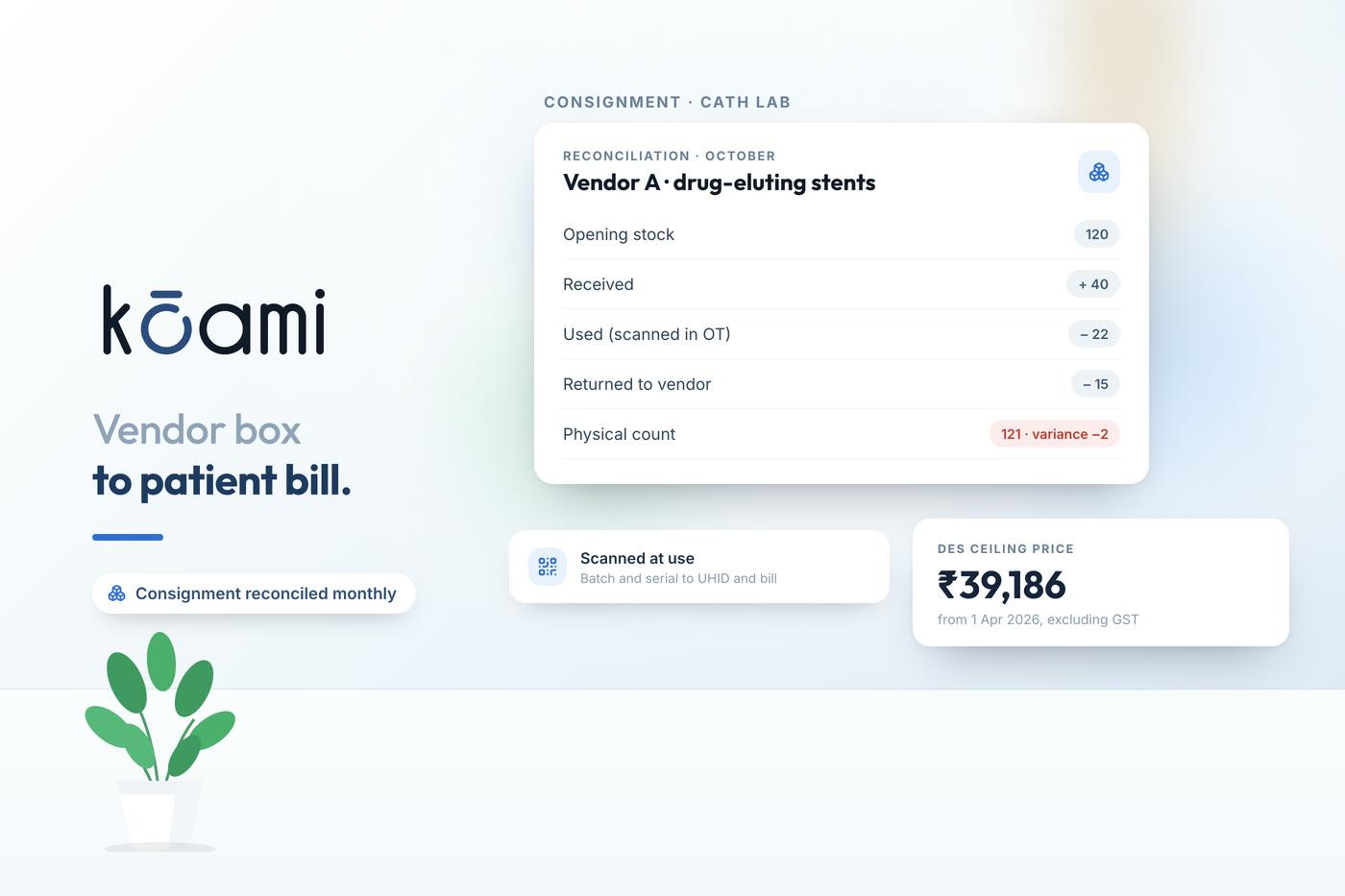
- The circulating nurse scans or records each implant as it is opened, against the patient's UHID and the procedure.
- The implant stickers go on the OT record, the implant register and the patient's file. The scan, not the sticker, is what triggers billing and the vendor usage report.
- Opened-but-unused items are scanned with a reason (wrong size, contaminated, surgeon's decision).
- The OT logbook entry and the discharge summary pull the batch and serial number from the same record, so they cannot differ.
If a manufacturer issues a recall, a scan-linked record lets you find every affected patient by batch in minutes rather than by reading case files. Adverse events with medical devices can be reported to the Materiovigilance Programme of India, coordinated by the Indian Pharmacopoeia Commission.
Billing and vendor invoicing
Patient billing and NPPA requirements
Two NPPA rules apply directly to implant billing:
- Coronary stents are price-controlled under Schedule I of the Drugs (Prices Control) Order, 2013. From 1 April 2026, NPPA Order S.O. 1587(E) sets ceiling prices of ₹10,762.15 for bare-metal stents and ₹39,186.03 for drug-eluting stents, including bioresorbable scaffolds, exclusive of GST. NPPA has also required hospitals that bill patients directly to "specifically and separately mention in their estimate / proforma invoice / final billing" the cost of the stent, its category (BMS or DES), brand name, manufacturer or importer, batch number and specifications, according to a Department of Pharmaceuticals release of March 2026.
- Orthopaedic knee implants have had NPPA ceiling prices since August 2017. The same March 2026 release says the cap was extended up to 15 November 2026 or until further orders. Check NPPA's current position before billing knee replacements after that date.
So the patient's bill needs the implant as its own line, with category, brand, manufacturer and batch, at a price at or below the ceiling where one applies. This should come automatically from the scan, not be typed by the billing clerk.
Vendor invoicing
At an agreed interval, often weekly, send each vendor a usage report from your scans: patient reference (not necessarily the name), date, item, batch, serial and quantity. The vendor invoices against it. Match the invoice to the usage report and to the price in your rate contract before approving payment. Many hospitals raise a purchase order after use for each consumed item, which keeps the payables trail clean.
Returns, expiry and reconciliation
- Near-expiry. Run a monthly report of consigned items expiring in the next 90 days and send it to each vendor for replacement.
- Returns. Record every item the vendor takes back on a return note with batch and serial, and remove it from the consignment location.
- Damage and loss. Follow the agreement. Record each event with a reason and who approved it.
- Loaner sets. Instrument sets that travel with consignment implants need their own tracking through sterilisation and return.
The reconciliation worksheet
Run this per vendor, per month. Columns:
- Item, size, batch
- Opening stock (from last month's count)
- Received (consignment GRNs)
- Used (OT scans)
- Returned to vendor (return notes)
- Expected closing = opening + received − used − returned
- Physical count
- Variance = physical count − expected closing
- Used items billed to patients
- Unbilled used items = used − billed
- Vendor invoiced quantity
- Invoice variance = vendor invoiced − used
Worked example, illustrative, for one orthopaedic vendor: opening 120, received 40, used 22, returned 15. Expected closing is 123. The physical count is 121, a variance of −2. Investigation finds one implant used in an emergency case at night and not scanned, and one transferred to the second OT without a record. The night case also means only 21 of 22 used implants were on patient bills. The vendor invoiced 22. Without the worksheet, the hospital would have paid for 22 implants and billed 21.
Consignment is free stock until the day the counts disagree. Then it is a question of whose record is right.
KPIs to track
- Count variance per vendor per month (target: zero, with every variance explained)
- Unbilled implants: used items not on a patient bill
- Use-to-bill time: hours from scan to the line appearing on the patient bill
- Use-to-invoice time: days from use to vendor invoice
- Implant traceability rate: percentage of implant cases with batch and serial in the medical record, logbook and discharge summary (MOM.10.d)
- Expiry write-offs: value of consigned items expired on your shelf, and who bore the cost
Where a connected system helps
The three records that must agree, the OT's usage, the patient's bill and the vendor's stock, usually live in three places: the OT register, the billing software and the vendor's spreadsheet. When the scan in theatre updates the consignment location, adds the line to the patient's running bill and feeds the vendor usage report, the worksheet above is largely produced by the system and the investigation is about exceptions only. Kōami's inventory module is built to handle consignment locations alongside purchased stock, with batch and serial tracked from GRN to patient. For related disciplines, see our guides on batch and expiry control and vendor management.
This article is general information. Check NPPA's current orders and your state's requirements before relying on any price or date.
If you would like to see an implant move from consignment GRN to OT scan to patient bill in one system, book a demo.
Frequently asked questions
- What is consignment stock for implants in a hospital?
- Consignment stock is inventory the vendor places in the hospital but continues to own until it is used. The hospital stores and safeguards it, reports what was used, and is invoiced only for consumed items. It lets the OT or cath lab keep a full range of sizes without the hospital paying for them in advance.
- What implant details must a hospital record for each patient?
- NABH's 6th edition standard MOM.10.d asks that the batch and serial number of implantable prostheses and medical devices be recorded in the patient's medical record, the master logbook and the discharge summary. For coronary stents, NPPA also requires the bill to show the stent's cost, category, brand, manufacturer or importer and batch number.
- What is the current NPPA ceiling price for coronary stents?
- From 1 April 2026, under NPPA Order S.O. 1587(E), the ceiling price is Rs 10,762.15 for a bare-metal stent and Rs 39,186.03 for a drug-eluting stent, including bioresorbable scaffolds, exclusive of GST. NPPA revises these prices, so check its latest order.
- How often should consignment stock be reconciled?
- At least monthly with each vendor, with a physical count of every consigned item. High-value categories such as cardiac and joint replacement implants are often counted weekly. The reconciliation should tie opening stock, receipts, consumption and returns to the physical count, and tie consumption to patient bills.
- Who pays for an implant that is opened but not used?
- It depends on your consignment agreement. Write it down: whether opened-but-unused or damaged items are charged to the hospital, absorbed by the vendor, or charged to the patient only when clinically justified and documented. An unwritten rule becomes a monthly argument.
Sources
- PIB, Issue of high trade margins in essential medical devices, Department of Pharmaceuticals, 17 Mar 2026 (stent billing requirement; knee implant ceiling extension)
- NPPA Order S.O. 1587(E), 25 Mar 2026: coronary stent ceiling prices w.e.f. 1 Apr 2026 (Gazette text)
- Medical Devices Rules, 2017 (consolidated), including Fifth Schedule QMS clause on distribution records, CDSCO
- CDSCO circular, 30 Sep 2022: Class A and B medical devices under licensing from 1 Oct 2022
- NABH Accreditation Standards for Hospitals, 6th Edition (MOM.10 on implantable prostheses)
- Materiovigilance Programme of India, Indian Pharmacopoeia Commission
Follow Kōami on LinkedIn
Get the next guide on hospital operations, software and compliance in your feed, as soon as it is published.