Biomedical Waste Management Rules: Hospital Records Guide
Published
The pollution control board inspector is polite and quick. She walks the yellow-bag storage area, checks that the sharps containers are white and puncture-proof, and then sits down and asks for paper: last month's register, the CBWTF handover receipts, the training attendance sheet, the Hepatitis B status of the housekeeping staff, the minutes of the last BMW committee meeting, and last year's Form IV. The colour-coded bins were fine. The records took two hours to assemble.
This guide is for infection control nurses, facility managers and quality coordinators who own biomedical waste compliance in a hospital. It sets out what the Bio-Medical Waste Management Rules, 2016 and their amendments require you to record, and gives a daily log template and an annual-report preparation checklist.
The colour categories in one table
Schedule I of the 2016 Rules, as amended in 2018, sorts waste into four colour categories. A summary:
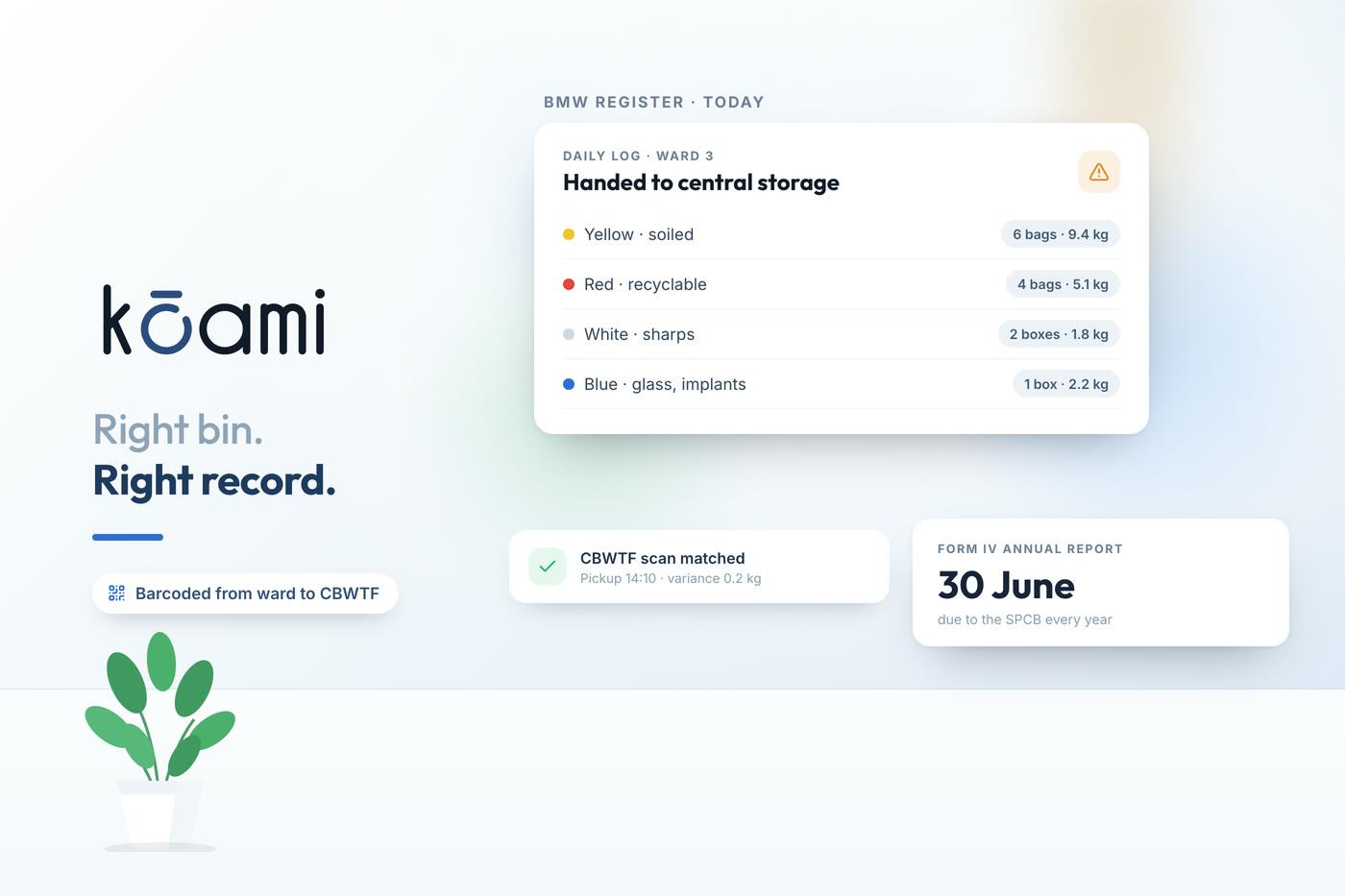
- Yellow (non-chlorinated plastic bags or containers): human and animal anatomical waste; soiled waste such as dressings, swabs and blood bags; expired or discarded medicines including cytotoxic drugs; chemical waste; discarded linen, mattresses and bedding (routine masks and gowns were added in 2018); microbiology, biotechnology and lab waste, in autoclave, microwave or hydroclave-safe bags or containers. Chemical liquid waste is collected separately and goes to the effluent system.
- Red (non-chlorinated plastic bags or containers): contaminated recyclable waste such as tubing, bottles, IV sets, catheters, urine bags, syringes without needles and gloves.
- White (translucent): sharps, including needles and blades, in puncture-proof, leak-proof, tamper-proof containers.
- Blue: glassware and metallic body implants, in puncture-proof and leak-proof boxes or containers with blue marking.
Two related duties under Rule 4: pre-treat laboratory, microbiology waste, blood samples and blood bags on site through disinfection or sterilisation (the rules refer to WHO guidance, with sterilisation to Log 6 or disinfection to Log 4), and phase out chlorinated plastic bags (other than blood bags) and gloves, which was required by 27 March 2019. A May 2019 amendment clarified that urine bags, effluent bags, abdominal bags and chest drainage bags are not covered by the chlorinated-bag phase-out.
Barcoding and the handover chain with the waste facility
The 2018 amendment added a duty to establish a bar-code system for bags or containers of biomedical waste, as per CPCB guidelines, by 27 March 2019. CPCB's April 2018 guidelines describe how it should work:
- Every colour-coded bag or container carries a bar code or QR code label, with the colour marked on the label and a "C" mark on yellow bags for cytotoxic waste.
- The State Pollution Control Board issues each healthcare facility a unique code.
- Facilities with 30 or more beds procure their own digital weighing scale and bar code scanner and scan every bag before handover.
- For facilities with fewer than 30 beds, the common biomedical waste treatment facility (CBWTF) scans and weighs bags at pickup and issues a printed receipt that should not fade for at least five years.
- The CBWTF scans bags again at its plant. If bags have not been scanned at the plant more than 24 hours after collection, the system is meant to alert the SPCB.
- Weight, date, time and location are captured, and regulators get access to the data.
The practical point: the bar code connects your ward-level generation to the CBWTF's treatment record. If your own register says 46 kg of yellow waste left on Tuesday and the CBWTF record says 38 kg, someone will ask why.
Daily, monthly and annual records
Daily: the BMW register
Rule 4(n), as amended in February 2019, requires all bedded healthcare units to "maintain and update on day to day basis the bio-medical waste management register and display the monthly record on its website". Untreated anatomical, soiled and biotechnology waste must not be stored for more than 48 hours (Rule 8(7)); a longer period requires informing the prescribed authority.
Event-based: accidents
Rule 15 requires a major accident (a spill, a needle-stick cluster, a fire in the storage area) to be intimated to the prescribed authority immediately, with a written report in Form I within twenty-four hours. Rule 4(o) adds that major accidents, including a nil report, are part of the occupier's reporting. Minor accidents are recorded and summarised in the annual report.
Six-monthly: the BMW committee
Rule 4(r) requires a committee to review and monitor biomedical waste management, meeting at least once every six months, with minutes submitted with the annual report. Facilities with fewer than thirty beds may designate a qualified person instead.
Annual: Form IV
Rule 13 requires the annual report in Form IV to reach the prescribed authority on or before 30 June every year. Bedded facilities must also publish it on their website (Rule 4(p) and Rule 13(4)).
Retention
Rule 14(1) requires records of generation, collection, reception, storage, transportation, treatment and disposal to be kept for five years. Incineration, hydroclave and autoclave operation records also have a five-year requirement.
Authorisation
Rule 10 requires an authorisation from the SPCB, applied for in Form II, irrespective of the quantity of waste. For bedded facilities its validity is synchronised with the consent validity; for non-bedded facilities it is a one-time authorisation. Track the expiry date as you would a licence.
Training and health-check records for handlers
Rule 4 also covers the people handling the waste:
- Training for all healthcare workers and others handling biomedical waste at induction and at least once every year, with details reported in the annual report (Rule 4(g)).
- Immunisation of all workers handling biomedical waste, including against Hepatitis B and tetanus (Rule 4(h)).
- Health check-ups at induction and at least once a year, with records maintained (Rule 4(m)).
These records are where inspections most often find gaps, because staff turnover in housekeeping is high and outsourced staff are easy to miss. Keep the records by person, not only by training session, so you can answer "has this worker been trained and vaccinated?" for anyone on today's roster.
NABH's 6th edition hospital standards also expect biomedical waste to be "handled appropriately and safely" under IPC.4.d, and the 6th edition changes emphasise monitoring of the programme.
Template: the daily BMW log
One row per collection point per day, or one row per bag if you scan. Suggested columns:
- Date and collection time
- Ward or department
- Category and colour (yellow sub-category, red, white, blue)
- Number of bags or containers
- Weight in kg (from your own scale for 30+ beds)
- Bar code or bag ID range
- Pre-treatment done (for lab and microbiology waste): method and initials
- Handed to internal transport by, received at central storage by
- Time into central storage
- CBWTF pickup time, vehicle number, receipt number
- Weight recorded by CBWTF (from receipt or portal)
- Variance between your weight and CBWTF weight
- Remarks: spills, damaged bags, mis-segregation found
At month end, totals by category feed the website display under Rule 4(n), and twelve months of totals feed Form IV.
Checklist: preparing the annual report
Start in April, not on 29 June.
- Twelve months of category-wise quantities, reconciled with CBWTF receipts or portal data
- Monthly website displays for the year, all published
- Treatment equipment operation records (autoclave, any on-site treatment), with validation and maintenance
- Training sessions held: dates, topics, attendance, and the list of staff trained
- Immunisation and health check-up status for all handlers, including outsourced staff
- Accident register: major accidents with Form I copies, minor accidents summarised
- BMW committee meeting minutes for both half-years
- Authorisation number and validity; CBWTF agreement and its validity
- Liquid waste and effluent treatment arrangements
- Any changes in bed strength, departments or waste quantities, with reasons
- Form IV filled, signed, submitted by 30 June, and uploaded to the website
Five gaps worth checking before an inspection
These are the places where the rules ask for evidence that sits outside the waste room, so they are the easiest to miss:
- Outsourced housekeeping staff missing from the training, immunisation and health check-up records because they are on the contractor's payroll, not yours.
- Weight mismatches between your register and the CBWTF's receipts or portal data that nobody has explained.
- Website displays of the monthly record that stopped being updated after the person who did them left.
- Committee minutes that exist for one half-year but not the other.
- Authorisation and CBWTF agreement expiry dates that nobody tracks until the inspector asks.
Each of these is a records problem, not a segregation problem, and each can be fixed by assigning one owner and one date in the quality calendar.
Digital logs and audit readiness
The BMW rules generate records in five places: the ward, the central storage area, the CBWTF, HR (training and vaccination) and the quality office (committee and accidents). On paper, the inspector's two-hour wait comes from collecting those five sources into one story.
A connected setup brings them together. Ward bags scanned at collection, weights captured at storage, the CBWTF receipt matched to the day's log, training and immunisation stored against each staff member, and the monthly total calculated rather than added up by hand. Kōami connects workforce records such as training and vaccinations to the same staff master used for rostering, which means the person on today's housekeeping roster can be checked against the rules' training and immunisation requirements. For the broader accreditation picture, see our NABH accreditation guide.
A note on change: the BMW Rules have been amended several times since 2016, most recently in April 2026, which added AYUSH representation to the rules' committees without changing occupier record-keeping. Check your State Pollution Control Board's current forms and portal requirements, which can differ by state.
This guide is general information, not legal advice. Your SPCB's directions take precedence.
If you want to see how waste logs, staff training records and accreditation evidence sit together in one system, book a demo.
Frequently asked questions
- How long must biomedical waste records be kept?
- Rule 14(1) of the Bio-Medical Waste Management Rules, 2016 requires records of generation, collection, reception, storage, transportation, treatment and disposal to be kept for five years. Incineration and autoclave operation records also have a five-year requirement.
- When is the BMW annual report due?
- Rule 13 requires the occupier to submit the annual report in Form IV to the prescribed authority, usually the State Pollution Control Board, on or before 30 June every year. Bedded facilities must also put the annual report on their website.
- Is barcoding of biomedical waste bags mandatory?
- Yes. The 2018 amendment requires occupiers to establish a bar-code system for bags or containers of biomedical waste, as per CPCB guidelines, by 27 March 2019. CPCB's guidelines ask hospitals with 30 or more beds to have their own weighing scale and bar code scanner.
- Does every hospital need a BMW committee?
- The rules require a committee that meets at least once every six months, with minutes submitted with the annual report. Facilities with fewer than thirty beds may instead designate a qualified person to review and monitor biomedical waste management.
- How quickly must a BMW accident be reported?
- Rule 15 requires a major accident to be intimated to the prescribed authority immediately and a written report in Form I sent within twenty-four hours. Minor accidents are recorded and included in the annual report.
Sources
- Bio-Medical Waste Management Rules, 2016, G.S.R. 343(E), CPCB
- Bio-Medical Waste Management (Amendment) Rules, 2018, G.S.R. 234(E), 16 Mar 2018 (TNPCB copy)
- Bio-Medical Waste Management (Amendment) Rules, 2019, G.S.R. 129(E), 19 Feb 2019, Gazette of India
- Bio-Medical Waste Management (Second Amendment) Rules, 2019, G.S.R. 360(E), 10 May 2019 (TNPCB copy)
- Bio-Medical Waste Management Rules as amended to 17 Apr 2026, CPCB
- CPCB Guidelines for Bar Code System for Effective Management of Bio-medical Waste, 2018
- NABH Accreditation Standards for Hospitals, 6th Edition (IPC.4.d)
Follow Kōami on LinkedIn
Get the next guide on hospital operations, software and compliance in your feed, as soon as it is published.