Why Role-Based Access Beats Shared Logins
Published
Walk into a busy ward and you will often find a workstation logged in under a generic account, left open so whoever needs it can chart quickly. It is understandable. It is also the single habit that undoes almost every other security control a hospital has. The moment several people share one login, the record can no longer tell you who did anything. Role-based access exists to make the fast, safe path and the traceable path the same path, so nobody has a reason to reach for the shared account again.
What a shared login actually costs
A shared account feels efficient. In reality it quietly disables the things that protect both patients and staff. When five nurses use one login, the audit log records five people's work under one name, which means it records nothing useful. If a record is accessed inappropriately, there is no way to know who did it. If a medication is charted in error, the trail leads to an account, not a person. The clinician who did everything correctly is now indistinguishable from the one who did not.
The costs stack up quickly.
- Accountability disappears, because every action traces to a shared name
- Access cannot be scoped, so the shared account tends to accumulate broad permissions
- Offboarding breaks, because you cannot remove one person from a shared credential without disrupting everyone
- Passwords get written down and rarely changed, because rotating them means retraining a whole ward
- Investigations stall, because the log cannot answer the one question that matters: who
None of this means the staff are careless. It means the system offered them a shortcut that was faster than doing it right, and people under pressure take the faster path. The fix is not a lecture about compliance. It is making individual access fast enough that the shortcut loses its appeal.
Roles map to how a hospital actually works
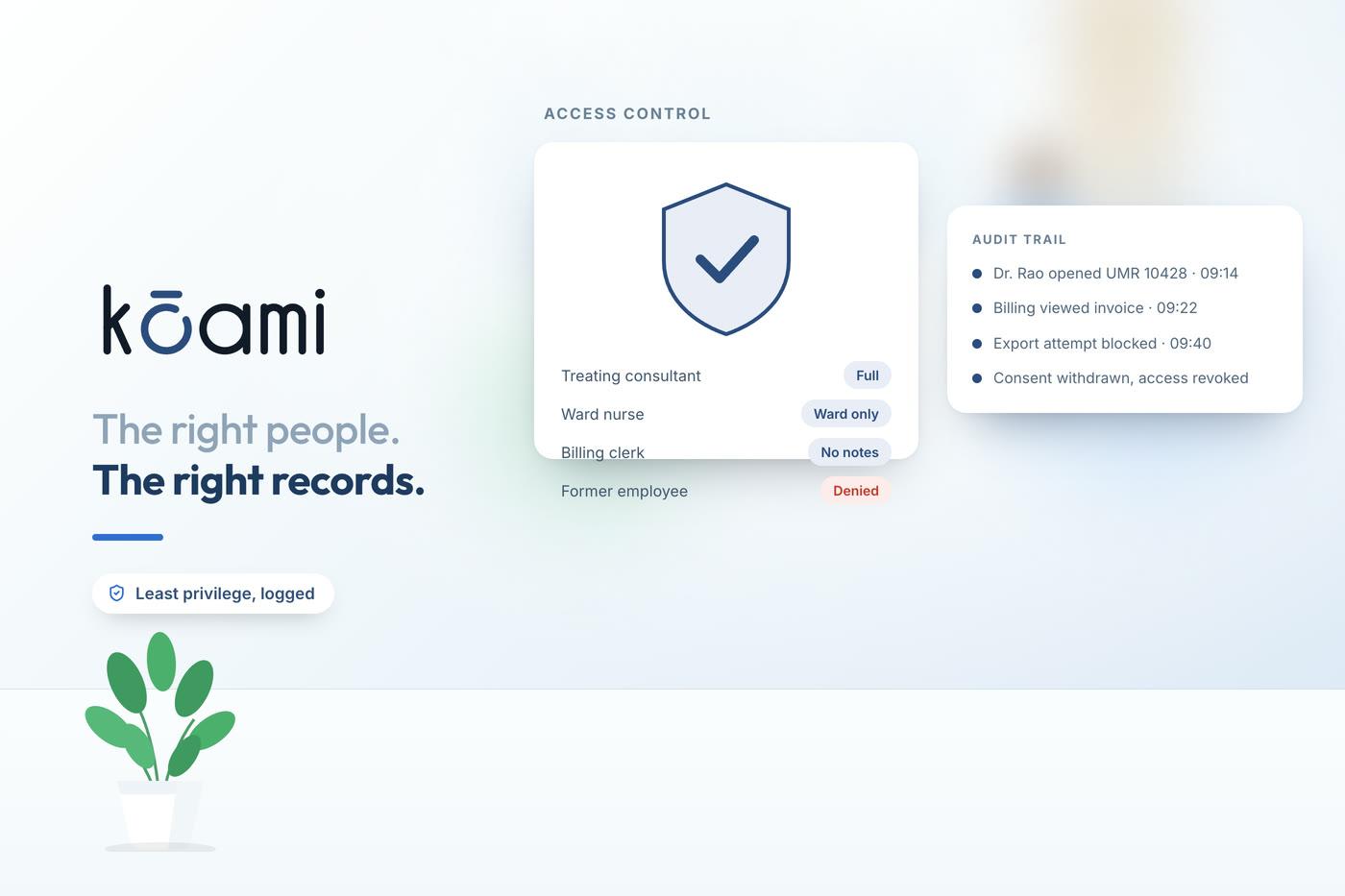
Role-based access control, RBAC, starts from a simple observation: a hospital is already organised by role. A ward nurse, a consultant, an OPD receptionist, a pharmacist, a lab technician, a billing clerk. Each needs a different slice of the system, and those slices are stable. A nurse needs the observation charts and medication administration for their ward. A billing clerk needs the financial and demographic data but has no business reading clinical notes in depth.
RBAC formalises this. Instead of granting permissions to individuals one by one, you define roles with the access that role requires, and assign people to roles. When someone joins, they get a role and the correct access follows automatically. When they move from the ward to theatre, you change their role and their access changes with it. The permissions live with the role, and the person simply inherits them.
Access should follow the job, not the person, and certainly not a password stuck to a monitor.
Least privilege is the discipline that keeps it honest
Defining roles is the easy part. The discipline that gives RBAC its value is least privilege: each role gets the minimum access it needs to do the work, and no more. It is tempting to grant generously, because broad access means fewer requests and fewer complaints. That generosity is exactly how a compromised account or a curious insider ends up with reach across the whole hospital.
Least privilege applied properly looks like this.
- Each role is scoped to the data and actions its work genuinely requires
- Access is reviewed periodically, not granted once and left forever
- Elevated access is deliberate and time-limited rather than permanent by default
- Access is removed promptly when someone changes role or leaves
- Sensitive categories get tighter scoping, so not every clinical user can open every record
The point is not to make clinicians' lives harder. A nurse should never notice least privilege on a normal day, because their role already contains everything their job needs. They notice it only at the edges, when the system declines to show them something outside their remit, which is precisely the moment you want a boundary.
Individual identity makes everything else work
Here is the part that ties it together. Almost every other security control depends on knowing who is acting. Audit logs are meaningful only if each action maps to a person. Multi-factor authentication protects an account only if that account belongs to one individual. Least privilege can only be scoped if the system knows which person, in which role, is logged in. Shared logins knock the foundation out from under all of it.
That is why Kōami is built around individual accounts with role-based permissions rather than shared credentials. Each person authenticates as themselves, carries the access their role defines, and leaves a trail under their own name. The convenience that once drove people to shared logins, fast access on a busy ward, comes instead from quick individual sign-in and sensible session handling, so the safe path is also the fast one.
Making the transition realistic
Moving a ward off shared logins fails when it is imposed as a rule without removing the friction that created the workaround. The transition works when individual login is genuinely quick: fast authentication, sessions that do not force constant re-entry during active use but time out when a device is abandoned, and roles pre-built so nobody waits days for access. Get that right and staff stop resenting the change, because the new way is not slower, it is simply attributable.
Role-based access with least privilege is not a security feature you bolt on. It is the model that lets every other protection mean something. It gives each action an owner, keeps each person's reach matched to their job, and turns the record from a shared blur into an honest account of who did what. The shared login was never really about convenience. It was about the system not making individual access easy enough. Fix that, and the shared login has nothing left to offer.
Follow Kōami on LinkedIn
Get the next guide on hospital operations, software and compliance in your feed, as soon as it is published.