Making MFA Painless for Busy Wards
Published
Security teams love multi-factor authentication and wards quietly hate it, and both are right. MFA genuinely stops the most common way accounts get compromised, a stolen or guessed password, from being enough on its own. It is also, in its clumsier forms, exactly the kind of friction that makes a nurse with a deteriorating patient reach for a shared login instead. The whole challenge is not whether to use MFA on clinical systems. It is how to make it fast enough that nobody has a reason to route around it.
Why a password alone stopped being enough
Passwords fail in predictable ways. They get reused across systems, so a leak somewhere else becomes a way into the EMR. They get written on notes stuck to monitors. They get phished. On a busy ward they get shared, which means they are not really secret at all. A single factor, something you know, is a thin defence for data this sensitive, because knowing is easy to steal.
MFA adds a second, different kind of factor, something you have or something you are, so that a stolen password is not a stolen account. The attacker who phished the credential still cannot log in without the second factor. That is the entire value, and it is substantial: it neutralises the most common attack against the most sensitive data in the hospital.
- Something you know: the password, which alone is too easy to compromise
- Something you have: a device, a token, a passkey on a phone
- Something you are: a fingerprint or face, fast and hard to lend to a colleague
The friction is the whole problem
Here is the uncomfortable truth. If MFA takes too long or interrupts too often, clinicians will defeat it, not out of malice but out of clinical necessity. A prompt that fires every few minutes, or demands a code typed from a separate device while the clinician's hands are gloved and busy, does not make the ward more secure. It makes the ward invent a workaround, and the workaround, usually a shared always-on session, is far less secure than the password MFA was meant to strengthen.
So the design goal is specific: authentication strong enough to stop stolen credentials, light enough that the safe path is also the fast path. That means paying attention to the moments where friction actually bites.
- The first login of a shift, which should be quick even if it is the most secure step
- Returning to a workstation after stepping away, where a full re-login is overkill
- Shared ward devices, where the challenge is switching users fast, not proving identity slowly
- Gloved or sterile contexts, where typing a code from a phone is simply not going to happen
An MFA scheme that clinicians route around has negative value; it created friction and bought no security.
What painless actually looks like
Painless MFA is not weaker MFA. It is MFA that fits the shape of clinical work. Several design choices make the difference between adoption and revolt.
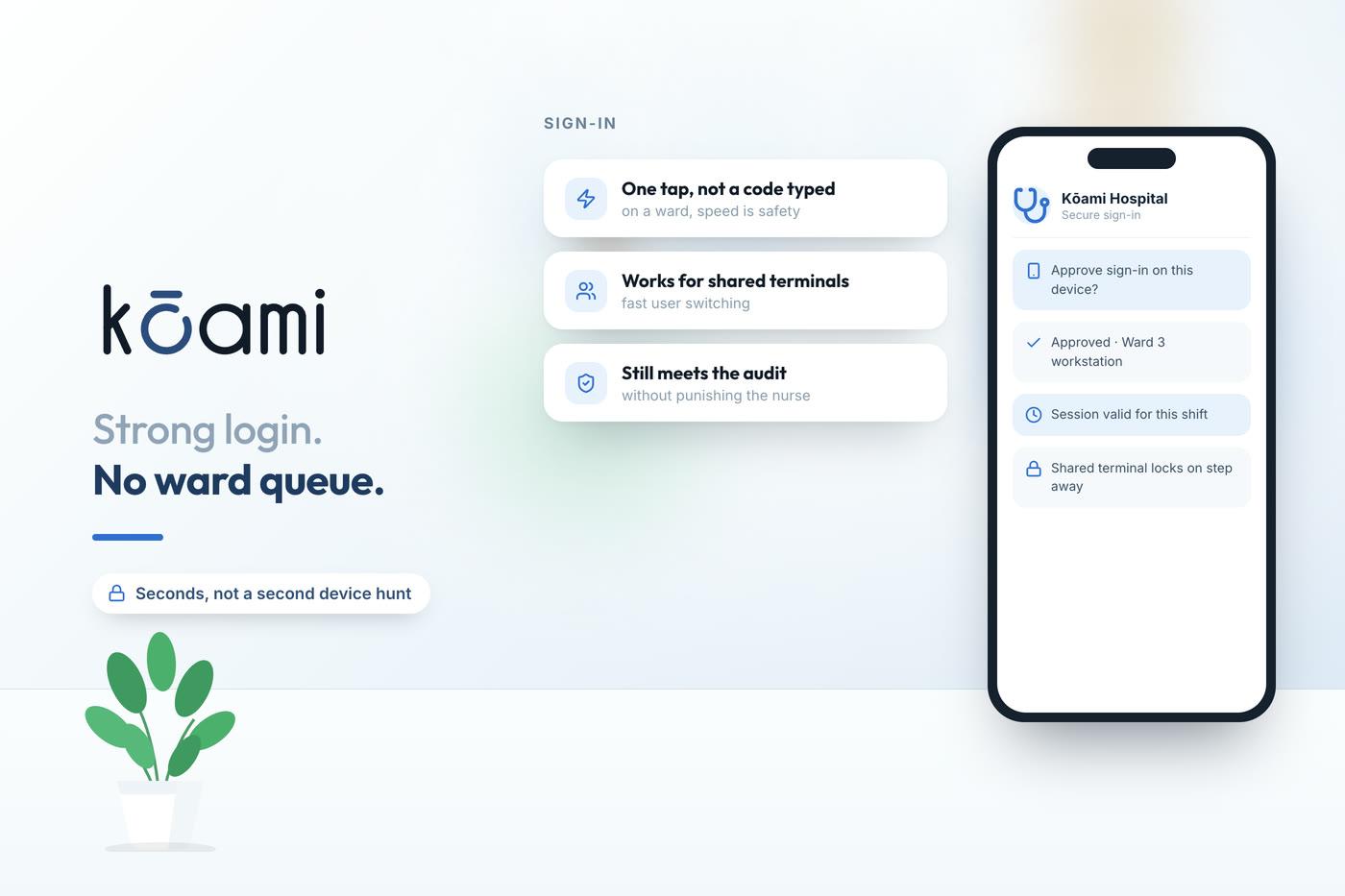
Fast factors first. A tap on a registered device or a fingerprint is far more ward-friendly than reading a six-digit code off one screen and typing it into another. Push approvals and passkeys give strong security with a single gesture. The less the clinician has to type, the more likely the control survives contact with a real shift.
Risk-based prompting. Not every action needs the same challenge. A first login of the day on a new device deserves full verification. Continuing an active session on the same trusted workstation does not need to be interrupted every few minutes. Prompting harder when the context is unusual, and staying quiet when it is routine, concentrates the friction where it earns its keep.
Sensible sessions. On shared ward devices the real need is fast user switching: one clinician steps away, the next authenticates in seconds and the session is unambiguously theirs. Sessions that stay open during active use but time out when a device is abandoned protect the record without forcing constant re-entry. This is also what finally kills the shared login, because individual access is now quick enough that the shortcut offers nothing.
Kōami supports multi-factor authentication designed for this reality, favouring fast factors and session handling that suits a ward, so that strong authentication does not come at the price of a workaround.
Rolling it out without a revolt
Even good MFA fails if it is dropped on a ward as a mandate with no groundwork. The rollouts that stick share a pattern. They enrol staff in advance, so nobody is registering a device for the first time while a patient waits. They pilot on one ward, learn where the friction actually lands, and fix it before scaling. They provide a fallback for the genuine edge case, the lost phone, without making the fallback so easy that it becomes the default. And they explain the why in terms clinicians care about, which is not compliance but the fact that this is what stops someone else logging in as you and touching your patients' records.
The measure of success is quiet. If MFA is working, clinicians stop noticing it, shared logins fade because individual access is no longer slower, and the security team stops seeing the account compromises that a single password used to allow. Nobody thanks a login screen, and they should not have to. The best outcome is that strong authentication simply becomes the unremarkable way the day starts, fast enough to disappear into the routine, strong enough that the one attack it was built to stop no longer works.
Follow Kōami on LinkedIn
Get the next guide on hospital operations, software and compliance in your feed, as soon as it is published.