Hotel PMS vs Channel Manager vs Booking Engine: What Each One Does
Published
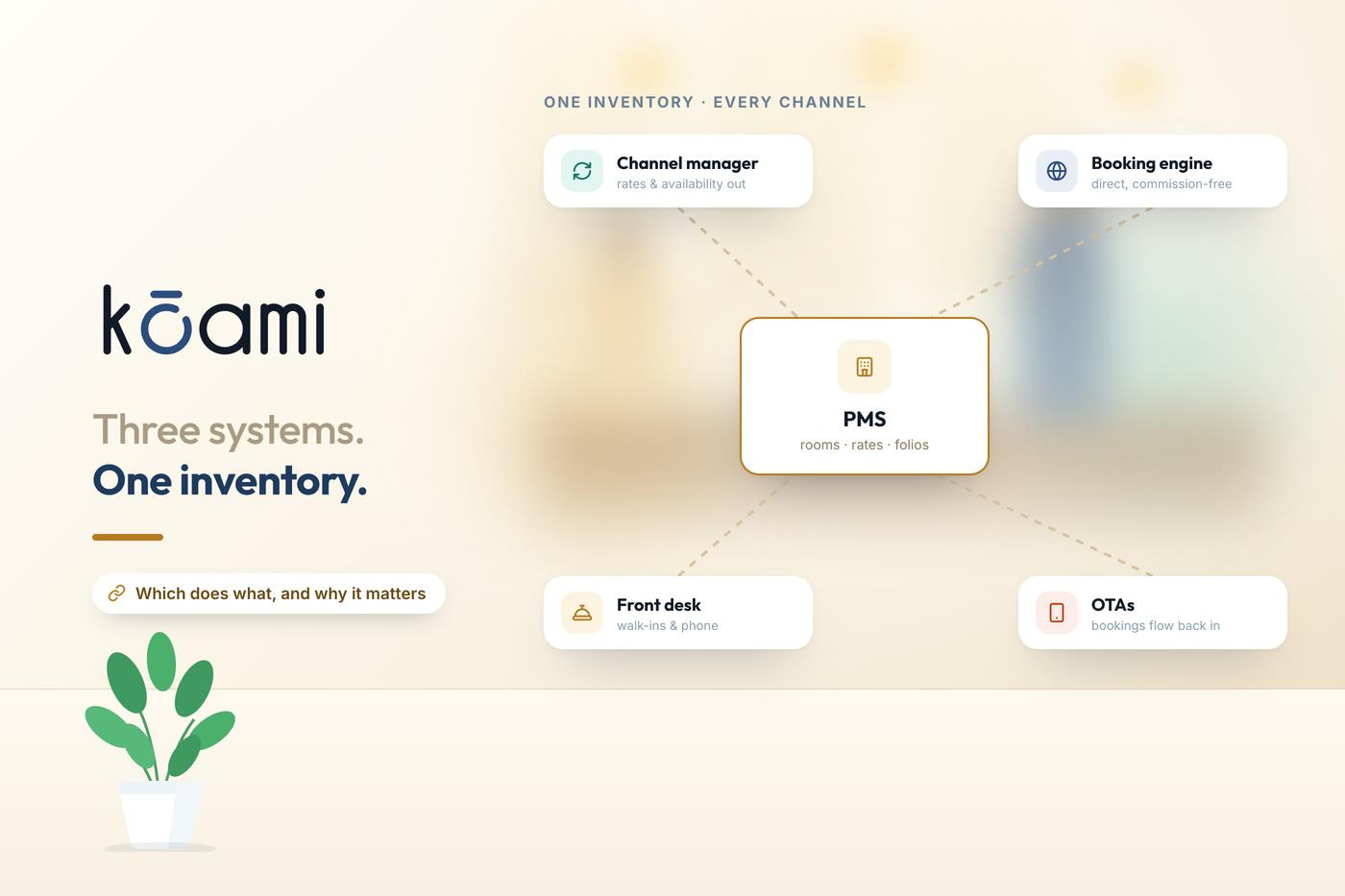
A hotel owner is usually sold three products in the same month: a PMS for the front desk, a channel manager "so you can sell on the OTAs", and a booking engine "so you can stop paying commission". Each comes from a different salesperson, each has its own subscription, and each claims to be the one that matters. They are all right, and that is the problem — because the three only work when they behave like one system.
This guide explains what each one does, how bookings and rates move between them, and why the join between them is where most hotels lose rooms and money.
What is a hotel PMS?
A property management system (PMS) is the hotel's operating record. It holds the rooms and their status, the reservations, the guest profiles, the folios and payments, and the night audit that closes each business day. It is where the front desk lives.
Everything else in hotel software either feeds the PMS or reads from it. If the PMS says room 204 is sold for tonight, that is the truth the rest of the property — and every sales channel — has to agree with.
What is a channel manager?
A channel manager distributes your inventory to online travel agencies (OTAs) and other channels. It pushes three things outward — availability, rates and restrictions, usually shortened to ARI — and brings the resulting bookings, modifications and cancellations back in.
Without one, someone updates each OTA extranet by hand. With one, a booking on one channel reduces availability everywhere within moments, and a rate change made once reaches every channel. That is what prevents the classic overbooking: two OTAs each selling your last deluxe room on the same Saturday.
What is a hotel booking engine?
A booking engine is the reservation flow on your own website. A guest picks dates, compares rooms, adds extras, pays and gets a confirmation — without an OTA in the middle.
Its business case is commission. OTAs commonly charge in the range of 15 to 25 percent of the booking value, depending on the agency and your contract; a direct booking on your own engine pays a payment-gateway fee instead. Its marketing case is the guest relationship: a direct guest's email and phone number belong to you, not to the agency.
How do the PMS, channel manager and booking engine work together?
In a well-built setup, the PMS is the single source of availability and rates. The channel manager reads from it and pushes outward; the booking engine sells from it directly; and every booking, from any source, is written back into the PMS as one reservation.
- A guest books on an OTA → the channel manager receives it → the PMS records it → availability drops on the website and every other channel.
- A guest books on your website → the PMS records it directly → the channel manager pushes the new availability to the OTAs.
- The revenue manager raises Saturday's rate → the PMS updates the rate calendar → the website and the OTAs show the new price.
When the three are separate products, each of those arrows is an interface between two vendors. Interfaces fail quietly: a mapping breaks after an OTA renames a room type, a sync stalls overnight, a cancellation arrives in the channel manager but never in the PMS. The hotel finds out when a guest arrives with a confirmation for a room that is already occupied.
Do I need all three?
If you sell on any OTA and also take direct bookings, yes — in practice, almost every hotel needs all three functions. What you do not necessarily need is three products. The choice is between:
- Three separate products joined by interfaces, each with its own subscription, support desk and failure modes.
- A PMS with an integrated channel manager and booking engine, where all three read and write the same inventory.
The second removes the interfaces, and with them the most common causes of overbooking and missing reservations. It also means one place to fix a problem at 11 pm.
What is rate parity and why does it matter?
Rate parity means offering the same room at the same price across your channels. OTAs care about it because they do not want to be undercut; you care about it because a guest who sees a lower price elsewhere loses trust in all of them.
The practical issue is visibility. Rates drift — a promotion left running on one OTA, a markup misconfigured on another — and nobody notices until a guest complains. A parity monitor compares what each channel is actually showing with what you meant to publish, and flags each one as in parity, undercut, above or closed.
How do I get more direct bookings?
Make the direct route the easiest one, then give guests a reason to take it:
- A booking engine that is fast on a phone, shows the total including taxes, and takes UPI and cards.
- Add-ons that only exist on the direct route — an airport transfer, a dinner, early check-in — rather than deep discounts that break parity.
- A confirmation, pre-arrival message and online check-in that make booking direct feel better, not just cheaper.
- Guest details captured at every stay, so the next booking can be invited directly.
Where Kōami Hotel360 fits
Kōami Hotel360 is one system rather than three. The PMS, the booking engine and the channel manager share one inventory and one booking writer — a reservation from the desk, the website or a channel is the same kind of record, written the same way. The booking engine gives each property a direct-booking website with online payment, add-ons and promo codes. The channel manager maps rooms and rates per channel, pushes availability, rates and restrictions, receives channel bookings into an inbox, and runs a parity monitor. Connectivity to your OTAs and any existing channel partner is configured per property during onboarding.
Beyond distribution, the same system runs the restaurant POS, housekeeping, banquets, revenue and accounts — see hotel management software for India for the full picture, or our guide to choosing hotel management software if you are building a shortlist.
Follow Kōami on LinkedIn
Get the next guide on hospital operations, software and compliance in your feed, as soon as it is published.