GST on Hotel Rooms in India (2026): 5% and 18% Slabs, ITC and Restaurants
Published
A business traveller stays three nights. The first two are at a weekday rate of ₹6,800; the third, a Saturday, is at ₹8,200. A billing system that picks one GST rate for the whole stay gets at least one night wrong — and since September 2025 the gap between the two rates is thirteen percentage points, not six.
This guide sets out how GST on hotel accommodation works in India in 2026: the current slabs, what happened to input tax credit, how restaurant GST in a hotel is decided, and what your billing software has to do to invoice it correctly. It describes the rules as notified at the time of writing; confirm the treatment of your own property with your chartered accountant.
What is the GST rate on hotel rooms in 2026?
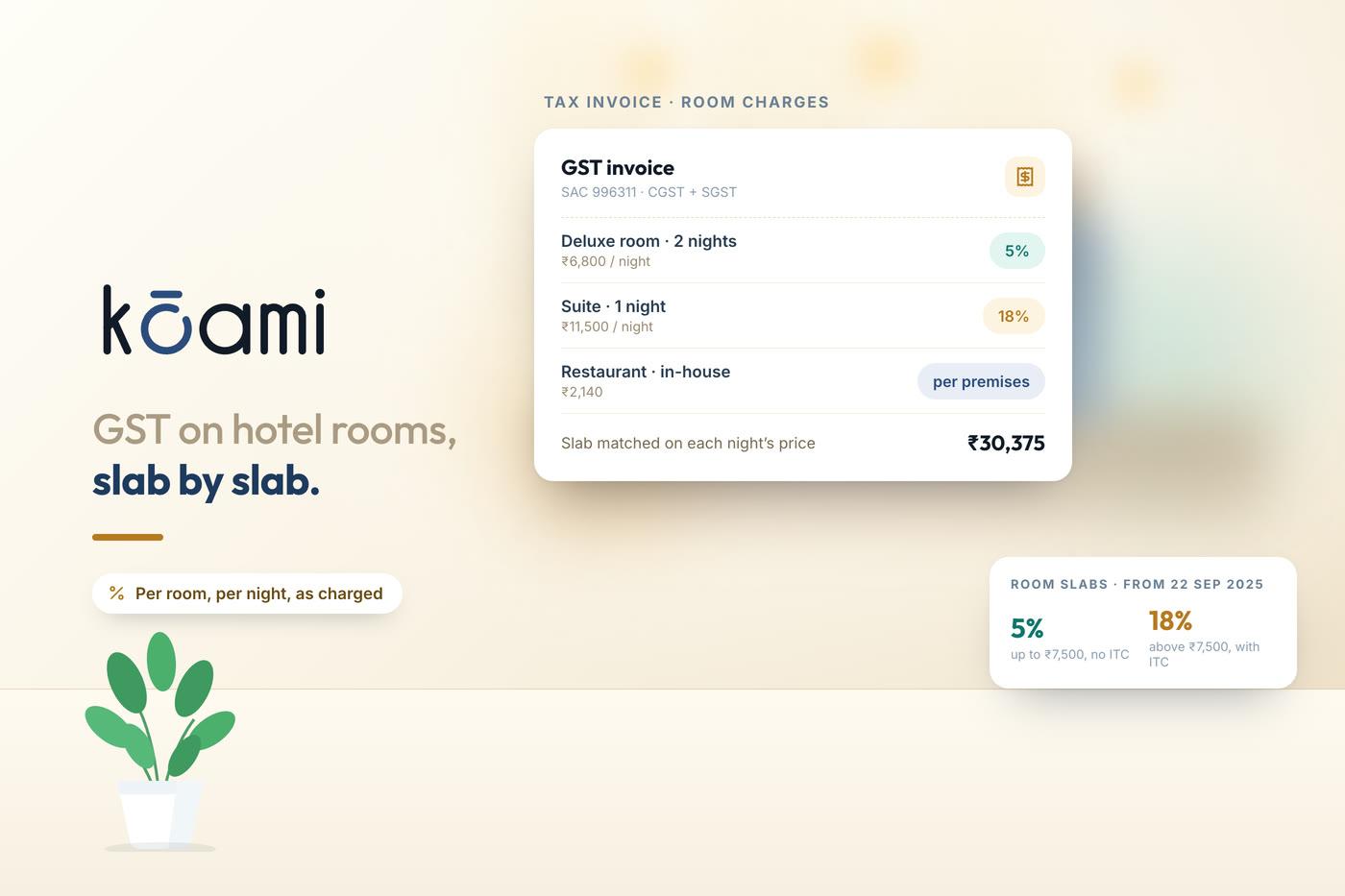
From 22 September 2025, hotel accommodation is taxed in two slabs, decided by the value of supply of each unit per day:
- ₹7,500 or less per unit per day: 5%, without input tax credit.
- Above ₹7,500 per unit per day: 18%, with input tax credit.
Before that date the structure had three bands — 12% up to ₹7,500 and 18% above it, with rooms at ₹1,000 or less exempt until July 2022, when that exemption was withdrawn. Older articles and rate cards still show the 12% band; it no longer applies.
Is the slab decided per night or per stay?
Per unit, per day. Each night is tested on its own value, so a stay can cross the threshold: in the example above, the two weekday nights at ₹6,800 attract 5% and the Saturday at ₹8,200 attracts 18%. The test uses the price actually charged — the transaction value — not a published rack rate; the old "declared tariff" test was dropped in 2018.
Two practical consequences. Discounts matter: a ₹8,000 room sold at ₹7,400 after a corporate discount falls into the 5% slab. And invoices need to show the rate night by night, not as one blended line.
Why does "without ITC" matter at the 5% rate?
Input tax credit (ITC) is the GST a hotel pays on its own purchases — linen, furniture, renovation, maintenance contracts, software — which it can normally set off against the GST it collects. At the 5% slab that credit is not available for the accommodation supply.
For a hotel whose rooms sell mostly at ₹7,500 or less, this is a real trade: guests pay less tax, but the hotel absorbs the GST on its inputs as a cost. Hotels with rooms on both sides of the threshold need to apportion their credits between the supplies that allow ITC and those that do not, which is an accounting job your billing data has to support.
How is GST on a hotel restaurant decided?
By whether the hotel is a "specified premises". From 1 April 2025, a premises is specified if, in the preceding financial year, any unit of accommodation was supplied there at a value above ₹7,500 per unit per day. A hotel can also choose to declare its premises as specified.
- Restaurant service at a specified premises: 18%, with ITC.
- Restaurant service elsewhere: 5%, without ITC.
The status is decided by last year's room prices, not today's — so a hotel that sold even one room above ₹7,500 in the previous financial year charges 18% on its restaurant this year, including to diners who are not staying. Declarations to opt in, and to opt out again, are made on prescribed annexures within a window before the financial year begins; check the current window with your adviser, because it decides the rate for the whole year.
What SAC code and place of supply apply to hotel rooms?
Hotel accommodation is classified under SAC 996311 (room or unit accommodation services). Restaurant and food services have their own codes, and a hotel invoice that mixes the two should show each line under its own code and rate.
The place of supply for accommodation is where the property is. That means the invoice carries CGST and SGST of the hotel's state, even when the guest's company is registered in another state. A company can generally claim credit only on GST charged to a registration in the same state, which is why corporate travel desks ask hotels for the company's local GSTIN where it has one.
What should a GST-compliant hotel invoice show?
At minimum: the hotel's GSTIN and the guest's or company's GSTIN for B2B stays, the invoice number in a series that runs by financial year, the SAC for each line, the taxable value, the rate and the CGST and SGST amounts — for rooms, night by night when the rate differs. Credit notes should reference the original invoice. For businesses above the e-invoicing threshold, B2B invoices must also carry an IRN generated through the invoice registration portal.
What does the billing software need to do?
The rules are not complicated; applying them by hand at a busy check-out desk is. The software should:
- Hold GST slabs as configurable tax groups, so a rate change is a settings change, not a software update.
- Match the room slab on each night's actual price, after discounts.
- Apply the restaurant rate that matches the premises' status for the year.
- Number invoices and credit notes by financial year, with an HSN/SAC summary.
- Generate the e-invoice IRN for B2B invoices where required.
- Produce GST summaries your accountant can file from, and export to Tally.
Where Kōami Hotel360 fits
Kōami Hotel360 computes room GST per night on each night's price using configurable slab tax groups, so a stay that crosses ₹7,500 is invoiced correctly without anyone overriding a line. Invoices and credit notes are numbered by financial year with an HSN/SAC summary; B2B invoices can generate an e-invoice IRN through a connected GST suvidha provider; and the accounts module builds a day book from billing, a GST output summary and a Tally export.
The same folio carries restaurant, spa and minibar charges with their own codes and rates, so one invoice at check-out is one correct invoice. For the rest of what a hotel system should do, see hotel management software for India, and for the close of each business day, our guide to the night audit.
This article explains the general rules as notified at the time of writing and is not tax advice. Rates, thresholds and declaration windows can change by notification; confirm the treatment for your property with your chartered accountant.
Follow Kōami on LinkedIn
Get the next guide on hospital operations, software and compliance in your feed, as soon as it is published.