Occupancy, ADR and RevPAR: Hotel KPIs Explained with Formulas
Published
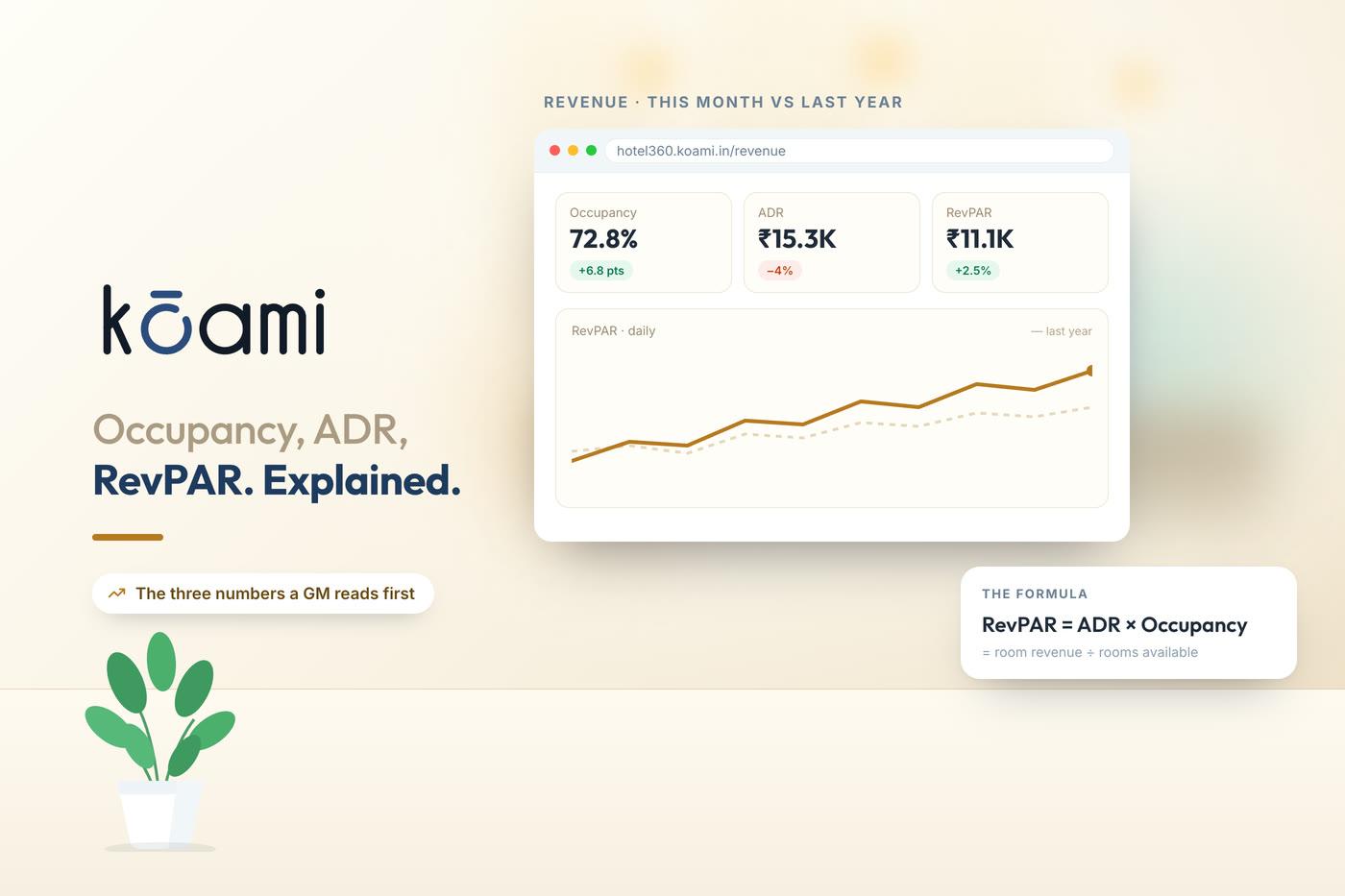
A hotel owner hears that occupancy is up eight points on last October and is pleased. The revenue manager is not, because the hotel achieved it by discounting, and room revenue per available room is barely higher than it was. Both are reading true numbers. They are reading different ones.
This guide explains the three numbers every hotel GM reads first — occupancy, ADR and RevPAR — with the formulas, a worked example, the two that sit beside them (TRevPAR and GOPPAR), and the mistakes that make them disagree between departments.
What is hotel occupancy?
Occupancy is the share of available rooms that were sold.
Occupancy = rooms sold ÷ rooms available
A 120-room hotel over a 30-day month has 3,600 room nights available. If it sold 2,520, occupancy is 2,520 ÷ 3,600 = 70%.
Occupancy tells you how full the hotel was. It says nothing about the price, which is why on its own it can be bought: drop the rate far enough and almost any hotel can be full.
What is ADR?
Average daily rate (ADR) is the average room revenue per room sold.
ADR = room revenue ÷ rooms sold
If those 2,520 room nights earned ₹1,26,00,000 in room revenue, ADR is ₹1,26,00,000 ÷ 2,520 = ₹5,000.
ADR tells you the price you achieved. On its own it can also be bought, in the other direction: refuse every discount and ADR rises while the hotel sits half empty.
What is RevPAR?
Revenue per available room (RevPAR) is room revenue divided by every room you had to sell, sold or not.
RevPAR = room revenue ÷ rooms available = ADR × occupancy
In the example, ₹1,26,00,000 ÷ 3,600 = ₹3,500, which is the same as ₹5,000 × 70%.
RevPAR is the number that cannot be bought by moving only one lever. It rises only when the combination of price and volume improves, which is why it is the standard measure of room performance and the one owners and lenders ask for.
Why can occupancy rise while RevPAR falls?
Because the price fell faster than the volume rose. Suppose next month the same hotel discounts to fill rooms: occupancy rises to 78% but ADR falls to ₹4,300. RevPAR is now ₹4,300 × 78% = ₹3,354 — lower than before, despite the fuller hotel, and with more rooms to clean and more guests to serve for less money.
The reverse is also possible: ADR rises, occupancy falls, and RevPAR falls with it. Reading the three together is the point.
What are TRevPAR and GOPPAR?
Two numbers that widen the view beyond rooms:
- TRevPAR (total revenue per available room) = total revenue from all departments ÷ rooms available. For a resort or a hotel with busy restaurants, banquets and a spa, it shows whether the guests you are attracting spend beyond the room.
- GOPPAR (gross operating profit per available room) = gross operating profit ÷ rooms available. It brings costs in, so a strategy that raises revenue but raises costs faster shows up as a problem rather than a success.
A city hotel may live by RevPAR; a resort that earns as much from F&B, spa and activities as from rooms should watch TRevPAR closely; an owner reads GOPPAR.
How should rooms available and rooms sold be counted?
Consistently — that is most of the answer. Decide, write down and apply the same rules every day:
- Whether out-of-order rooms are removed from rooms available, or kept in and treated as unsold.
- Whether complimentary and house-use rooms count as sold. Most hotels exclude them from the sold count used for ADR, because they carry no revenue and would drag ADR down.
- Whether room revenue is net of GST and of inclusions such as breakfast in a bed-and-breakfast rate. It should be net of tax; inclusions should be split out to F&B.
- Whether day-use rooms count as sold.
Most disagreements between the front office's figures and the accounts' figures trace back to one of these four.
How do hotels improve RevPAR?
By pricing to demand rather than to habit:
- Watch pickup and pace — how fast future dates are filling compared with the same time last year — and move prices before a date fills, not after.
- Use restrictions such as minimum length of stay on peak nights to protect them from one-night bookings that block longer stays.
- Segment the price: corporate, leisure, groups and packages each have different sensitivity.
- Shift mix toward direct bookings, which improves net revenue even at the same ADR.
- For resorts, sell the stay, not the room — packages with dining, spa and experiences raise TRevPAR.
Where Kōami Hotel360 fits
The revenue dashboard in Kōami Hotel360 shows occupancy, ADR, RevPAR and TRevPAR against the same time last year and budget, with pickup over one, seven and thirty days, pace, and channel and segment mix. Forecasts run 90, 180 and 365 nights ahead, and pricing recommendations take day of week, occupancy, lead time and demand events into account, with caps and floors so a recommendation cannot run away. Because the numbers come from the same folios the front desk and outlets post to, the night-audit flash report, the revenue dashboard and the accounts read from one set of figures.
To see how those figures are produced each night, read our guide to the hotel night audit; for how distribution affects them, see PMS vs channel manager vs booking engine.
Follow Kōami on LinkedIn
Get the next guide on hospital operations, software and compliance in your feed, as soon as it is published.