Best Hotel Management Software in India (2026): How to Compare a PMS
Published
At ten past eleven on a Saturday night, the restaurant manager at a 60-room hotel sends a guest's dinner bill to the front desk on a printed slip. The night auditor types it into the folio. The guest checks out at six the next morning, before the auditor has reached the slip, and leaves owing ₹4,800 that nobody will ever collect. This is not a staffing problem. It is a software problem, and it is the most common one in Indian hotels.
Choosing hotel management software is mostly about avoiding that kind of leak. This guide is for owners, general managers and finance heads comparing systems in 2026: what the software has to do, the four kinds of vendor you will meet, how pricing actually works, and the questions that separate a hotel system from a booking screen.
What is hotel management software?
Hotel management software is the system a hotel runs its operations on. At its centre is the property management system (PMS) — reservations, front office, room status, folios and the night audit — and around it sit the booking engine, the channel manager, the restaurant point of sale, housekeeping, revenue management, banquets, stores and accounts.
Vendors use "PMS" and "hotel management software" almost interchangeably, which is why the label on the brochure tells you very little. The useful question is which of those modules are included, and whether they share one guest record and one folio or are separate products joined by an interface.
What should hotel software do for an Indian hotel?
Ten things, and a system that misses any one of them leaves your team covering the gap by hand:
- Reservations from one inventory. The desk, the website and every OTA sell from the same availability, so the last room cannot be sold twice.
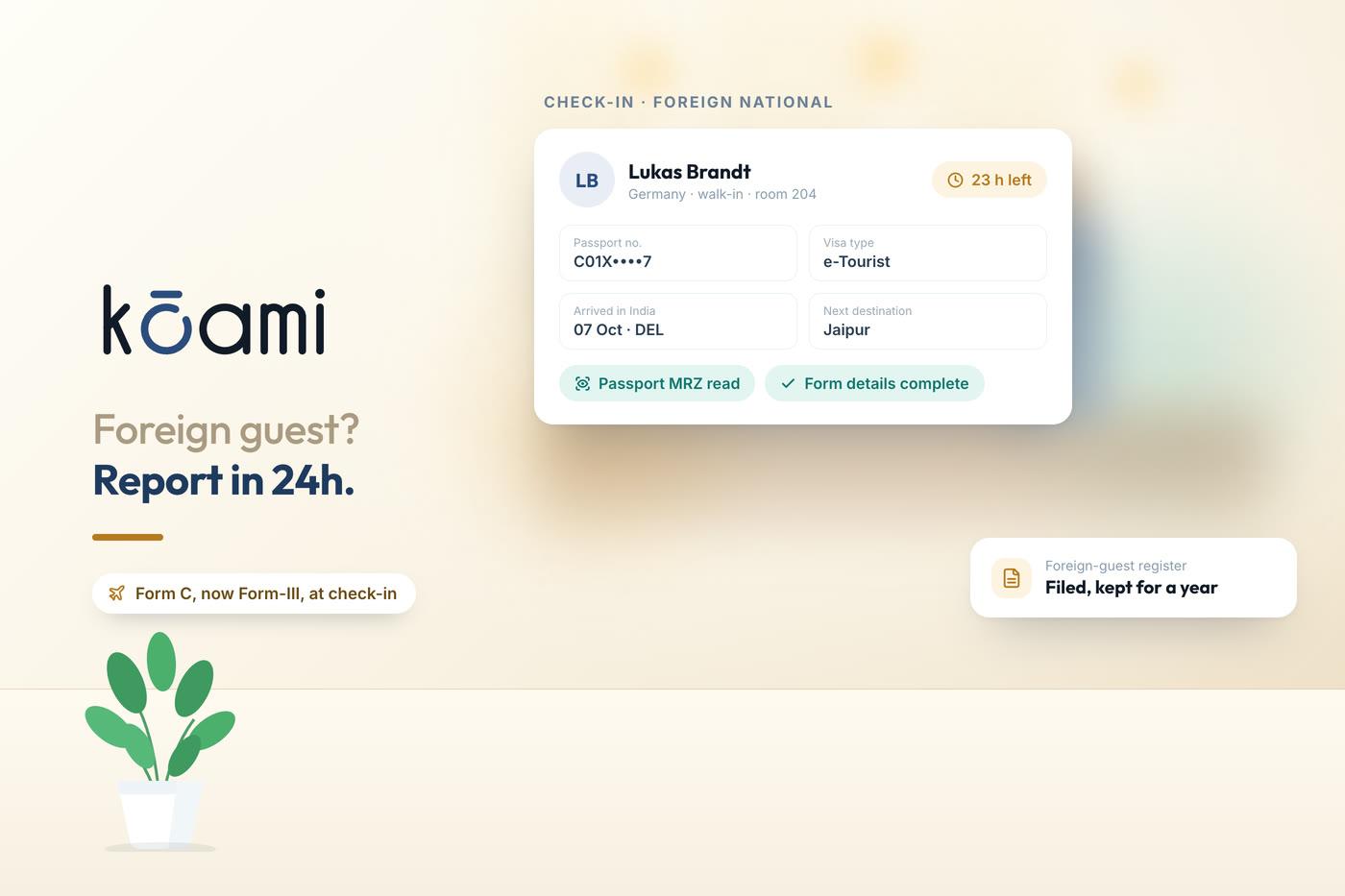
- Guided check-in. ID capture, Form C details for foreign nationals, signature, deposit and room assignment in one flow, not on paper.
- Folios that every outlet posts to. Restaurant, room service, spa, minibar and laundry charges land on the room automatically.
- GST that is right per night. Room GST depends on the price of each unit per night, so the software must match the slab night by night, not once per stay.
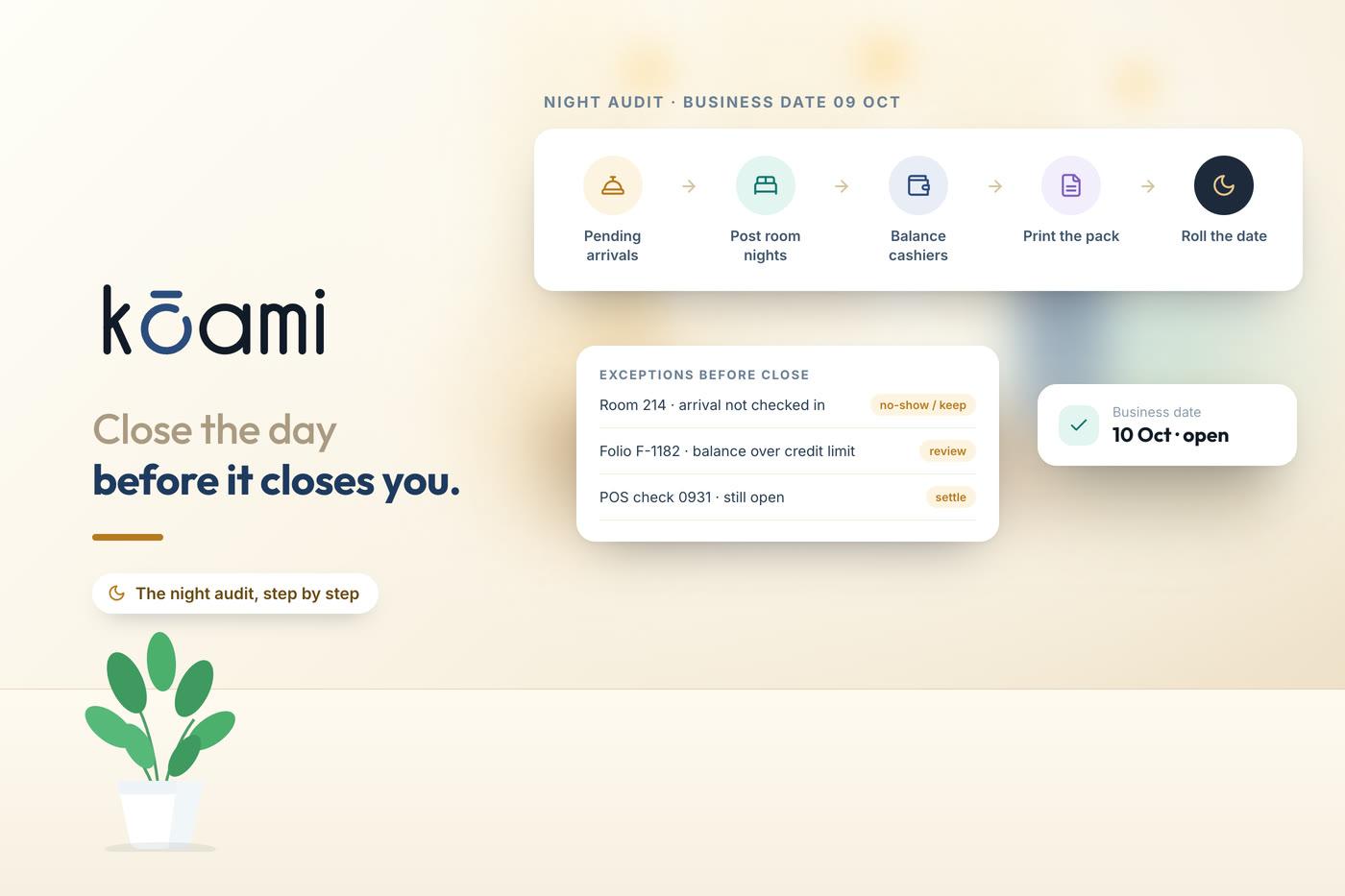
- A night audit your night manager can run. Pending arrivals, room-night posting, cashier balancing and the date roll, without phoning the vendor.
- A booking engine and channel manager. Direct bookings with online payment, plus rates and availability pushed to the OTAs you sell on.
- Housekeeping that sees check-outs instantly. A live room board on a phone, so a departed room is cleaned before the next guest is waiting in the lobby.
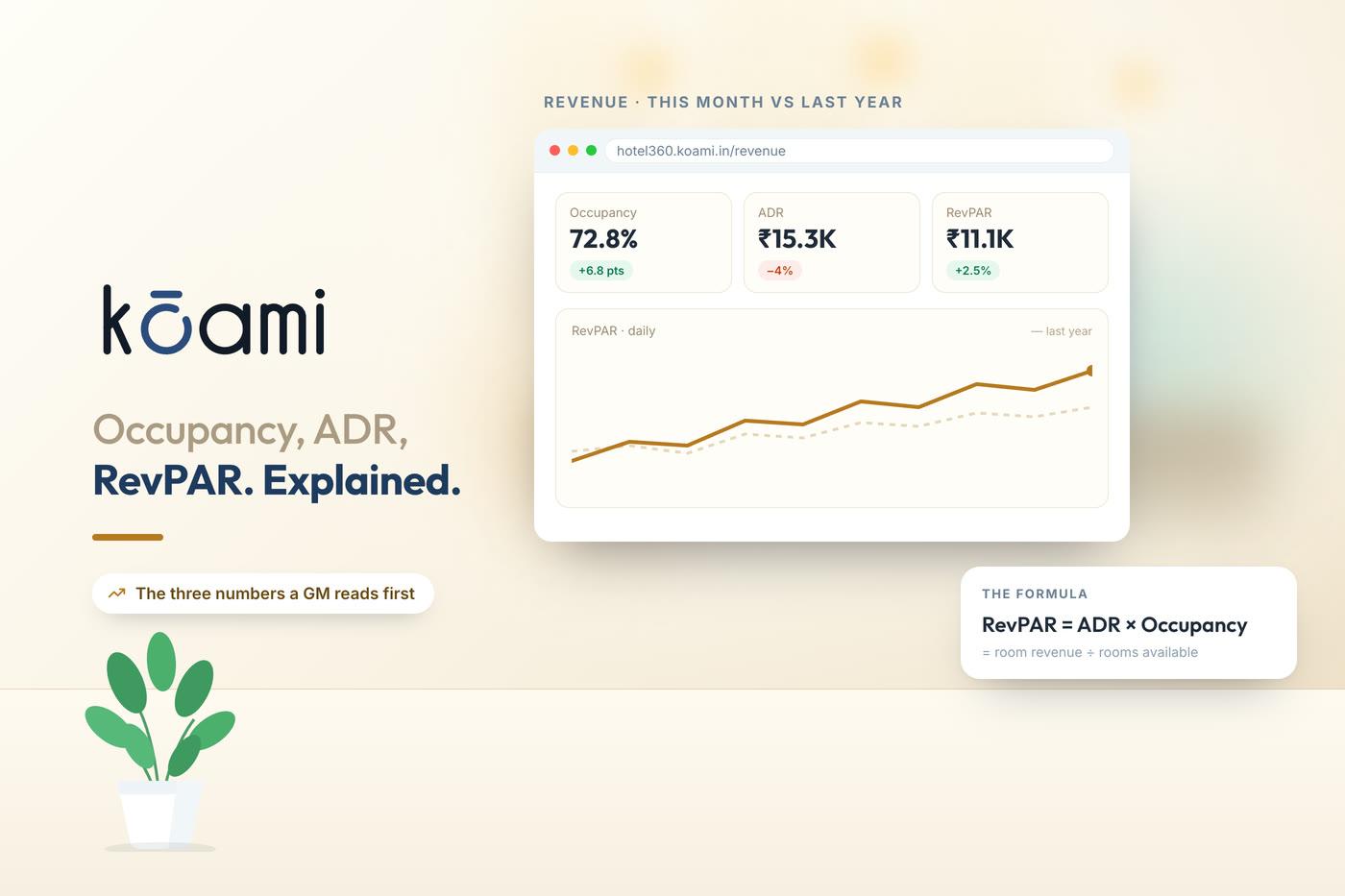
- Revenue numbers you can trust. Occupancy, ADR and RevPAR against last year and budget, from the same data the desk uses.
- Accounts that close. A day book from billing, GST summaries and an export your accountant can load into Tally.
- Room to grow. A second property, a banquet hall or a spa without a second contract and a second database to reconcile.
If you are not sure what some of these mean, our explainer on the PMS, channel manager and booking engine covers how the three fit together.
Which kinds of hotel software vendor will you meet?
Four, broadly. None of them is wrong; they fail in different ways.
Global enterprise PMS
Built for international chains, with deep configuration and long implementation projects. They suit large branded hotels with an IT team. Watch for licence and implementation cost, India-specific gaps that need local add-ons, and support hours set in another time zone.
India-focused cloud PMS
Cloud systems priced for independent and mid-size Indian hotels, usually strong on front desk and GST billing. They suit 20–150 room properties. Watch for modules sold separately — the channel manager, POS and banquets often carry their own subscriptions — and for how restaurant bills actually reach the folio.
Channel-manager-first vendors
Companies that started with OTA distribution and added a PMS later. Their distribution is usually excellent. Watch for a thinner PMS: night audit, housekeeping, banquets and accounts are often basic or missing.
All-in-one hotel suites
One system for the whole property — PMS, distribution, POS, housekeeping, banquets, spa, revenue and accounts on one data model. They suit hotels and groups that want one set of numbers and one bill. Watch for depth: ask to see each module run a real scenario, not a slide.
How is hotel management software priced in India?
Almost always as a subscription, and in one of three shapes: per room per month, per property per month, or a base PMS fee with each additional module priced separately. Some vendors also take a per-booking fee on the booking engine or charge for each OTA connection.
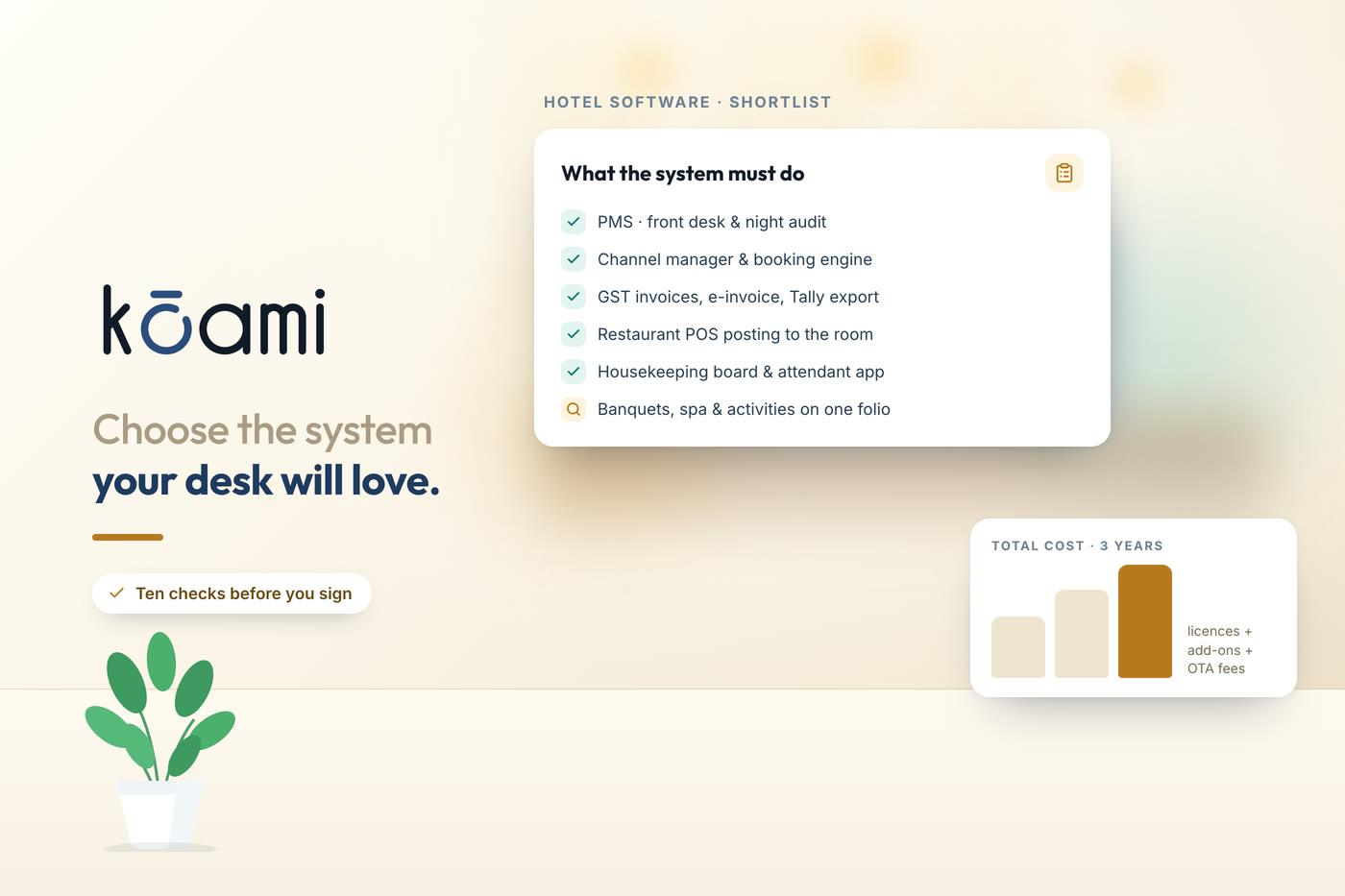
The headline number is rarely the real number. To compare honestly, add up three years of: the PMS licence, every module you will actually use (channel manager, booking engine, POS outlets, banquets, spa), per-connection and per-transaction fees, implementation and training, hardware such as POS terminals and printers, and the staff hours spent reconciling between systems if they are separate. That last line is the one most comparisons leave out, and for a busy hotel it is usually the largest.
What is the cheapest hotel management software in India?
The cheapest software to buy is a basic front-desk PMS on a per-room subscription, and for a small property that only sells rooms it can be enough. The cheapest software to run is different: it is the system that stops charges leaking, does not need a second product for every department, and lets a small team close the day without spreadsheets.
So the honest way to ask the question is "what will this cost per room per month once every module we need is included, and what will it save in lost charges and staff time?" A complete suite at a fair price often costs less over three years than a cheap PMS plus four add-ons — and it is the only way to get one set of numbers.
What questions expose a weak hotel system in a demo?
Ask the vendor to show, not describe:
- Post a restaurant bill to a room from the POS and show it on the folio immediately.
- Book a stay where one night is ₹6,800 and the next is ₹8,200, and show the GST on each night.
- Check in a foreign guest and show where the Form C details are captured.
- Run the night audit with one pending arrival and one open restaurant check.
- Sell the last room on an OTA and show the website stop selling it.
- Mark a room dirty on check-out and show it on the housekeeping phone.
- Export a day book and show it in a format your accountant accepts.
- Add a second property and show one dashboard for both.
A vendor who cannot do these live in thirty minutes is telling you how your first month will go.
How long does it take to implement hotel software?
For a single property, two to six weeks is realistic, and the variable is almost never the software. It is set-up: room types and rooms, rate plans and tariffs, GST slabs, outlets and menus, users and roles, and the opening balances — in-house guests, advances and city-ledger accounts — on the day you switch. Training the night audit and the restaurant is the step most often rushed. Groups usually go live one property at a time.
Where Kōami Hotel360 fits
Kōami Hotel360 is an all-in-one suite built for Indian hotels, resorts, convention centres, serviced apartments and villas. The PMS, booking engine, channel manager, restaurant POS with a kitchen display, housekeeping, engineering, spa, activities, banquets and MICE, revenue management, stores and Tally-ready accounts are one product on one data model, so every outlet posts to the same guest folio and the GM reads one set of numbers for every property.
It is a premium suite priced for independent hotels: quoted per property by room count and the modules you switch on, so a 30-room hotel does not pay for a convention centre's banquet engine. If you are building a shortlist, our page on hotel management software for India has the full checklist — and a demo will run every scenario above on your own room types.
Follow Kōami on LinkedIn
Get the next guide on hospital operations, software and compliance in your feed, as soon as it is published.