Securing Patient Data in Cloud-Based EMR Systems
Published
Moving an EMR to the cloud does not make patient data more or less secure by itself. It changes where the risks live and who is responsible for which layer of the defence. A hospital that treats the cloud as someone else's problem is exposed; a hospital that understands the split, and builds on top of a platform designed for it, ends up with protections that an on-premise server room rarely matched. The security of patient data in a cloud EMR is not a product you buy. It is a set of controls you configure, operate, and check.
The shared responsibility line
The first thing to get straight is who does what. A cloud platform secures the physical infrastructure, the data centres, the hypervisor, the base network. That is real and valuable, but it is not the whole job. The application layer, the access controls, the way data is handled inside the system, the discipline of who can see which record: those sit with the software and the hospital that runs it. Confusing the two is how breaches happen. The infrastructure was never the weak point; the misconfigured access was.
So the useful question is not is the cloud secure but is the whole stack secure, from the data centre up through the application to the clinician logging in on a ward tablet. Each layer needs its own controls, and they have to fit together.
- Infrastructure: the physical and network security of the hosting platform
- Platform: encryption, key management, network isolation, backups
- Application: authentication, role-based access, audit logging, session handling
- Operational: the hospital's own policies on who gets access and how it is reviewed
Encryption in transit and at rest
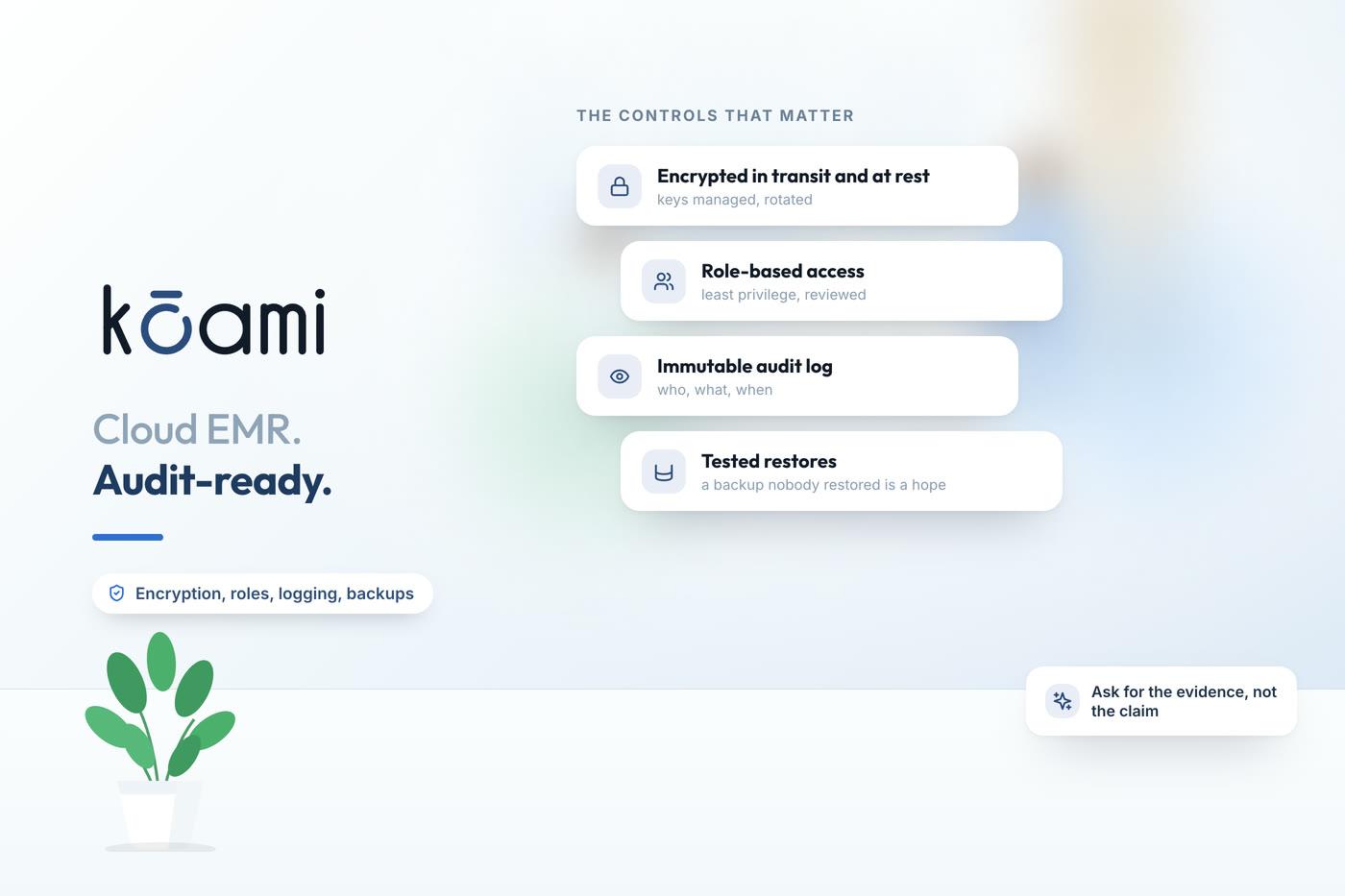
Encryption is the baseline, and it has to cover data both while it moves and while it sits still. In transit means every connection between a clinician's device and the system is encrypted, so a UMR travelling across the network cannot be read by anything sitting in the middle. At rest means the stored data, including the database and any backups, is encrypted so that a stolen disk or a copied backup file is useless without the keys.
The keys are the part people forget. Encryption is only as good as the management of the keys that unlock it. That means keys held separately from the data they protect, rotated on a schedule, and never sitting in plain text in a config file or a code repository. Kōami encrypts patient data both in transit and at rest, and treats key handling as a distinct discipline rather than an afterthought, because encryption with careless keys is theatre.
The database being encrypted means nothing if the key is in the same place, readable by the same account.
Access is where most breaches actually happen
Ask where health data actually leaks and the answer is rarely broken cryptography. It is access. An account with more reach than it needed, a shared login nobody can trace, a leaver whose credentials still worked, an internal user browsing records they had no business opening. The strongest encryption in the world does not help when the person reading the record is authenticated and simply should not be.
So the controls that matter most day to day are the boring ones.
- Role-based access, so a clinician sees what their role requires and not the whole hospital
- The principle of least privilege applied and reviewed, not granted once and forgotten
- Multi-factor authentication, so a stolen password is not enough on its own
- Prompt de-provisioning when someone changes role or leaves
- Session controls that time out abandoned logins on shared ward devices
These are capabilities Kōami provides and the hospital operates. The platform can enforce role-based access and MFA; it is the organisation that decides who gets which role and reviews those decisions. That division is not a gap; it is how it should work. The software makes the right thing possible and the wrong thing hard, and the hospital's governance does the rest.
Proving it after the fact
Prevention is only half of data protection. The other half is being able to reconstruct what happened, because sooner or later someone will ask who accessed a particular record and when. A cloud EMR should log access to patient data comprehensively: who opened which record, from where, and when, retained long enough to be useful for review.
This audit capability does double duty. It deters casual snooping, because staff know that access to a record leaves a trace. And it is the mechanism by which a hospital investigates a concern, whether that is a suspected inappropriate access or simply a routine check that access patterns look reasonable. Aligned with the kind of access-tracking that workflows such as NABH expect, comprehensive logging turns security from a promise into something you can actually examine.
A word on certification, honestly
It is worth being plain here. A new platform can build strong technical controls, encryption, role-based access, MFA, comprehensive audit logging, from day one. What it cannot honestly claim on day one is a shelf of external certifications, and any vendor waving certification badges before they are earned should make you cautious. The right questions to ask a cloud EMR are about capabilities you can inspect: how is data encrypted, how are keys managed, how is access controlled and reviewed, what exactly is logged, and who on our side holds which responsibility.
Security in a cloud EMR is not a status you reach and stop thinking about. It is the ongoing operation of a set of controls that span the platform and the hospital, checked and adjusted as roles change and threats evolve. The encryption keeps the data unreadable to outsiders. The access controls keep it readable only to the right insiders. The audit log lets you prove both. Get those three working together, and the cloud becomes not a risk to patient data but one of the better places to protect it.
Follow Kōami on LinkedIn
Get the next guide on hospital operations, software and compliance in your feed, as soon as it is published.