Streaming Slices Instead of Downloading Studies
Published
There is a moment familiar to anyone who has waited on medical imaging: the study has been ordered, the images exist, and now everyone stands around while a viewer downloads a study that is hundreds of megabytes, sometimes more, before showing a single slice. The clinician wants one image. The system insists on delivering all of them first. That gap - between what the reader needs to see and what the old model forces them to fetch - is exactly what streaming imaging closes. Instead of downloading a study, you stream its slices, and the difference in experience is the difference between waiting and working.
Why the Download Model Fails at Scale
The download-then-view approach made sense when studies were small and networks were local. A plain radiograph is a modest file; fetching it whole costs nothing anyone notices. But imaging did not stay small. A modern CT or MRI produces hundreds or thousands of slices, and a study can run to a gigabyte. The download model scales badly against that reality in every direction that matters.
- Time to first image grows with the size of the whole study, so the reader waits longest exactly when the study is largest and the stakes are often highest.
- Bandwidth is spent moving data that may never be looked at, because a reader who needs to check one region does not need every slice at full fidelity.
- The client has to hold the entire study in memory, which pushes the hardware requirement up and the portability down.
The fundamental error is coupling the unit of transfer to the unit of storage. A study is how the images are stored. It is not how they are read. Kōami's imaging back end breaks that coupling deliberately, treating the study as something you draw from rather than something you must first swallow whole.
What WADO-RS Actually Streams
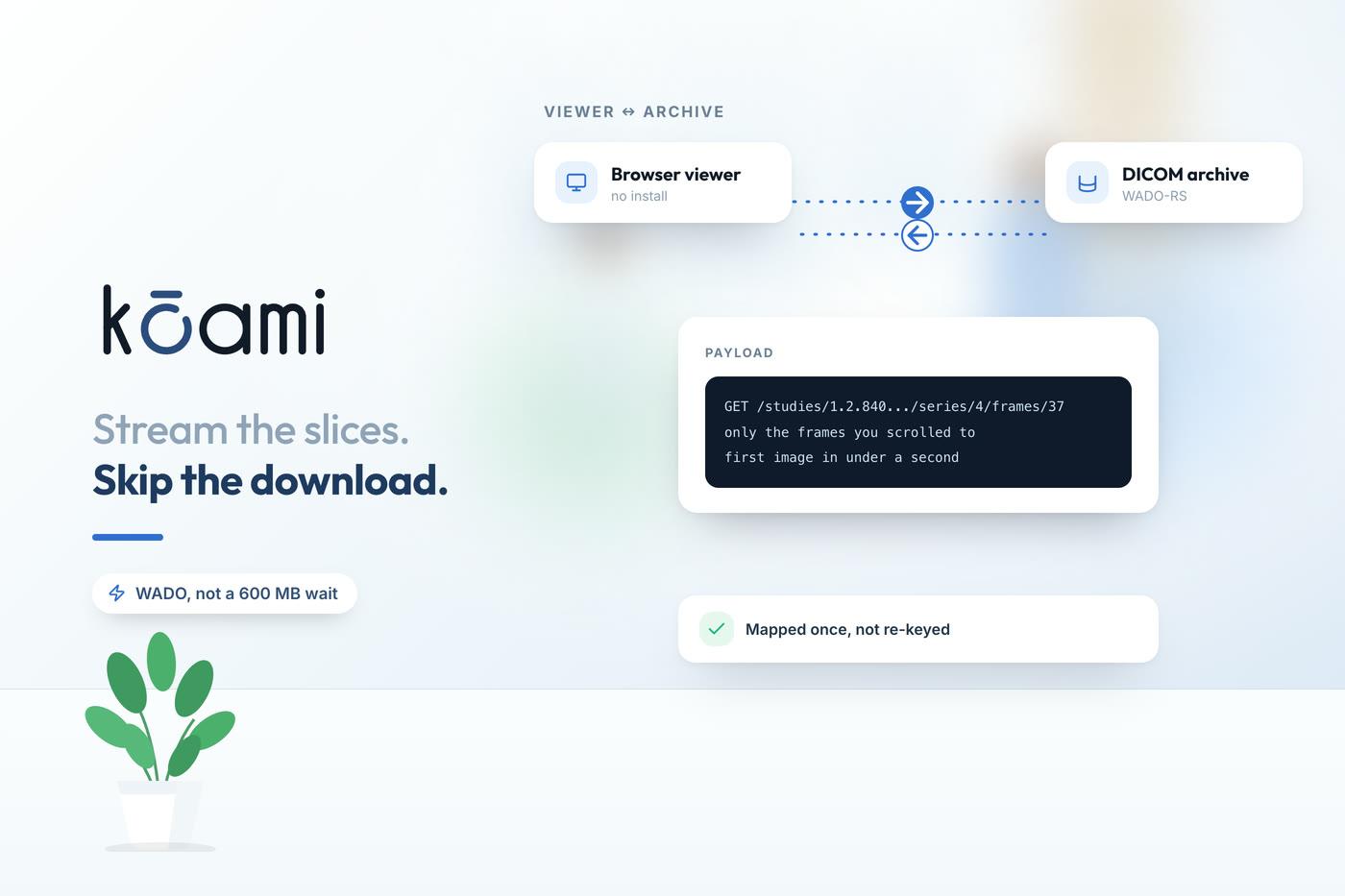
The mechanism is DICOMweb, the family of web-native standards for medical imaging, and specifically WADO-RS - Web Access to DICOM Objects, the RESTful retrieval part. Where the old WADO fetched whole objects, WADO-RS lets a viewer request imaging at the granularity it needs: a study, a series, a single instance, or the frames within a multi-frame instance, addressed by ordinary web requests.
- The viewer can ask for one series, or one image, without pulling the rest of the study along with it.
- Frame-level retrieval means a viewer can pull individual slices as the reader scrolls into them, rather than the whole stack up front.
- Because it is REST over HTTP, it flows through the same web infrastructure everything else uses - caches, load balancers, ordinary firewalls - with no special protocol tunnel to maintain.
The insight of DICOMweb is small and powerful: address medical images the way the web addresses everything else, and imaging stops needing its own private plumbing.
Kōami's viewer speaks WADO-RS to its back end so that the pictures arrive as the reader moves through them, at the resolution the moment calls for.
Progressive Loading Is the Experience the Reader Feels
Streaming is not only about fetching less; it is about ordering the fetch intelligently so the reader is productive within seconds. The techniques stack together, and their combined effect is a viewer that feels immediate even against a large study on an ordinary connection.
- First image first: the viewer prioritises the slices the reader is looking at now, so an image appears in seconds while the rest of the series loads behind it.
- Progressive resolution: a lower-resolution version can render immediately and sharpen as the full-fidelity data arrives, so there is always something on screen to orient by.
- Predictive pre-fetch: as the reader scrolls in one direction, the viewer fetches ahead of them, so the next slices are already waiting by the time the reader reaches them.
- Server-side heavy lifting: reconstruction and decompression can be handled by the back end where the client is modest, so a laptop is not asked to do a workstation's job.
Kōami combines these so that opening a large study feels less like a download and more like turning to a page in a book that is already open. The reader never experiences the study's total size; they experience only the slices in front of them.
What Streaming Gives You Beyond Speed
The obvious win is that studies open faster, and that alone justifies the approach. But the architecture pays dividends past raw speed, in ways that shape how a whole imaging service can operate.
- Reading over ordinary networks becomes practical, so a radiologist on a home connection or a clinician on hospital wifi is not gated by the need to pull gigabytes.
- The central archive stays the single source of truth, because the viewer streams from it rather than making local copies scattered across devices that then have to be reconciled.
- Modest client hardware suffices, which is what makes browser-based, install-free reading genuinely viable rather than technically possible but painfully slow.
Streaming, in other words, is the enabling layer beneath portable, browser-first imaging. Kōami builds on it so that the lightness of the reading experience is backed by an architecture that keeps the data governed, current, and central.
Streaming slices instead of downloading studies is one of those changes that sounds like a technical detail and turns out to reshape the daily experience of everyone who touches imaging. The reader stops waiting for data they will not look at. The network stops straining under transfers it does not need to carry. The archive stays authoritative while the images travel to wherever the reader happens to be. WADO-RS and DICOMweb are not exotic; they are imaging finally adopting the ordinary logic of the web. And the result the clinician feels is simply this: they open a study and the picture is there, which is all they ever wanted the system to do.
Follow Kōami on LinkedIn
Get the next guide on hospital operations, software and compliance in your feed, as soon as it is published.