Patient Identification in Hospitals: Fixing Duplicate MRNs
Published
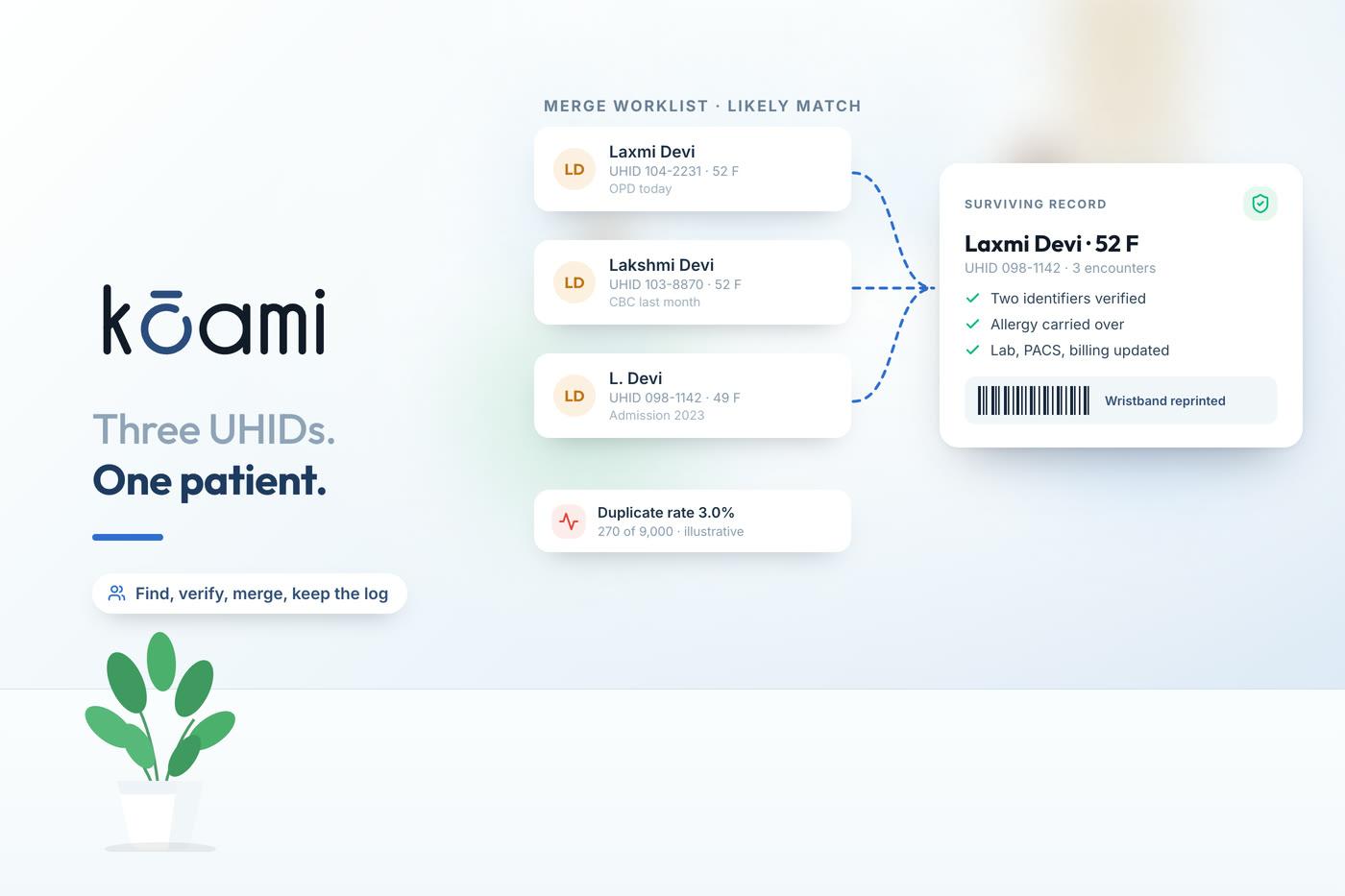
At 7:40 on a Monday morning, a woman registers at the OPD counter as Laxmi Devi, age 52. Her CBC from last month sits under Lakshmi Devi, and her 2023 admission is filed under L. Devi with her son's mobile number. Three UHIDs, one person. The consultant sees an empty history, repeats tests that were done three weeks ago, and nobody notices the allergy recorded in the oldest file. Nothing dramatic happened, which is exactly why duplicate records survive in most hospitals for years.
This guide is for the CIO and the head of front office, with the quality manager in the room. It covers the two-identifier rule, wristbands that actually get scanned, how duplicates are created, a merge SOP you can adopt, and one metric to run every month.
Why patient identity breaks in Indian hospitals
Identity errors here are rarely about careless staff. They come from how names, ages and phones work in Indian households, and from counters built for speed.
- Spelling and transliteration: a Telugu or Hindi name typed in English has several fair spellings. Venkateswarlu, Venkateshwarlu and Venkateswaralu are all reasonable at a busy counter.
- Name order and initials: many South Indian patients write the family name as an initial (K. Srinivas), while the Aadhaar card may show Kotha Srinivas.
- Age without date of birth: older patients often know only an approximate age, so systems fill 01-01-YYYY, and every 60-year-old becomes born on 1 January.
- Shared mobile numbers: one son's phone is registered for both parents, an aunt and two children.
- Name changes after marriage, and the father's or husband's name used interchangeably in the relation field.
- Emergency registrations: an unconscious road accident patient is registered as Unknown Male, approx 35, and later identified under a new record instead of the original one.
- Speed at the counter: creating a new UHID takes 40 seconds. Searching properly takes 90. At 9 am with a queue of 30, new wins.
- Multiple systems: a lab or pharmacy system that creates its own patient record, or a branch with its own numbering, quietly doubles the master list.
There is a second failure that is worse than a duplicate: the overlay. That is when two different people end up in one record, usually through a wrong merge or a wrong selection from the search list. A duplicate hides history. An overlay shows the wrong history to the treating doctor. Every rule below is designed to reduce duplicates without creating overlays.
The two-identifier rule, and what counts as an identifier
The NABH 6th edition hospital standards (effective 1 January 2025) are explicit on three points. AAC.2.b requires that a unique identification number is generated at the end of registration. COP.1.b requires a uniform process for identification of patients that uses at least two identifiers. IMS.3.a requires a unique identifier assigned to the medical record. Patient identification was also one of the nine patient safety solutions WHO launched in 2007, and the Joint Commission's patient safety goal in the US uses the same two-identifier principle and excludes room number or physical location.
In practice, a workable policy for an Indian hospital looks like this:
- Primary pair: full name plus UHID or MRN, read from the wristband or the record, never from memory.
- Supporting check: date of birth, or age where DOB is not known, plus sex.
- Not identifiers: bed number, ward, diagnosis, consultant's name, or whatever the attendant says while pointing at the bed.
- When to check: before medication, blood and blood components, sample collection, imaging, procedures and surgery, and at every transfer handover.
Write down which pair your hospital uses and make every department use the same one. Uniform is the word NABH chose for a reason.
Barcode wristbands staff will actually scan
A wristband only helps if it is printed at the right moment, carries the right data and gets scanned where errors happen.
- What to print: full name, UHID, age or DOB, sex, and a barcode that encodes the UHID. Keep the diagnosis off the band, since it is visible to every visitor.
- Where to print: admission desk, emergency, labour room and daycare, with a printer at each point so nobody writes a band by hand because the printer is two floors away.
- Newborns: a band at birth with the mother's name and UHID (for example, Baby of Sunita, linked to her record) before the baby leaves the delivery area.
- Scan points: bedside medication administration, sample collection with labels printed at the bedside, blood transfusion and OT check-in. A barcode that is never scanned is decoration.
- Reprints: log every reprint with the user and reason. Frequent reprints on one ward usually mean bands are being cut off for IV lines and not replaced.
- Downtime: keep a pre-printed handwritten band procedure for power or network failure, and reconcile those patients within the shift.
A simple weekly audit works: pick 20 inpatients per ward at random, check that a band is on, legible and matches the record. Report the percentage.
How duplicates get created, and the fix at source
Merging is cleanup. The cheaper work is stopping new duplicates at registration.
- Search that fails on spelling: make the counter search by mobile number first, then by phonetic name and age band. Show existing matches before the New Patient button becomes active.
- Quick registration in emergency: allow it, flag the record as temporary, and require MRD to reconcile it within 24 hours.
- Legacy data: migrations from an old system often double the master list overnight. De-duplicate before go-live, not after. Our piece on legacy data migration covers the sequence.
- Interfaces: no lab, PACS or pharmacy system should create its own patient. They should receive the UHID from the master record.
- ABHA: an ABHA number is a strong matching key when the patient has one and shares it, but many will not at every visit. Use it to strengthen matching, never as the only key. See ABHA integration in hospital software.
- Branches: in a multi-site group, one patient master across branches avoids the same person holding a different UHID at each location.
Finding candidate duplicates: match rules
Run a weekly job that compares records and produces a ranked worklist. A starting rule set, to tune on your own data:
- Very likely: same ABHA number on two UHIDs. Still verify, because ABHA numbers can be typed into the wrong record.
- Likely: same mobile number, same DOB, and names that match phonetically.
- Possible: phonetically matching name and same DOB, different mobile.
- Weak: matching name, age within one year, same pincode.
Then build in the family traps, which look like duplicates and are not:
- Twins share DOB, surname, mobile and often similar first names.
- A father and son with the same name and the same phone.
- A mother and newborn registered minutes apart on the same mobile.
- Approximate ages with default 01-01 birth dates match far too easily.
The MRN merge SOP
This is the asset to adapt for your hospital. Roles are written for a 100 to 300 bed hospital and can be combined in a smaller one.
- Step 1, raise: a registration executive or MRD officer raises a merge request from the worklist or the counter. Nobody merges at the counter itself.
- Step 2, hold: both records are flagged as merge pending, so staff see a warning when they open either one.
- Step 3, verify identity: MRD compares at least two identifiers plus one independent attribute, such as a government ID number, ABHA number, address, or the patient confirming by phone.
- Step 4, check clinical content: compare allergies, blood group, diagnoses, active orders, pending results and admissions. Any conflict in blood group or sex stops the merge and goes to a clinical reviewer.
- Step 5, choose the surviving record: follow a written rule, for example the oldest UHID. The other record is retired and marked as merged into the survivor, never deleted.
- Step 6, execute: move encounters, results, imaging links, prescriptions, consents, bills, deposits and insurance details, and push the change to connected systems such as lab and PACS.
- Step 7, reconcile money: confirm deposits, refunds and outstanding balances add up on the surviving record.
- Step 8, notify: if the patient is admitted, reprint the wristband and inform the ward. Tell the patient which UHID to use from now on.
- Step 9, record: log who requested, who verified, the evidence used, timestamps and the before-and-after state. This is what an audit trail is for.
- Step 10, unmerge: keep a documented path to split a wrong merge, with the same approvals, and treat every unmerge as an incident to review.
Never auto-merge these, whatever the match score says:
- Twins, multiple births and any record named Baby of.
- Unknown or unidentified patients, until identity is confirmed.
- Records with different blood group or sex recorded.
- Two records that each have an active admission at the same time.
- Records carrying two different ABHA numbers.
- Medico-legal cases, until the medico-legal officer has reviewed them.
- Records with restricted access, such as confidential or VIP flags.
The duplicate-rate metric
Pick one definition and keep it for a year, so the trend means something.
- Duplicate creation rate (%): confirmed duplicate records created in the month, divided by new registrations in the month, multiplied by 100.
- Merge backlog: confirmed duplicate pairs not yet merged at month end.
- Overlays: wrong-patient filing events found in the month, reported through incident reporting, not hidden in IT tickets.
- Wristband compliance (%): inpatients with a correct band in the weekly audit.
- Scan compliance (%): medication administrations with a wristband scan, divided by all administrations recorded.
An illustrative month for a 250-bed hospital: 9,000 new registrations, 410 candidate pairs on the worklist, and 270 confirmed duplicates after MRD review. That is a creation rate of 270 divided by 9,000, or 3.0 percent. Broken down, 40 percent came from emergency quick registrations that were never reconciled, 35 percent from the morning OPD counters and the rest from re-registrations at the pharmacy. That breakdown tells you where to put the next training session and which screen to change.
If you have no matching tool yet, sample instead: take 200 random new registrations each month and search each one by mobile, name and age. The share that already existed is your estimated rate.
A 30-minute monthly review
Once a month, the CIO, the front office head, the MRD in-charge and the quality manager look at five numbers: creation rate, backlog, overlays, wristband compliance and scan compliance. Then they agree on one change for the next month, such as mobile-first search at the emergency desk or a printer at the labour room. Small, specific fixes beat a yearly retraining drive.
Kōami is designed around one patient master shared by registration, MRD and the clinical record, so a merge confirmed by MRD is meant to carry through lab, imaging and billing together, with the before-and-after kept in the log. The same master feeds the EMR a consultant opens, which is where a clean identity finally pays off.
If you are planning a patient master clean-up or a wristband rollout and want to see how a single patient master behaves across departments, we are happy to walk you through it on synthetic data. Book a demo: koami.in/book-demo
Frequently asked questions
- How many identifiers does NABH require for patient identification?
- The NABH 6th edition hospital standards (COP.1.b) require a uniform process for identifying patients that uses at least two identifiers. Most Indian hospitals pair the full name with the UHID or MRN, and use date of birth or age as a supporting check.
- Can the bed number be used as a patient identifier?
- No. Patients move between beds, wards and the ICU, so a bed number points to a location, not a person. International references such as the Joint Commission's patient safety goal on identification also exclude room number and physical location.
- Should duplicate patient records be merged automatically?
- No. Software should find and rank likely duplicates, but a trained person should confirm each merge against evidence. Twins, newborns, unknown patients and records with conflicting blood group or sex should never be merged automatically.
- Is the ABHA number enough to identify a patient?
- No. Many patients will not have an ABHA number or will not share it at every visit, so it can strengthen matching but cannot replace the hospital's own UHID and two-identifier checks.
- What is a good duplicate record rate for a hospital?
- There is no single published benchmark that fits every Indian hospital. Measure your own rate monthly with a fixed definition, break it down by counter and shift, and track whether it falls after each fix.
Sources
- NABH Accreditation Standards for Hospitals, 6th Edition (effective 1 Jan 2025): AAC.2, COP.1, IMS.3
- WHO launches Nine patient safety solutions (2 May 2007), including patient identification
- The Joint Commission: Hospital National Patient Safety Goals chapter (NPSG.01.01.01)
- The Joint Commission FAQ: Two patient identifiers, understanding the requirements
Follow Kōami on LinkedIn
Get the next guide on hospital operations, software and compliance in your feed, as soon as it is published.