Breaking Down Data Silos in Healthcare
Published
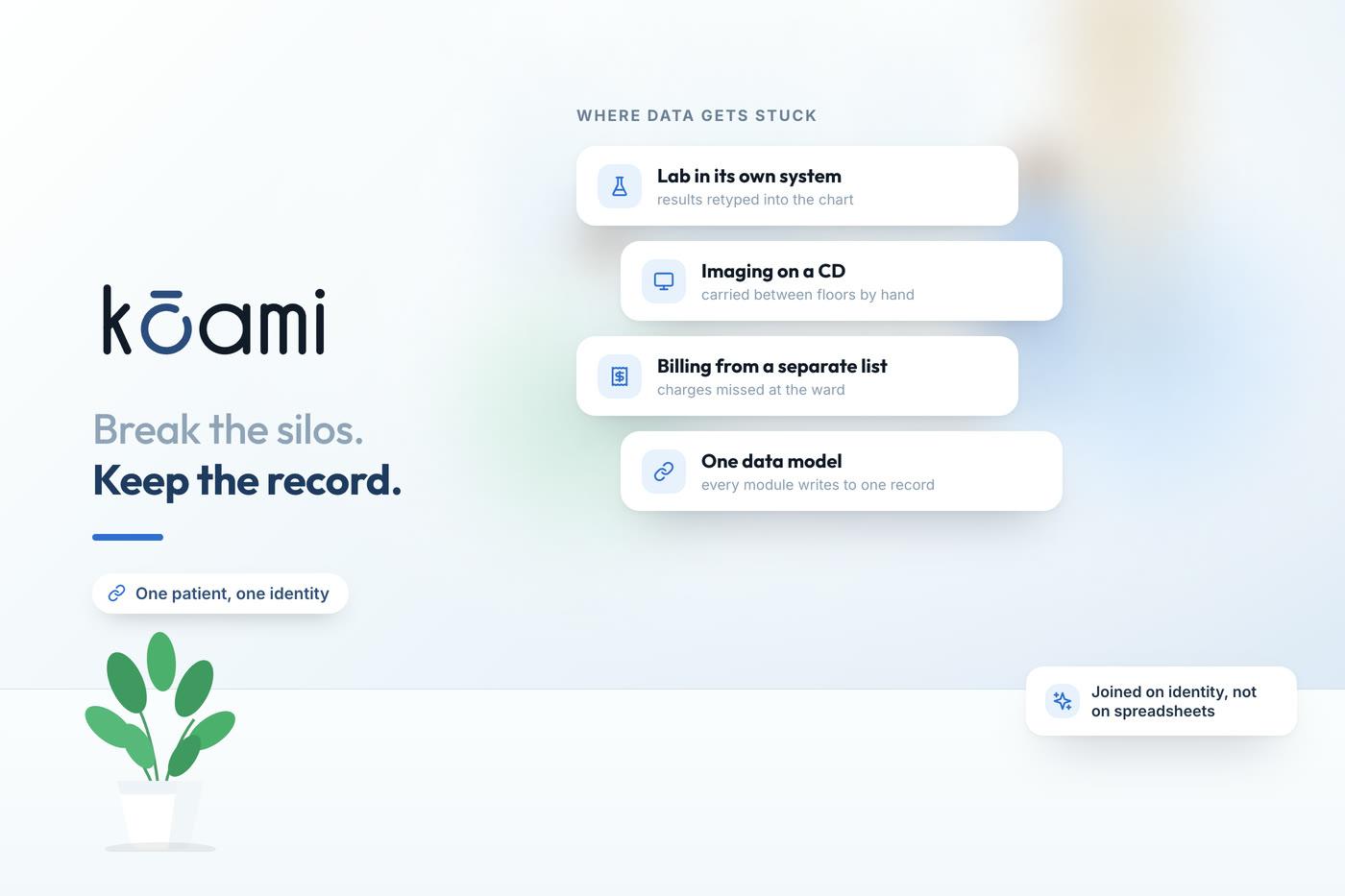
A patient arrives in the emergency department at midnight, unconscious, with a chronic condition managed at the same hospital's OPD for years. The registration clerk creates a fresh record because the ED system cannot see the OPD one. The lab results from last week sit in a database the ED clinician cannot reach. The old CT is in a PACS that speaks a different language. Somewhere in the building, every piece of information needed to treat this patient well already exists. It just cannot travel. This is the everyday cost of data silos, and it is paid in duplicated tests, delayed decisions and the small, dangerous gaps where important context falls through.
How silos form without anyone deciding to build them
No hospital sets out to fragment its own data. Silos accumulate one reasonable decision at a time:
- The lab buys a best-of-breed LIS; the radiology department picks its own RIS and PACS.
- The HMIS grows organically, with modules added by different vendors over a decade.
- A new insurance-desk tool is bolted on because it was quick to deploy.
- Each system has its own patient identifier, so the same person is three different IDs across three databases.
Individually, every choice made sense. Collectively they produce a hospital where the UMR in one system does not resolve in another, and where "integration" means a staff member re-keying data from one screen into the next. The clerk becoming a human data bus is not a workflow; it is a symptom.
What breaks when data cannot move
The consequences are not abstract. They show up at the bedside and on the balance sheet:
- Tests get repeated because the earlier result is invisible, wasting money and, for imaging, exposing patients to avoidable radiation.
- ADT events - admission, discharge, transfer - do not propagate, so the pharmacy, the diet kitchen and the billing desk work from stale information.
- Discharge summaries are assembled by hand from systems that will not talk, delaying beds and frustrating families.
- Clinical decisions are made with partial information because pulling the full picture takes more time than anyone has at 2 a.m.
Every silo is a place where a clinician has to choose between spending time they do not have or deciding with less than they should.
The deepest cost is the one nobody logs: the decision made without a piece of context that existed all along, one system away.
The standards that let systems talk
The good news is that healthcare interoperability is not an unsolved research problem. There are mature standards for exactly this, and the job is to use them properly rather than to invent something bespoke:
- HL7 v2 remains the workhorse for ADT, orders and results messaging between hospital systems, and most existing kit already speaks it.
- FHIR offers a modern, resource-oriented, REST-friendly model - Patient, Encounter, Observation, DiagnosticReport - that is far easier to build against.
- DICOM and DICOMweb move imaging, so a study acquired on one modality can be viewed and shared without exporting a folder of files.
The point of a standard is that it decouples systems. When the lab publishes results as FHIR Observations, any authorised system can consume them without a custom, brittle, point-to-point integration that breaks the next time either side upgrades.
Identity is the hard part
The unglamorous truth is that most interoperability failures are really identity failures. If system A calls the patient UMR-4471 and system B calls the same human PT-88213, no amount of HL7 will reliably stitch them together. Before messages can flow meaningfully, a hospital needs a way to resolve one patient to one identity across every system that touches them. The Kōami approach treats the patient identity as the anchor the modules share, so that an OPD encounter, an IPD admission, a lab result and an imaging study all hang off the same person rather than off four disconnected records that happen to describe the same body. Get identity right and the messaging standards do their job. Get it wrong and even perfect FHIR produces confidently linked nonsense.
Connected by design, not by adapter
The distinction that matters when evaluating clinical software is whether interoperability was designed in or bolted on. A suite where the HMIS, the inventory, the imaging and the HRMS were built to share identity and to exchange data through standard interfaces behaves differently from a collection of products stitched together with adapters after the fact. In the Kōami ecosystem the modules are meant to speak to each other natively - an admission is visible where it needs to be, an imaging study is reachable over DICOMweb by the clinician who needs it - while open, standards-based interfaces let the hospital's other systems join the conversation rather than being walled out.
None of this requires a hospital to rip everything out and start again, which is rarely realistic. It requires choosing systems that speak the common languages - HL7, FHIR, DICOMweb, plain REST - and that anchor on a shared patient identity. Breaking down silos is less a single project than a standing principle: every new system earns its place partly by how well it lets data move. The patient in the ED at midnight does not care about your architecture. They only benefit from the fact that, this time, everything the hospital already knew about them was actually there when it counted.
Follow Kōami on LinkedIn
Get the next guide on hospital operations, software and compliance in your feed, as soon as it is published.