HPR and HFR Registration: Full Forms, Facility ID and the Steps
Published · Updated
A nursing home in a district town gets told it needs to be on the Health Facility Registry before its empanelment renewal goes through. The administrator opens the portal, gets as far as the facility type dropdown, and stops, because the options do not obviously describe a twelve-bed establishment that does deliveries and minor surgery and has a pharmacy at the front. The application sits half-finished for three weeks.
This is the commonest way HFR registration fails. Not a technical barrier, just a form asking questions nobody has decided the answer to.
What is HFR, and what is HPR?
Full forms: HFR stands for Health Facility Registry and HPR for Healthcare Professionals Registry. Both are run by the National Health Authority under the Ayushman Bharat Digital Mission (ABDM).
HFR is the national register of health facilities. HPR is the national register of health professionals.
- The Health Facility Registry lists hospitals, clinics, labs, pharmacies and diagnostic centres, public and private, each with a unique facility ID.
- The Healthcare Professionals Registry lists doctors, nurses and other practitioners with verified credentials, each with a unique identifier.
Together they answer the two questions any health information exchange has to answer before it can move a record: which facility is this, and who is the person who wrote it. Everything else in ABDM sits on top of them.
HPR vs HFR: the difference
- What is registered: HFR registers a place (a hospital, clinic, lab, diagnostic centre or pharmacy). HPR registers a person (a doctor, nurse, pharmacist or other health professional).
- Who applies: HFR is completed by the facility's owner or administrator. HPR is completed by each professional for themselves.
- What you get: an HFR ID for the facility, and an HPR ID for the professional.
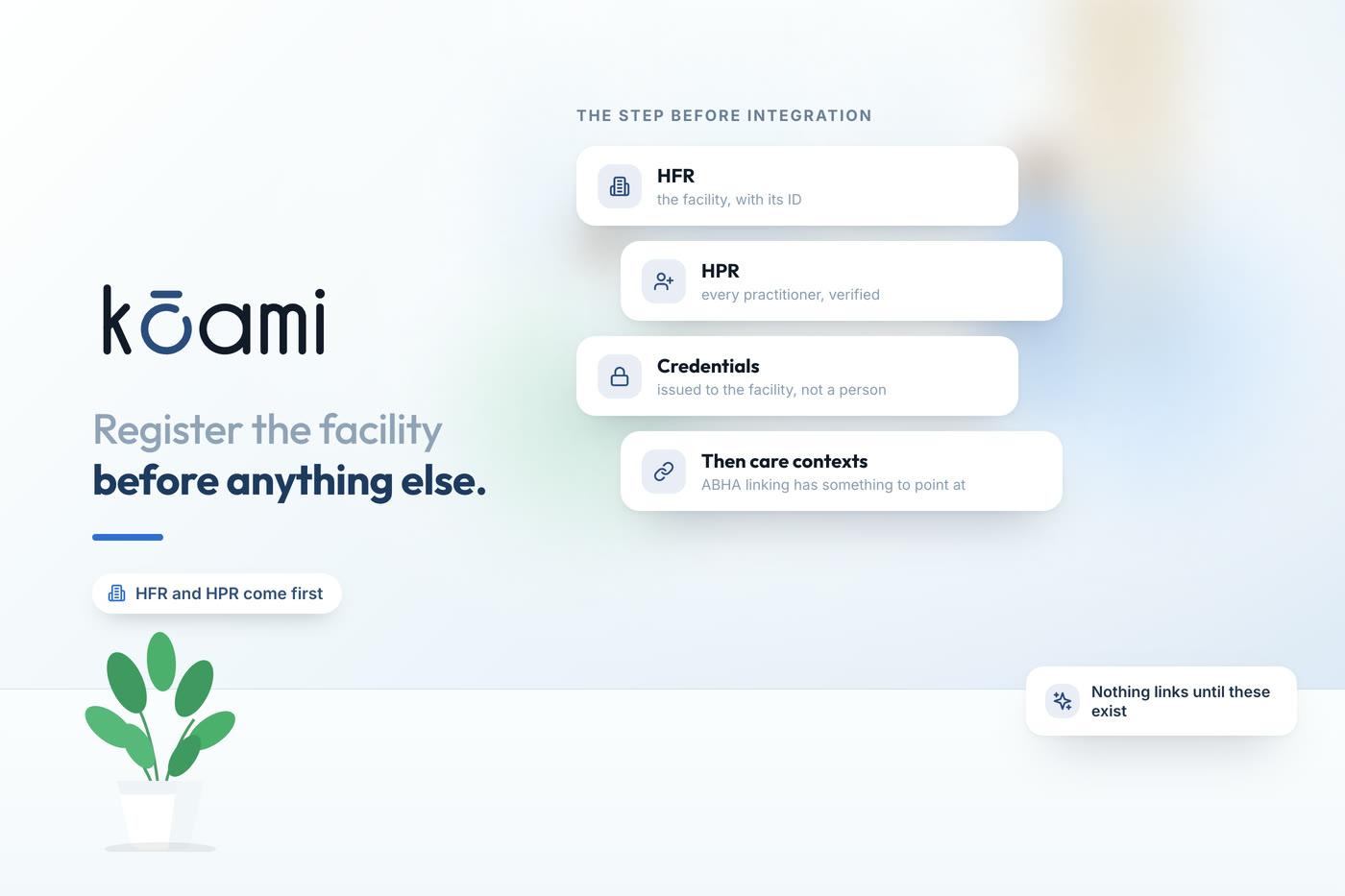
- How they connect: a professional's HPR profile names the facility where they work, using that facility's HFR ID. That is why HFR comes first.
Why registration comes before anything else
Without an HFR ID your facility cannot become a Health Information Provider, so no record you create can be linked or shared.
It has also stopped being optional in practice. Accreditation processes and insurance empanelment, including government schemes, increasingly ask for it, which means a facility without an HFR ID is not merely outside the digital network — it may be outside a payer's list. The requirement arrives through the commercial door rather than the technical one, and usually with less notice than anyone would like.
What you need before you open the portal
Gathering these first turns a three-week stall into an afternoon.
- The facility's legal name, exactly as it appears on its registration or licence, not the name on the signboard.
- Ownership and facility type, decided in advance. If your establishment does not fit neatly, pick the closest match and be consistent everywhere else.
- Address with the correct district and sub-district, and the geolocation.
- Registration or licence numbers for the establishment, and for the pharmacy and lab if they are separately licensed.
- The services you actually offer, and specialities, which will later determine what other facilities and payers understand about you.
- Bed count, and whether you are in-patient capable.
- A responsible person with a working mobile number and an ABHA, because verification runs through them.
- The system uses email and mobile as contact points; use an address that outlives the person currently in the job.
The decisions people get wrong
Three fields cause most of the corrections later, and all three are decisions rather than facts to look up.
Facility name. Use the licensed legal name. Hospitals routinely register the brand name, then find it does not match the name on the empanelment paperwork or the pharmacy licence, and every downstream verification asks about the discrepancy.
Facility type and ownership. Get it right the first time. Changing it later is possible and tedious, and in the meantime everything that references your facility carries the wrong classification.
The contact person. Registering under a doctor's personal mobile is convenient and creates a dependency that surfaces the day they leave. Use a role-based contact where the system allows it, and record who holds it.
What HPR registration involves
HPR is per-person, and it is the clinician's own registration, not the hospital's.
A doctor registers with their identity, their council registration details and their qualification, and the record is verified against the relevant council. The hospital's role is to make it happen: explain why it matters, help with the process, and keep track of who has done it.
That last part is the hospital's real work. Records created in an ABDM context need an author with a verifiable identity, so a hospital whose consultants are not on HPR will find gaps in exactly the records it most wants to share. Visiting consultants and part-time specialists are the ones who slip, because nobody in the hospital owns their paperwork.
HFR is a form. HPR is a change-management problem wearing a form.
Facility ID and facility name in HPR registration
When a doctor, nurse or pharmacist registers on HPR, the form asks where they work. The facility ID it asks for is that workplace's HFR ID, and the facility name is the name the facility registered under on HFR.
Two things follow from that. The facility has to be on HFR before its staff can attach themselves to it, so a hospital should finish HFR before asking its people to do HPR. And the name will only match if the facility registered its legal name, which is where a brand-name registration catches up with you.
If a professional cannot find their workplace in the search, the usual cause is that the facility has not completed HFR registration, or its application is still awaiting approval. The fix is on the facility's side, not the professional's. Someone who works at more than one place can add each workplace.
HPR registration for pharmacists, nurses and doctors
HPR started with doctors and nurses and has since been opened to more professional categories, pharmacists among them. The pattern is the same for each:
- identity verification, usually an Aadhaar OTP or an existing ABHA;
- the registration number from the professional's council, such as the State Medical Council, State Nursing Council or State Pharmacy Council;
- qualification details;
- verification of the record against that council's register.
Check the category list on the HPR portal for your own profession before you start, because it has grown over time and the documents asked for differ slightly between councils.
HFR registration for a medical store or pharmacy
A medical store or retail pharmacy registers on HFR as a facility in its own right: the pharmacy facility type, the drug licence number and the pharmacist in charge. Have the licence in hand before you open the form.
A hospital pharmacy is usually different. It is normally covered by the hospital's own facility registration rather than a separate entry, unless it holds its own licence and runs as a separate establishment. Decide which applies before you start, because registering the same pharmacy twice creates exactly the duplicate that later verifications trip over.
How to find your facility's HFR ID
- The person who completed the registration receives the HFR ID once the application is approved, and it is shown when they log in to the HFR portal.
- The portal lets you search facilities by name and location, which is also how staff can check the exact registered name before they do HPR.
- If nobody knows who registered the facility, recover the login through the registered mobile number rather than registering again. A second registration for the same facility is far harder to untangle than a forgotten password.
After registration, what actually changes
Registration by itself changes nothing clinically, and it is worth being honest about that internally so nobody expects otherwise.
What it does is unlock the next steps: your certified software can be configured against your facility ID, ABHA numbers can be created and linked at your counters, records can become discoverable to patients, and payers and accreditation bodies can find you where they expect to. It also puts your facility's details into a national directory, which means the accuracy of what you entered now has consequences beyond your own records.
A practical follow-up that most facilities skip: check your own listing a month later. Details entered under time pressure are frequently wrong in small ways, and a wrong district or a missing service is easier to fix before anything depends on it.
A short sequence for a facility starting from zero
- Decide facility type, ownership and legal name. Write them down and use them consistently everywhere.
- Collect licence and registration numbers, including pharmacy and lab.
- Ensure the responsible person has an ABHA and a mobile number they will keep.
- Complete HFR registration and note the facility ID somewhere your billing and compliance teams can find it.
- Get your regularly practising clinicians onto HPR, starting with whoever signs discharge summaries.
- Give your software vendor the facility ID and ask what they need to configure, and what they need from you.
- Verify your public listing, and correct it.
None of this is difficult. It is administrative work that stalls because it needs decisions rather than effort, and the hospitals that finish it quickly are the ones where somebody was made responsible for making those decisions rather than for filling in the form.
Frequently asked questions
- What is the full form of HPR and HFR?
- HPR is the Healthcare Professionals Registry and HFR is the Health Facility Registry. Both are national registries run by the National Health Authority under the Ayushman Bharat Digital Mission (ABDM).
- What is the difference between HPR and HFR?
- HFR registers a place, such as a hospital, clinic, lab or pharmacy, and gives it an HFR ID. HPR registers a person, such as a doctor, nurse or pharmacist, and gives them an HPR ID. A professional's HPR profile links to the facility where they work through its HFR ID.
- What is the facility ID in HPR registration?
- It is the HFR ID of the facility where the professional works. The facility must already be registered on HFR, under its legal name, for staff to find it when they register on HPR.
- Can a medical store register on HFR?
- Yes. A retail pharmacy or medical store registers on HFR as a facility in its own right, using the pharmacy facility type and its drug licence details. A hospital pharmacy is usually covered by the hospital's own registration unless it is separately licensed.
- Can pharmacists register on HPR?
- HPR has been opened to more professional categories over time, pharmacists among them. Registration uses identity verification and the registration number from the State Pharmacy Council. Check the current category list on the HPR portal.
- How do I find my hospital's HFR ID?
- The person who registered the facility receives the HFR ID after approval and can see it after logging in to the HFR portal. The portal also lets you search facilities by name and location.
Sources
Follow Kōami on LinkedIn
Get the next guide on hospital operations, software and compliance in your feed, as soon as it is published.